What the SEC’s Fourth Marketing Rule Alert Flagged on Testimonials, Endorsements, and Ratings
The fourth Marketing Rule Risk Alert rests on whether disclosure is present and prominent, and whether the firm can prove it.
Topic
The fourth Marketing Rule Risk Alert rests on whether disclosure is present and prominent, and whether the firm can prove it.
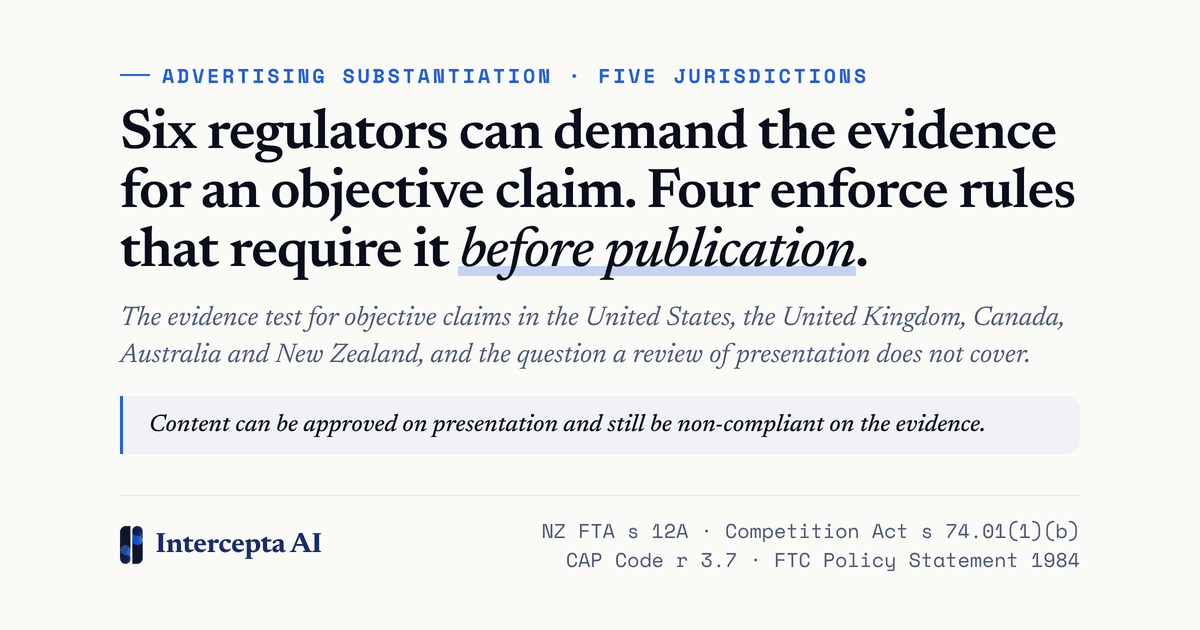
When an advertiser claims a level of proof it cannot support, the claim itself is the violation, whatever the disclosures say. What the FTC substantiation standard requires before you publish, and why pointing to a study is not the same as holding the evidence.
California's AI Transparency Act (SB 942) is operative from 2 August 2026. It settles AI-content provenance, not whether that content is compliant.
Aviva is quoting home insurance through ChatGPT, and the FCA is already assessing AI across the distribution chain. The rules apply now.
In a single day the ASA upheld findings in three sectors. Each firm had assumed its audience, channel, or format sat outside the rules.
How regulatory exposure builds when approved content stays live as rules change — how to measure it, where it concentrates, how to reduce it.
Supervision has gone proactive: any signed-off asset can be examined at any point in its life. The obligation runs as long as content stays live.
FINRA named it a priority, but six regulators across five jurisdictions had already regulated it. Same conclusion, different frameworks.
FINRA's 2026 report gives generative AI a standalone section for the first time — governance, testing, and oversight expectations included.
Every asset an agency delivers to a regulated client carries the client's regulatory requirements. Three structural challenges to understand.
FINRA sanctions rose 77% in 2025 — driven not by new content, but by live content approved under rules that no longer apply.
Content production soared while compliance stayed manual. Nobody had built the infrastructure between the two — so we did.