A marketing claim can be accurate, clearly labelled and fully disclosed and still breach the rules if the business does not hold the evidence for what is asserted in the copy. Six regulators can demand that evidence for an objective claim, such as a claim that a product lasts longer or works better. Four of them, in New Zealand, Canada, the United States and the United Kingdom, enforce rules that require the evidence for some or all objective claims to be on file by the time the claim is published. The other two, a second regulator in the United Kingdom and one in Australia, can require it after publication and administer no general rule on when it must be held. This piece covers which claims need evidence, in which jurisdictions and by when, and how a marketing team can identify claims that lack it while the copy is still in draft, with a one-page template to download.
Reviewers who assess presentation alone may not identify a claim for which the business holds no evidence, because marketing content is subject to separate tests for how a claim is presented and for the evidence that supports it.
This piece sets out the evidence test for objective claims in the United States, the United Kingdom, Canada, Australia and New Zealand, where six regulators can require an advertiser to substantiate a claim. An objective claim, as the term is used here, is a statement that the audience is likely to take as fact and that can be proved or disproved, such as a claim that a battery lasts ten hours or that a product removes 99% of bacteria. Two of the five jurisdictions limit the test to particular kinds of claim. In Canada, the test applies to claims about the performance, efficacy or length of life of a product and to claims about its environmental benefits, with a standard of adequate and proper substantiation for environmental claims about a business. In Australia, outside sectoral regimes such as therapeutic goods, the reasonable-grounds rule of the general consumer law is limited to claims about future matters, such as promises and forecasts.
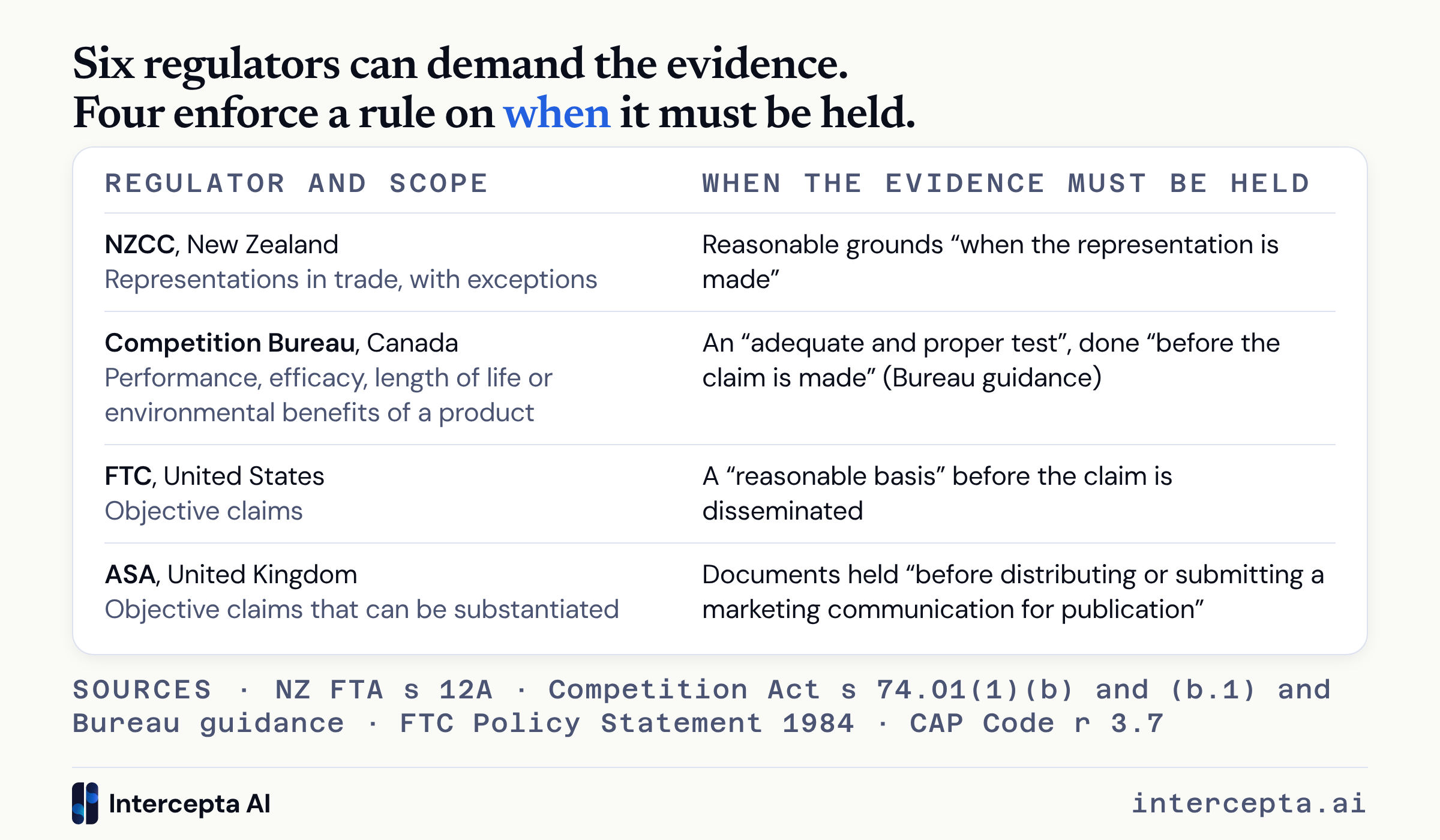
Four of the six regulators, the Commerce Commission (NZCC) in New Zealand, the Competition Bureau (the Bureau) in Canada, the Federal Trade Commission (FTC) in the United States and the Advertising Standards Authority (ASA) in the United Kingdom, enforce a rule that prescribes a sequence, in which the evidence exists first and the claim is published second. The other two, the Competition and Markets Authority (CMA) in the United Kingdom and Australia’s national consumer regulator, the Australian Competition and Consumer Commission (ACCC), seek the same material through their enforcement powers once a claim is published.
The sequence rule is stated in three forms. New Zealand sets it out in statute. In Canada, the statute requires an adequate and proper test, and the Bureau’s guidance provides that the test must precede the claim. The United States enforces it as regulatory doctrine that predates digital advertising. In the United Kingdom it is stated in a self-regulatory advertising code. Australia applies the same sequence to advertising to the public for therapeutic goods, such as medicines and medical devices, in a code made under statute, the Therapeutic Goods Advertising Code, which is enforced by the Therapeutic Goods Administration (TGA). The TGA is outside the count of six, which includes only regulators whose remit is not limited to one industry.
For a marketing team, the sections that follow describe the rule in each jurisdiction. The section on marketing and compliance review then sets out a workflow for drafting and approval based on the evidence each objective claim requires.
The rule in statute in New Zealand and Canada
In New Zealand, a claim made in trade breaches section 12A of the Fair Trading Act 1986 if the person making it had no reasonable grounds for it at that time, “irrespective of whether the representation is false or misleading”, so a claim later shown to be true can still be in breach. The NZCC’s guidance states that consumers generally lack the time or resources to test such claims for themselves and rely on them when deciding what to buy. The section does not apply to a claim that a reasonable person would not expect to be supported by evidence, such as obvious exaggeration, which the NZCC calls “puffery”. Section 12D also exempts a claim where another law sets requirements for supporting claims in a particular field, such as a trade or profession, provided the business meets those requirements when it makes the claim. The NZCC enforces the Act, and a company convicted of breaching section 12A can be fined up to NZ$600,000 for each offence. If a company is convicted of several offences under the same provision that are of a substantially similar nature and occurred at about the same time, the total of the fines cannot exceed the maximum for a single offence.
In Canada, a claim made to the public about the performance, efficacy or length of life of a product is reviewable conduct under the Competition Act if it is not based on “an adequate and proper test thereof, the proof of which lies on the person making the representation”. The advertiser must then prove the test, and the Bureau’s guidance states that the test “must have been done before the claim is made”. Section 74.01(1)(b.1) applies the same test to claims about a product’s environmental benefits. For those claims, the Bureau’s guidance on environmental claims provides that testing “must be conducted before the claim is made”. Section 74.01(1)(b.2) requires adequate and proper substantiation for claims about the environmental benefits of a business or business activity. Amendments that received Royal Assent on 26 March 2026 removed the earlier requirement that this substantiation accord with internationally recognised methodology. The Bureau’s Deceptive Marketing Practices Digest states that consumers are typically unable to judge whether a performance claim is well founded, that advertisers usually have the supporting information, and that competitors whose products perform as advertised can lose sales to unsupported claims.
In Canada, a corporation that makes a claim about a product’s performance, efficacy, length of life or environmental benefits without an adequate and proper test can be ordered by the Competition Tribunal or a court to pay a penalty of up to C$10 million, or C$15 million for each subsequent order, or three times the value of the benefit derived from the conduct if that is higher. If the benefit cannot reasonably be determined, 3% of the corporation’s annual worldwide gross revenues is used in place of three times the benefit. No penalty can be ordered if the corporation establishes that it exercised due diligence to prevent the conduct.
In Canada and New Zealand, an advertiser defending a claim within these rules is judged on the material that existed when the claim was made. A business that commissions a study after the regulator opens an inquiry may not remedy a breach that was already complete.
The rule as doctrine in the United States
In the United States, under the FTC’s 1984 policy statement on advertising substantiation, an advertiser that makes an objective claim must already hold, and have relied on, a reasonable basis for it when the claim is disseminated. A claim made without one is “an unfair and deceptive act or practice”. The level of support required depends on the claim. Under the FTC’s health guidance, a health-related claim requires “competent and reliable scientific evidence”. The policy statement provides that an objective claim implies that the advertiser has a reasonable basis for it, and that the implied basis matters to consumers in deciding whether to rely on the claim. The requirement is regulatory doctrine, and no statute states it expressly. The FTC first set it out in 1972, in a decision applying the prohibition in section 5 of the Federal Trade Commission Act, and later restated it in further decisions and in the 1984 policy statement. The FTC’s orders in substantiation cases typically require the business to hold the supporting evidence for the claim or stop making it.
For instance, in a final order of July 2026, the FTC barred a business that had advertised supplements as clinically proven from making such health claims unless it holds evidence meeting that standard. The order provides for no disclosure that could be made in place of that evidence. The policy statement also states that later evidence that a claim is true does not relieve a firm of liability for making it without prior substantiation, although the FTC may take such evidence into account in deciding whether to bring a case. An earlier piece on this blog, Clinically Proven, Except It Was Not, describes that order and a second FTC action of 2026 against supplement marketers.
The rule as code in the United Kingdom and Australia
In the United Kingdom, an objective claim breaches the advertising code if the marketer did not already hold documents capable of proving it when the marketing was released or submitted to a publisher. The requirement is set out in rule 3.7 of the UK Code of Non-broadcast Advertising and Direct and Promotional Marketing, known as the CAP Code after the Committee of Advertising Practice (CAP). It applies to claims that consumers are likely to read as statements of fact and that can be proved. CAP, the industry body that writes the code, states in the Preface to the CAP Code that the purpose of the Code as a whole is that marketing communications are “legal, decent, honest and truthful” and that consumers can continue to have confidence in them. The code is self-regulatory and is applied by the ASA, which judges the claim by how the audience is likely to understand it and may find an objective claim misleading on that ground alone where the evidence held does not support it.
The ASA applied that standard in two rulings published on 15 July 2026 against airlines’ carbon-offsetting claims. Both rulings are examined on this blog in The Edge of the Advertising Rules Is Not Where Companies Think. Both airlines’ offsetting schemes existed and operated. The ASA still ruled against the advertising of each because the evidence did not show that the emissions from specific flights customers had booked would be fully offset. A breach of the CAP Code can result in a ruling against the advertising that the ASA publishes. The same claim can also be subject to enforcement under consumer law, set out below.
The code enforced by the TGA is set out here because it applies the sequence to one sector of Australian advertising. An advertisement to the public for therapeutic goods, such as medicines and medical devices, breaches section 8(1)(b) of the Therapeutic Goods Advertising Code if it contains information that was not “substantiated by the advertiser prior to publication or dissemination”. Among its objects, the code states that advertising should be neither misleading nor deceptive and should help consumers make informed decisions about their health care. The code is a legislative instrument made under section 42BAA of the Therapeutic Goods Act 1989. An advertiser that does not comply with it can face criminal or civil penalties under the Act, which the TGA administers. The narrower position under Australia’s general consumer law is set out below.
Evidence on request in the United Kingdom and Australia
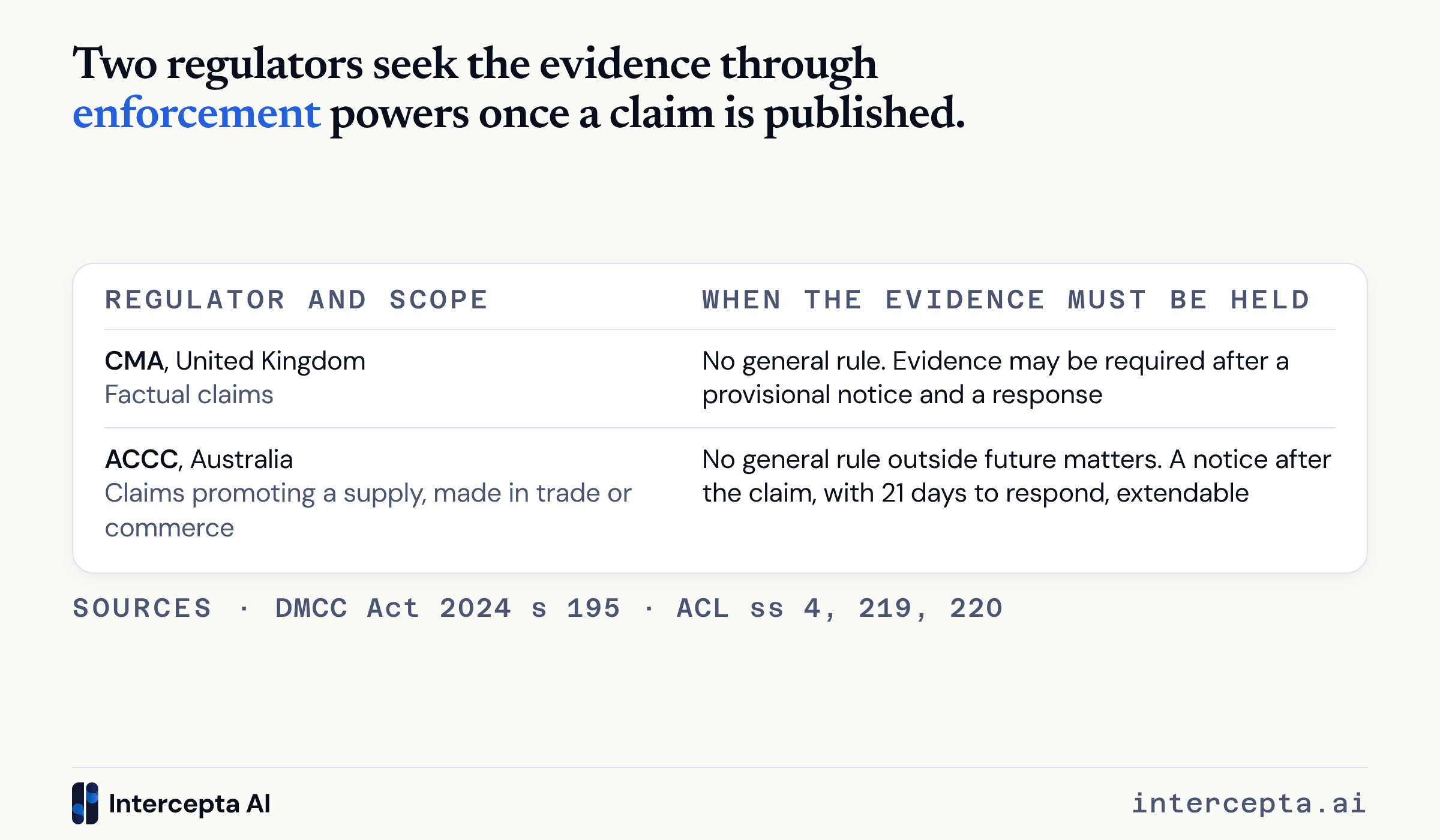
Two of the six regulators can require the evidence through their enforcement powers, and neither administers a general rule that states the sequence. In the United Kingdom, the CMA may determine that a factual claim is inaccurate if, during an investigation, the business does not provide adequate support for it on request. The CMA’s guidance, which is not itself a rule, states that the CMA expects a business’s factual claims to be supported by evidence that the business already holds at the time of a request. The power is conferred by section 195 of the Digital Markets, Competition and Consumers Act 2024, one of the CMA’s direct enforcement powers. It becomes available in a direct enforcement investigation into a suspected breach of the unfair commercial practices rules in force since 6 April 2025, once the CMA has given the business a provisional notice and the business has made representations in reply. The CMA may then “require the respondent to provide evidence as to the accuracy of any factual claim”. A final infringement notice may impose a monetary penalty of up to £300,000 or, if higher, 10% of the total value of the respondent’s turnover.
For environmental claims in the United Kingdom, the CMA Green Claims Code, guidance published in 2021 and described by the CMA in January 2026 as applying to businesses whatever their sector, provides that a business “should hold robust, credible, relevant and up to date evidence” for its claims. It also provides that claims made with no regard to whether the business knows that evidence to support them exists are “likely to be problematic, even if they turn out to be true”.
In Australia, under section 4 of the Australian Consumer Law, a representation about a future matter, such as a promise or a forecast, is “taken, for the purposes of this Schedule, to be misleading” if it is made without reasonable grounds. In proceedings, the maker is presumed to have lacked reasonable grounds unless evidence that it had them is produced. Separately, the ACCC may issue a substantiation notice under section 219 of the Australian Consumer Law. The section allows the ACCC to require a business to give information or produce documents that “could be capable of substantiating or supporting” a claim it has made. The business must comply within 21 days after the notice is given, a period the ACCC may extend. A business that does not comply within the compliance period can face a financial penalty. In a business snapshot first published in 2011 and updated in 2015, the ACCC stated that a substantiation notice is “a preliminary investigative tool” for deciding whether to investigate further. The ACCC also stated that the notice does not oblige a business to prove its claim true.
The sequence has a narrower legal basis in Australia. Outside sectoral regimes such as therapeutic goods, the reasonable-grounds rule in the Australian Consumer Law is limited to representations about future matters. A substantiation notice is given after a claim has been made. For other claims, no general duty to hold the evidence attaches at the moment of publishing. In practice, the difference is smaller than it appears, since a business that cannot respond to a substantiation notice from its existing files is exposed. Holding the evidence before the claim is published is a dependable way to be in a position to respond.
The position in the European Union
In the European Union, a national court or administrative authority may treat a factual claim as inaccurate if, in enforcement proceedings, the trader does not provide the substantiation required of it, or provides substantiation that the court or authority finds insufficient. Recital 21 of the Unfair Commercial Practices Directive states that the burden of proof is a matter for national law and that a power to require substantiation of factual claims is appropriate. Article 12 of the Directive requires member states to give their courts or administrative authorities that power. In proceedings to enforce the Directive, a court or authority can require a trader to substantiate a factual claim if it considers this appropriate in the case, having regard to the legitimate interests of the trader and of any other party to the proceedings. As under the powers of the CMA (UK) and the ACCC (Australia), the power is usually exercised after a claim is published. Particular kinds of claim are subject to requirements before publication. In this piece, the European Union is not counted among the six regulators because it sets the rules and the member states enforce them, each through its own authorities and courts.
Environmental claims about future performance and health claims on food are among the kinds of claim subject to requirements before publication. A claim that a business or product will achieve a future environmental goal, such as carbon neutrality by a stated date, may be a misleading practice under the EU rule on such claims unless three conditions are met. The business must have made clear and objective commitments and published them in a form that can be verified. The commitments must be set out in a detailed and realistic implementation plan with measurable targets, deadlines and the other elements needed to implement it, such as the resources allocated. The plan must be verified at intervals by an independent third-party expert whose findings are available to consumers. The Empowering Consumers Directive states that its purpose in this respect is to ensure that such claims are fair and credible. From 27 September 2026, every member state must apply the rule through its own national law. The EU environmental-claims rules are set out in more detail in EU marketing compliance in 2026: what applies and when, published on this blog in September 2026.
A health claim made for a food product breaches EU law unless it has been authorised at EU level and included in the EU lists of authorised claims. The claim must also meet the other requirements of Regulation (EC) No 1924/2006, the EU regulation on nutrition and health claims made on foods. Some claims on which a decision is still pending are an exception. Under transitional measures, they may continue to be used if they meet those other requirements and any national rules that apply to them. The Regulation states its aims as a high level of consumer protection, with scientific substantiation as the main consideration for health claims. For an authorised claim, the scientific evidence has been assessed at EU level as part of its authorisation.
What this means for marketing and compliance review
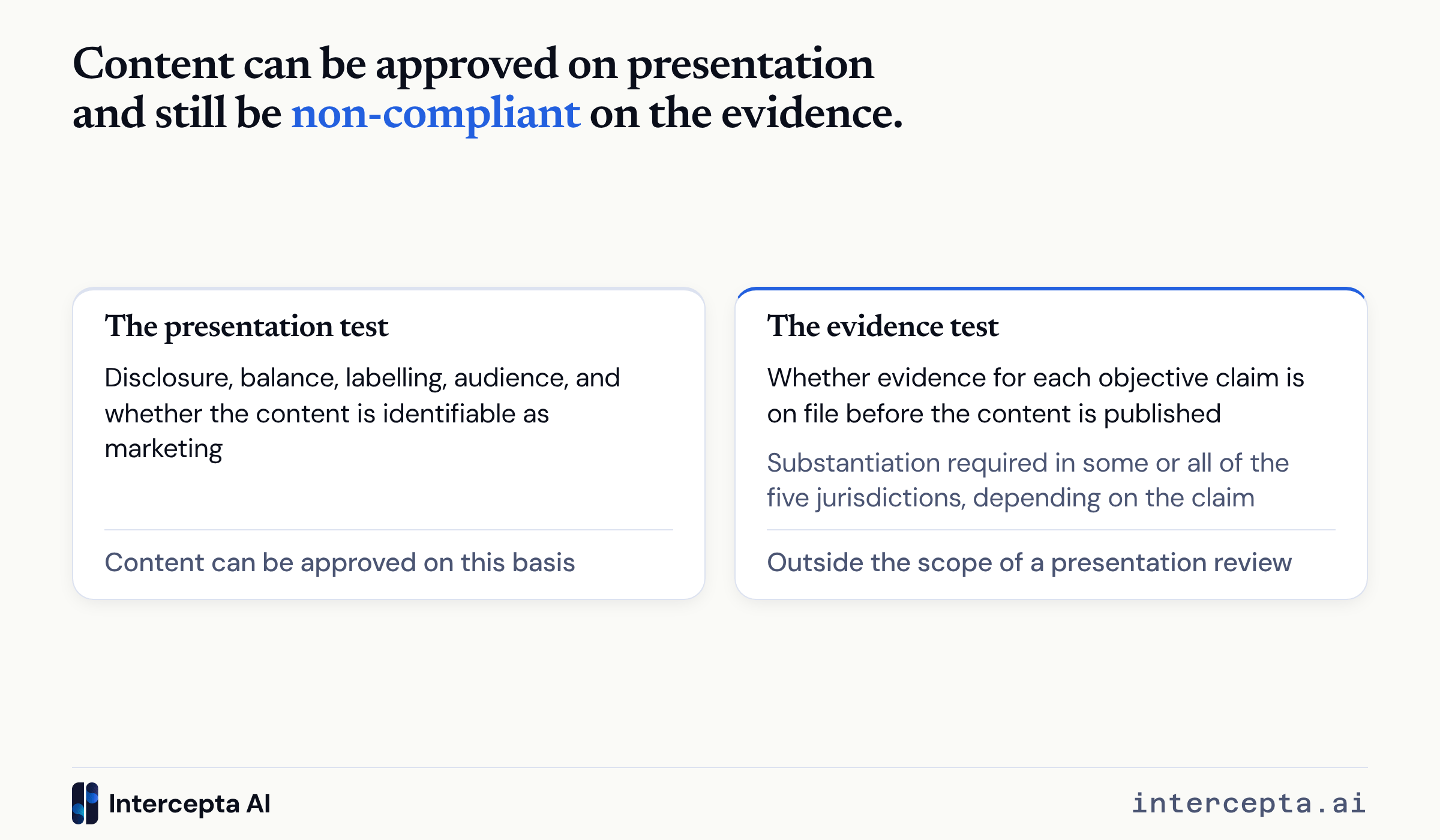
In a review designed for presentation, reviewers confirm the disclosure, the balance, the labelling, the audience and whether the content is identifiable as marketing. Content can be approved on that basis and still be non-compliant on the evidence, since the record a business holds is not part of the scope of that review. Claims subject to an evidence obligation can usually be identified in the copy itself, and an implied claim is identified from how the audience would understand it. An assertion that a product is proven, tested, effective against a named condition, cheaper than a rival or capable of a stated result is an objective claim that is subject to substantiation in some or all of the jurisdictions covered in this piece. For each objective claim, the review question is whether the evidence is on file before the content is published.
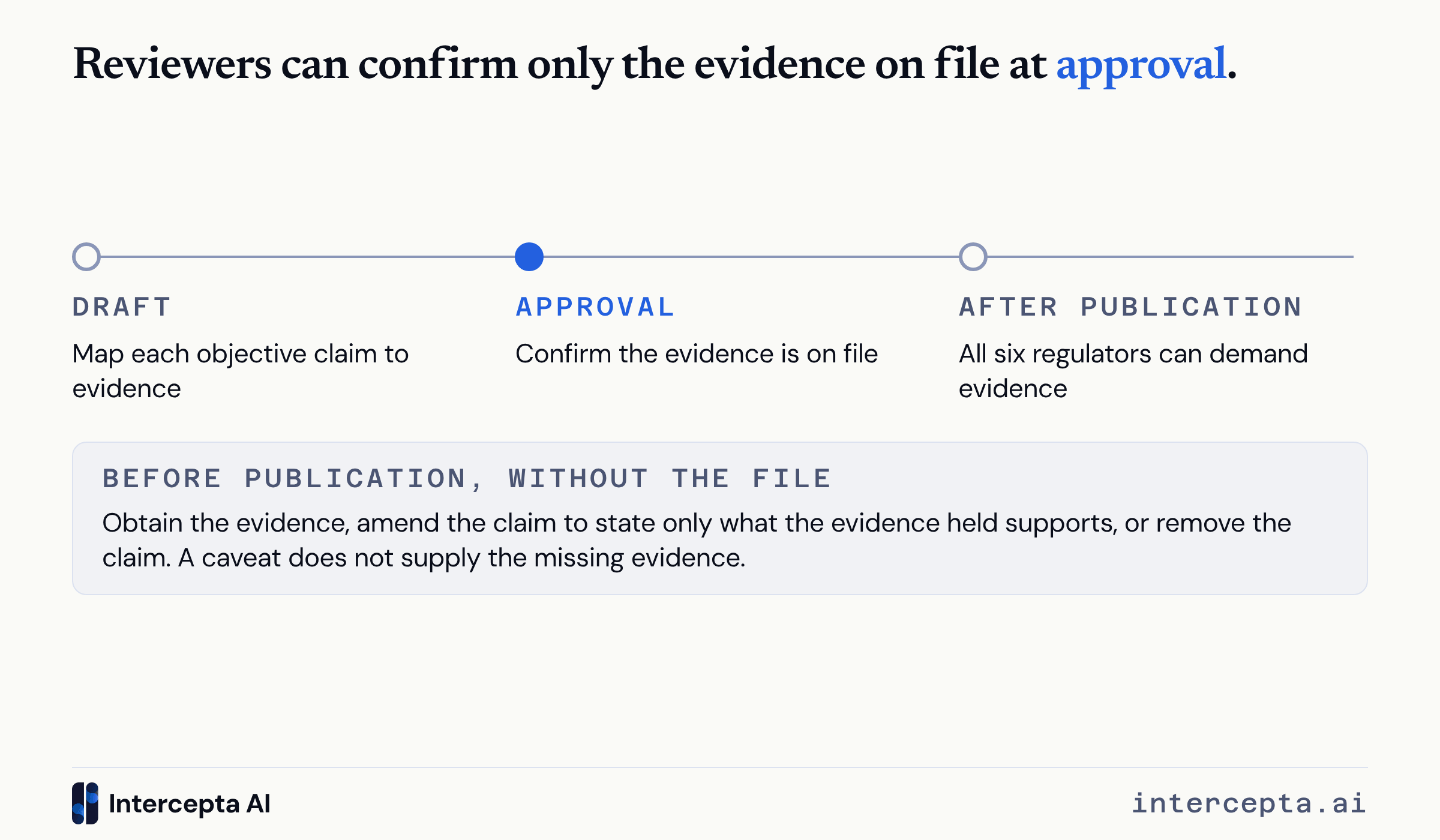
A marketing team that lists each objective claim and the documentation on file for it while writing the copy can see before approval which claims have none. At this stage, there is still time to seek evidence for those claims, or to amend or remove them. The list also records where each file is kept if a regulator asks for it. For a claim that a battery lasts ten hours, for example, the entry in the list would record the claim, the jurisdictions where the content will be published and the test report on file for it. A claim reused in later content is made again on each publication, so its entry is reviewed before each reuse to confirm that the evidence on file is still current. The objective claim list, a one-page template with two worked examples, one claim with evidence on file and one without, and a summary of the standards in each of the five jurisdictions and their sources, is available to download as a PDF. Reviewers can confirm only what has been documented, so the evidence for each objective claim should be on file before the content is approved. For content commissioned from an agency or a creator, the list should form part of the brief, because the content they produce for the advertiser is subject to the evidence test as well. Rule 1.8 of the CAP (UK) Code states that primary responsibility for observing the Code “falls on marketers” and that agencies and publishers, among others, “also accept an obligation to abide by the Code”. The FTC (US) Endorsement Guides provide that advertisers “are subject to liability for misleading or unsubstantiated statements made through endorsements”.
If the file exists, the compliance team assesses it against the standard in each jurisdiction where the claim is published. Without the file, the options before publication are to obtain the evidence, to amend the claim so that it states only what the material held supports, or to remove the claim. A caveat does not supply the missing evidence. Under the published positions of the NZCC (New Zealand), the Bureau (Canada) and the FTC (US), a business that obtains the evidence after publication may not remedy a breach that was complete on the day of publication. In the United Kingdom, CAP’s published advice states that an advertisement whose supporting evidence post-dates its appearance “will almost certainly breach 3.7”, the CAP Code rule that requires the evidence to be held before publication. A team that validates content against these rules can identify which claims may be subject to a compliance obligation and which rule may apply to each. The assessment of what the business holds is a matter for the compliance team.
The sequence is common, in law or in practice, to the five jurisdictions, and the evidence that satisfies it differs between them. For a performance claim, the standard is reasonable grounds in New Zealand, an adequate and proper test in Canada, documentary evidence capable of proving the claim in the United Kingdom and a reasonable basis in the United States. In Australia, outside sectoral regimes, the reasonable-grounds rule applies only to claims about future matters. The exposure created when one approved claim is published in several jurisdictions is the subject of One compliant claim, exposed in other jurisdictions, published on this blog in September 2026.
Download the objective claim list (PDF, one page) →
Validate before you publish. Keep the record.
Under the rules enforced by the FTC (US), the ASA (UK), the Bureau (Canada) and the NZCC (New Zealand), substantiation is required for some or all objective claims before publication. In the United States, Canada and New Zealand, a claim made without it can be non-compliant even if it is later shown to be true. In the United Kingdom, CAP’s published advice indicates the same. The CMA (UK) and the ACCC (Australia) can demand it afterwards. If your marketing programme makes objective claims in more than one of these markets, Intercepta AI was built to identify, before publication, claims in your content that may be subject to a compliance obligation under the regulatory rules its scanner covers. Each of those claims is shown with the rule that may apply to it. Your team can then record the evidence on file for each one before approval.
The scanner covers 1,100+ regulatory rules across the United States, United Kingdom, European Union, Canada, Australia and New Zealand. Each scan returns a documented report that maps each issue to the specific regulation it references, with remediation guidance for your compliance team to review. Marketing teams can validate content before publication. Compliance teams keep a documented record of that review alongside the evidence held for each claim. Every decision on every finding remains in the remit of your compliance team.
Cross-references
- For the substantiation standard as applied by a single regulator, see Clinically Proven, Except It Was Not.
- For one part of the presentation test, the requirement to disclose that content is marketing, see Hidden Advertisements in Health Marketing: Four Regulators Are Closing In.
- For the July 2026 ASA (UK) rulings on airline carbon-offsetting claims, see The Edge of the Advertising Rules Is Not Where Companies Think.
- For the timing of the evidence for environmental claims in the same five jurisdictions, see Green claims in 2026: the evidence has to exist first.
- For the European Union instruments and their dates, see EU marketing compliance in 2026: what applies and when.
- For a claim approved for one market and published in others, see One compliant claim, exposed in other jurisdictions.
Sources
New Zealand
- Fair Trading Act 1986, sections 12A, 12D and 40.
- Commerce Commission (NZ), fact sheet “Fair Trading Act: Unsubstantiated representations”, July 2018.
Canada
- Competition Act, R.S.C. 1985, c. C-34, section 74.01, current text, paragraphs 74.01(1)(b), (b.1) and (b.2).
- Competition Act, section 74.09, definition of court.
- Competition Act, section 74.1, administrative monetary penalties, paragraph 74.1(1)(c) and subsection 74.1(3).
- Competition Bureau, “Performance claims not based on an adequate and proper test”.
- Competition Bureau, The Deceptive Marketing Practices Digest, Volume 2, Substantiating performance claims: Standing the test of time for over 75 years.
- Competition Bureau, “Environmental claims and the Competition Act”, final guidelines, 5 June 2025.
United States
- Federal Trade Commission Act, section 5, 15 U.S.C. 45.
- Federal Trade Commission, Policy Statement Regarding Advertising Substantiation, 23 November 1984, appended to Thompson Medical Co., 104 F.T.C. 648 (1984).
- Pfizer, Inc., 81 F.T.C. 23 (1972).
- Federal Trade Commission, Health Products Compliance Guidance, December 2022.
- Federal Trade Commission, final order of 15 July 2026, File No. 242-3093. Subject firm anonymised in this piece under house policy; party-naming URL withheld under the sources-link policy.
- Guides Concerning Use of Endorsements and Testimonials in Advertising, 16 CFR Part 255, section 255.1(d).
United Kingdom
- Committee of Advertising Practice, CAP Code (Edition 12), Preface.
- Committee of Advertising Practice, CAP Code (Edition 12), rule 1.8 in section 1 (Compliance).
- Committee of Advertising Practice, CAP Code (Edition 12), rule 3.7 in section 3 (Misleading advertising).
- Committee of Advertising Practice, “Substantiation 101”, CAP News, 23 February 2023.
- Committee of Advertising Practice, AdviceOnline, “Substantiation”, updated 21 September 2026.
- Advertising Standards Authority, rulings A26-1326605 and A26-1326610, 15 July 2026, airline offsetting claims. Subject firms anonymised in this piece under house policy; party-naming URLs withheld under the sources-link policy.
- Digital Markets, Competition and Consumers Act 2024, Part 4 Chapter 1 and sections 182 and 195.
- Competition and Markets Authority, Green Claims Code, “Making environmental claims on goods and services”, September 2021.
- Competition and Markets Authority, “Making green claims: getting it right, across the supply chain”, 22 January 2026.
- Competition and Markets Authority, Unfair commercial practices (CMA207), paragraph 5.1, 18 November 2025.
- Competition and Markets Authority, Direct consumer enforcement guidance (CMA200), paragraph 2.55, 14 March 2025.
Australia
- Competition and Consumer Act 2010, Schedule 2 (Australian Consumer Law), sections 4, 219, 220, 221 and 224.
- Therapeutic Goods Act 1989 (Cth), sections 42BAA, 42DM and 42DMA.
- Australian Competition and Consumer Commission, Business Snapshot, “ACCC powers to issue infringement, substantiation and public warning notices”, 2011, updated 2015.
- Therapeutic Goods (Therapeutic Goods Advertising Code) Instrument 2021, made under section 42BAA of the Therapeutic Goods Act 1989, Schedule 1, sections 2 and 8(1)(b), as amended by F2026L01329, with its Replacement Explanatory Statement.
European Union
- Directive 2005/29/EC (Unfair Commercial Practices Directive), recital 21 and Article 12.
- Directive (EU) 2024/825 on empowering consumers for the green transition, recital 4, Article 1(2)(b), inserting point (d) into Article 6(2) of Directive 2005/29/EC, and Article 4(1).
- Regulation (EC) No 1924/2006 on nutrition and health claims made on foods, recitals 1 and 17 (as corrected, OJ L 12, 18 January 2007) and Articles 1(2), 10(1), 20, 28(5) and 28(6).
- Commission Regulation (EU) No 432/2012, recital 11.