Aviva Just Made ChatGPT an Insurance Distribution Channel
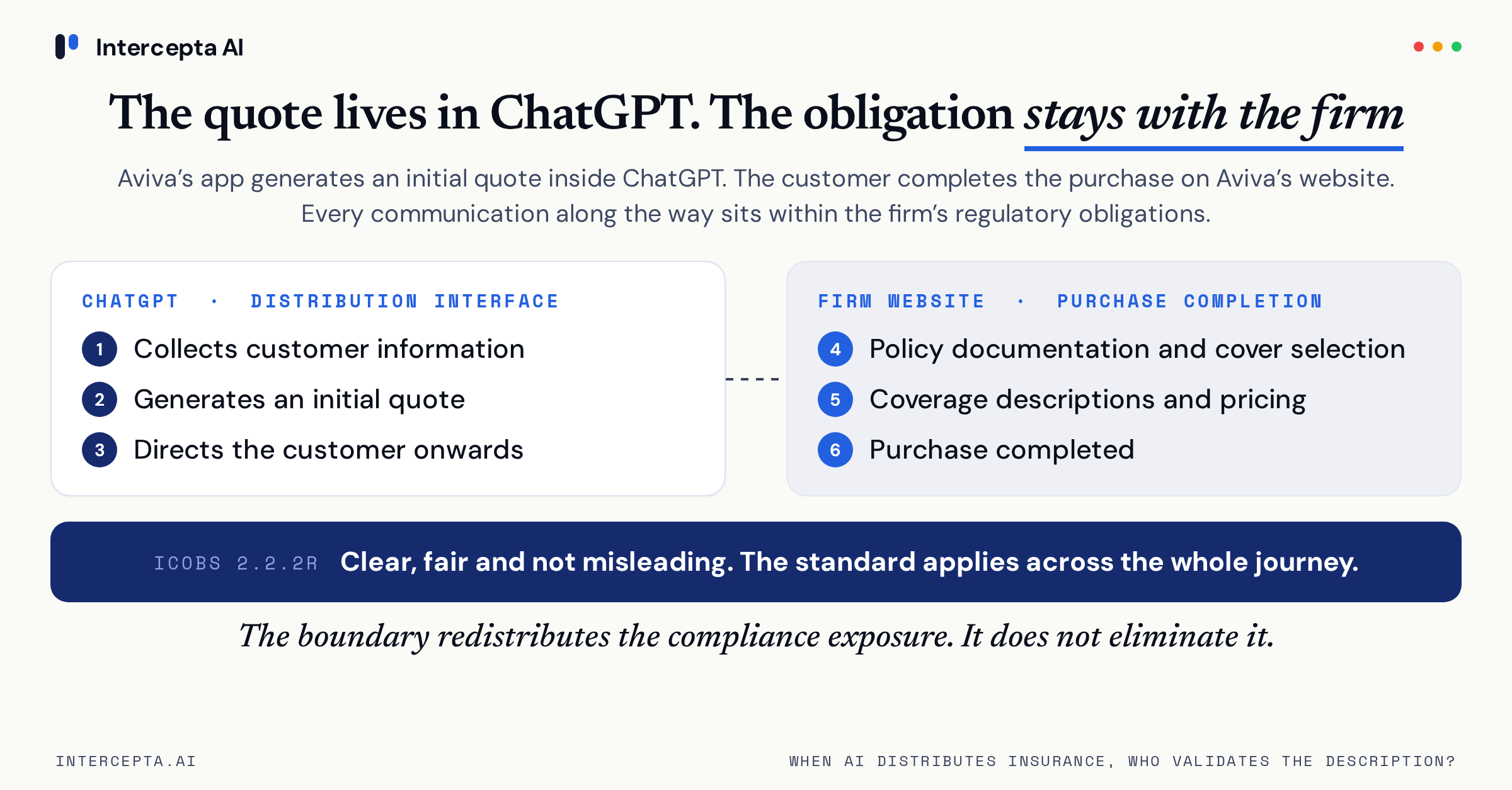
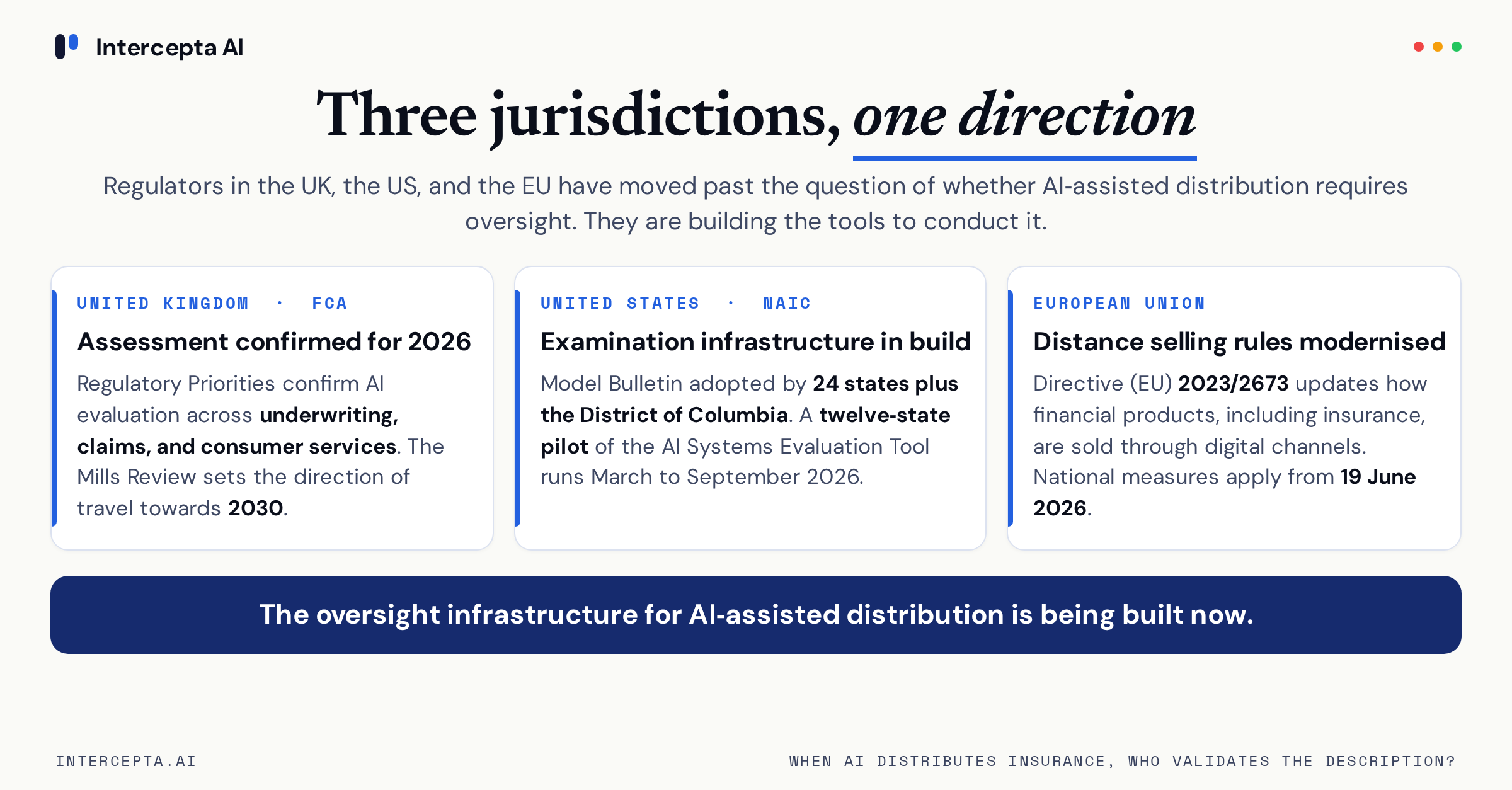
In March 2026, Aviva announced the launch of a home insurance quoting app on ChatGPT, marking the insurer’s first collaboration with OpenAI. The app went live in April, allowing users to answer a short series of underwriting questions within the ChatGPT interface and receive an initial quote for Aviva’s Signature Home Insurance product. Customers who wished to proceed were directed to Aviva’s website to select policy limits, add optional cover, review documentation, and complete the purchase.
On 1 June 2026, Aviva expanded the app to life insurance, allowing customers to generate a quote within ChatGPT and then complete their application on Aviva’s website, with their information pre-populated into the purchase journey.
The mechanism matters. ChatGPT is the distribution interface. It collects information, generates a quote, and redirects the customer. The policy documentation, the coverage descriptions, and the purchase completion all sit on Aviva’s own website. The app is a structured quoting tool delivered through a conversational channel, distinct from an AI writing free-form marketing copy about insurance products.
The regulatory question is the same one that applies to every other distribution channel. Does every communication a customer receives meet the standard the Financial Conduct Authority (FCA) requires?
The Regulatory Framework Is Technology-Neutral
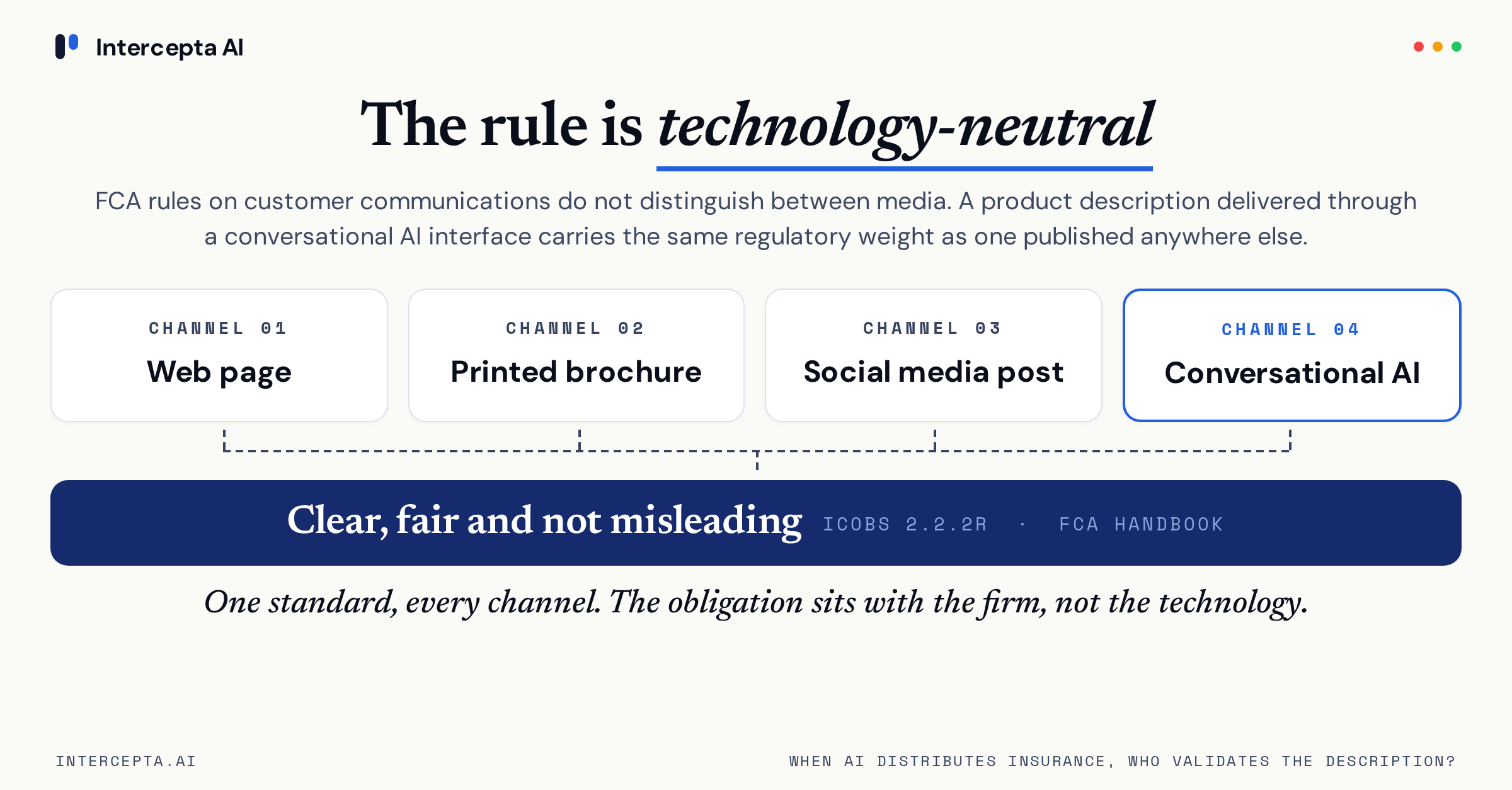
FCA rules governing how insurance firms communicate with customers do not distinguish between a web page, a printed brochure, a social media post, and a conversational AI interface. For non-investment insurance contracts, the operative rule is ICOBS 2.2.2R in the Insurance: Conduct of Business sourcebook. When a firm communicates information, including a financial promotion, to a customer, it must ensure the communication is clear, fair and not misleading. That obligation applies to the firm, regardless of the technology the firm uses to deliver the communication.
This means that the product descriptions, coverage information, and pricing statements a customer encounters during the quoting process fall within the scope of the firm’s regulatory obligations. The FCA applies the same standard regardless of medium. A product description delivered through a ChatGPT interface carries the same regulatory weight under ICOBS 2.2.2R as one published on a website or included in a policy summary.
The Consumer Duty, which came into force in July 2023, reinforces this position. Firms must deliver good outcomes for retail customers across the entire customer journey, including the information they receive at the point of sale. If a conversational interface is part of that journey, the information it presents must meet the same standard as any other customer-facing communication.
This is the natural consequence of extending distribution into new channels while operating under an existing regulatory framework.
The FCA Has Confirmed AI Assessment Across Insurance in 2026
On 24 February 2026, the FCA published its first annual Regulatory Priorities report for the insurance sector. The report replaced more than 40 individual portfolio letters and consolidated the regulator’s supervisory expectations into a single document addressed to insurers, intermediaries, and price comparison websites.
Among the four priority areas, the FCA confirmed that it will evaluate AI deployment in underwriting, claims, and consumer services this year. The regulator stated its support for firms’ use of AI but emphasised that firms must closely monitor customer outcomes.
PwC UK addressed the report in its February 2026 briefing, “FCA sets out 2026 insurance priorities”, and observed that the regulator “confirms its support for firms’ use of AI” while expecting firms to closely monitor the outcomes AI delivers for customers. The message is consistent with the FCA’s broader position. Innovation is welcome, but the regulatory obligations that protect consumers do not pause while firms experiment with new technology.
For insurance firms that are expanding into AI-assisted distribution, the timing is significant. The FCA has confirmed that the assessment is happening now, across underwriting, claims, and consumer services, in the same year that Aviva is quoting insurance through ChatGPT.
The Regulatory Tightening Extends Beyond the UK
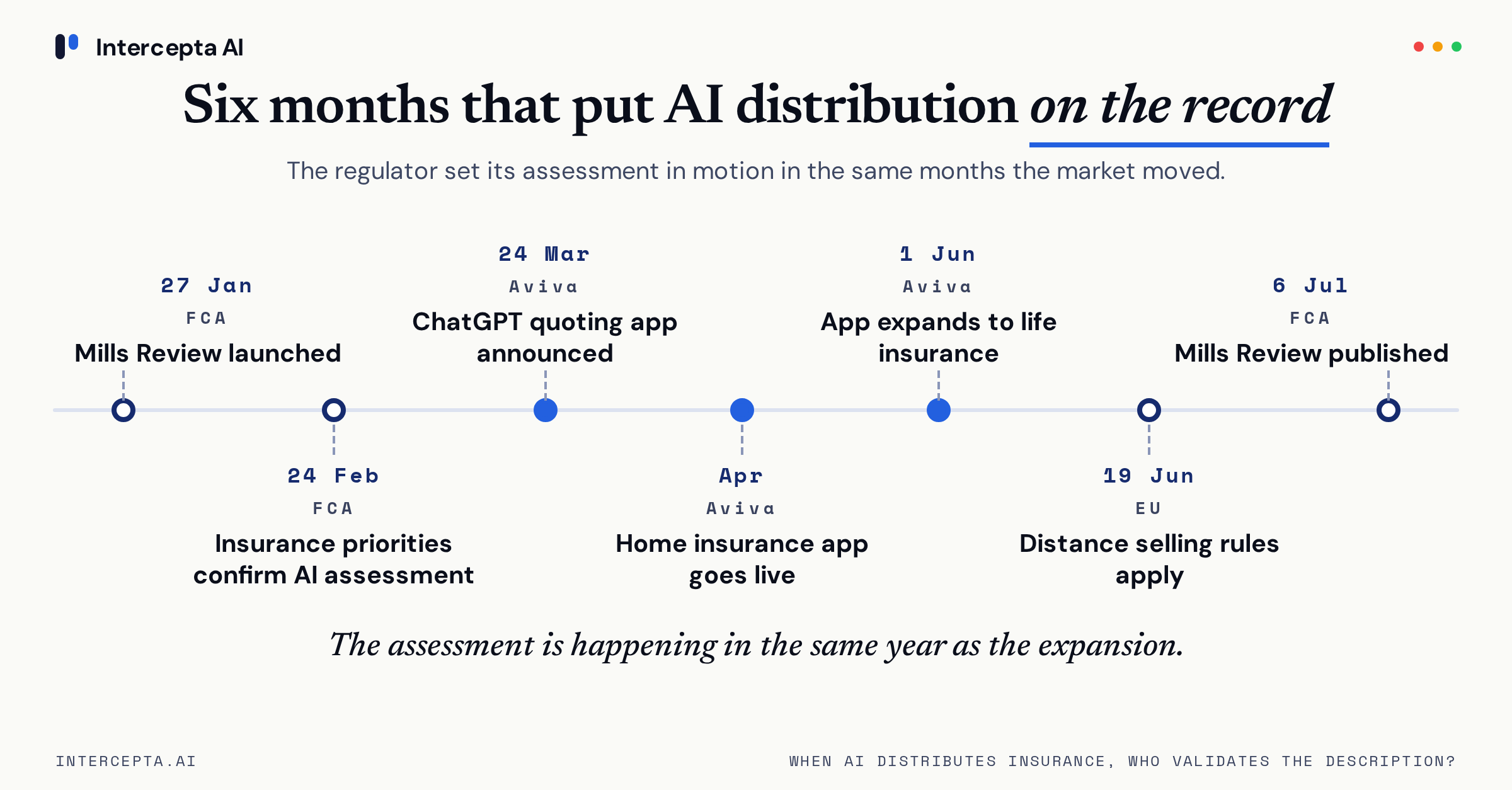
Supervisory infrastructure around AI in insurance is being built on both sides of the Atlantic. In the United States, 24 states plus the District of Columbia had adopted the National Association of Insurance Commissioners (NAIC) Model Bulletin on the Use of Artificial Intelligence Systems by Insurers, issued in December 2023, according to the NAIC implementation tracker as updated in April 2026. Four additional states, California, Colorado, New York, and Texas, have introduced their own insurance-specific AI regulation or guidance outside the Model Bulletin framework.
The NAIC is also operationalising enforcement. A multistate pilot of the AI Systems Evaluation Tool is running from March to September 2026 across twelve participating states, designed to give state insurance examiners a standardised method for reviewing insurer AI governance during market conduct examinations. The tool creates the examination infrastructure to assess whether firms are meeting the regulatory obligations that already exist, without creating new ones.
The European Union is moving in the same direction. Directive (EU) 2023/2673 on financial services contracts concluded at a distance, with national measures applying from 19 June 2026, modernises the rules governing how financial products, including insurance, are sold through digital channels. The directive governs the distance selling process rather than marketing content, and its relevance here is contextual. It confirms that European legislators are updating the framework around digitally distributed financial products alongside their UK and US counterparts.
For insurance firms that operate across jurisdictions, the pattern is consistent. Regulators in the UK, the US, and the EU have moved past the question of whether AI-assisted distribution requires oversight. They are building the tools to conduct it.
The Mills Review and the Direction of Travel
Three weeks before the FCA published its insurance priorities report, the regulator launched the Mills Review. Led by Executive Director Sheldon Mills, the review examined the long-term impact of artificial intelligence on retail financial services, looking towards 2030 and beyond.
The engagement paper, published on 27 January 2026, invited input from firms, consumer groups, technology providers, and academics across four themes. These cover how AI technology could evolve, how those developments could affect markets and firms, how consumers would be impacted, and how financial regulators may need to adapt.
One theme is particularly relevant to the Aviva development. The FCA’s engagement paper notes that by 2030, consumers may increasingly interact with financial services through AI-mediated interfaces rather than directly with firms. Agentic AI, the category of systems capable of independent decision-making and action on behalf of users, is identified as an area of growing regulatory attention. Insurance sits directly within the review’s scope. The engagement paper identifies insurance among the sectors where AI may act as a personal intermediary for consumers, and anticipates that continuous risk assessment and automated claims handling could reshape pricing and underwriting. The concrete implication for insurers is that the product descriptions an AI agent will compare are the same descriptions firms publish and remain responsible for today.
The FCA published the Mills Review on 6 July 2026. The review draws on nearly 140 submissions and a survey of more than 5,000 UK consumers, and presents seven priority recommendations to the FCA Board. Its central finding is that retail financial services are moving from human-led towards AI-enabled and increasingly delegated services, and it confirms that senior manager accountability continues to apply as AI systems take on more of the work. For firms already deploying AI in customer-facing roles, the review sets out the direction of travel and the expectation that existing accountability frameworks will carry into it. The FCA has confirmed that it will launch an AI good and poor practice publication later this year.
The Mills Review leaves the FCA’s current regulatory approach unchanged. It does, however, set out where the regulator expects the industry to move. If the trajectory from structured quoting apps to more autonomous AI-driven distribution continues, the compliance infrastructure firms build now will need to scale with that trajectory.
What This Means for Insurance Marketing and Compliance Teams
The Aviva ChatGPT app is a quoting tool with a clear boundary. The conversational interface generates a quote, and the customer completes the purchase on Aviva’s website. That boundary is important, and it redistributes the compliance exposure rather than eliminating it.
When a customer receives a quote through a conversational interface, the product descriptions, coverage summaries, and pricing information they encounter are all communications that fall within the firm’s regulatory obligations. The same is true of the marketing content that sits around the AI distribution channel, including the landing pages, the promotional emails, the social media posts that drive awareness, and the website content that completes the sale.
This is where the practical compliance question becomes most immediate. Real-time conversational AI outputs are difficult to review before they reach the customer. In contrast, the marketing content that surrounds and supports AI distribution, the content that describes the product, explains the coverage, and drives the customer towards the AI interface in the first place, is content that firms produce, approve, and publish through established workflows.
That content also carries substantial regulatory exposure. The FCA’s first Enforcement Watch newsletter, published on 28 January 2026, confirmed six open investigations into potential Consumer Duty breaches, with two of the most serious cases involving insurance firms in the home and travel markets. Across the wider market, the FCA reported that 19,766 financial promotions were amended or withdrawn following its interventions in 2024, a 97.5% increase from 10,008 in 2023. The financial promotions interventions and the Consumer Duty investigations both focus on the content firms put in front of customers. If your firm is expanding into AI distribution, the most immediate compliance priority is the marketing content you already control.
The AI distribution interface is one part of the customer journey. The marketing content that feeds into it, and the product descriptions that sit alongside it, represent the area of regulatory exposure that firms can address most directly through established publication workflows.
Start With the Content You Control
If your firm is publishing marketing content for insurance products, whether that content supports an AI distribution channel, a price comparison listing, a broker network, or a direct-to-consumer website, Intercepta AI can validate it against the regulatory rules that apply before it reaches a customer.
The platform scans marketing content against FCA financial promotions requirements, Consumer Duty obligations, and insurance-specific regulatory standards. It identifies potential compliance issues before publication, giving marketing teams a documented record of every scan and compliance teams an auditable trail of pre-publication validation.
Your first three scans are free.
Scan your first piece of content →
No payment method required.
Sources
- Aviva plc, “Aviva launches insurance app on ChatGPT,” 24 March 2026
- Aviva plc, “Aviva expands ChatGPT app to life insurance applications,” 1 June 2026
- Financial Conduct Authority, “Regulatory Priorities: Insurance,” 24 February 2026
- PwC UK, “FCA sets out 2026 insurance priorities,” February 2026
- Financial Conduct Authority, “Mills Review to consider how AI will reshape retail financial services,” 27 January 2026
- Financial Conduct Authority, “The FCA’s long term review into AI and retail financial services: designing for the unknown” (Sheldon Mills speech), 28 January 2026
- Financial Conduct Authority, “AI and the future of retail financial services (The Mills Review),” 6 July 2026
- FCA Handbook, ICOBS 2.2: Communications to clients and financial promotions
- Financial Conduct Authority, “Enforcement Watch,” 28 January 2026
- Financial Conduct Authority, “Financial Promotions Data 2024,” February 2025
- National Association of Insurance Commissioners, “Model Bulletin on the Use of Artificial Intelligence Systems by Insurers,” December 2023 (implementation tracker updated April 2026)
- National Association of Insurance Commissioners, “AI Systems Evaluation Tool Pilot Project,” March 2026
- European Union, Directive (EU) 2023/2673 on financial services contracts concluded at a distance, 22 November 2023