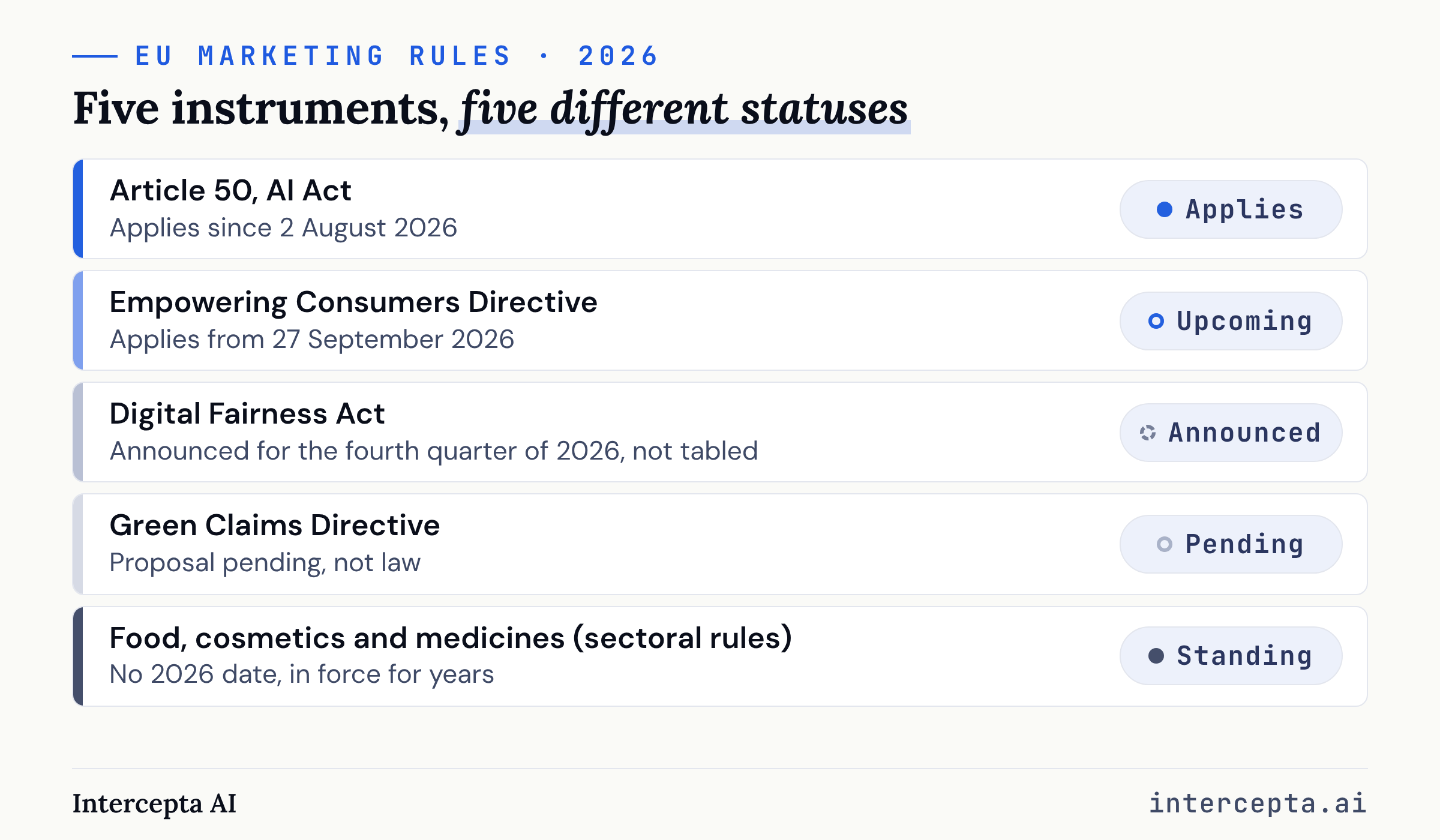
The EU’s marketing rules take effect by date rather than by instrument. Article 50 of the AI Act has applied since 2 August 2026, the Empowering Consumers Directive applies from 27 September 2026, and a Digital Fairness Act is announced for the final quarter of the year. This piece takes the dates in turn, and then the rules that carry no date at all, for the teams who publish marketing and must meet them.
The European Union has no single marketing regulator. It legislates horizontally, through instruments such as the Unfair Commercial Practices Directive, and by sector, through the regimes that govern food, cosmetics, medicines and financial services. Enforcement runs through national authorities in each Member State. For breaches of the consumer protection legislation listed in the Annex to Regulation (EU) 2017/2394, those authorities coordinate through the Consumer Protection Cooperation Network, while the sectoral regimes and the AI Act run through their own competent authorities. Marketing teams searching for the one authority that will judge their work in the European Union are searching for something that does not exist. The rules take effect on dates, and 2026 has set several of them in a single season.
These entries do not form a single class, and the differences determine what each requires. Two are rules of 2026, Article 50 of the AI Act, with its marking and disclosure duties on synthetic content, and the Empowering Consumers Directive, which from 27 September 2026 applies with no grandfathering for content or stock already in the market. A third, a Digital Fairness Act, is only an announcement for the fourth quarter of the year. A fourth, the Green Claims Directive, the instrument that would have required environmental claims to be verified before publication, stalled in June 2025. The sectoral rules on food, cosmetics and medicines carry no 2026 date at all, because they have applied for years. The sections that follow take the dates in order. The piece then addresses the three questions common to marketing compliance in every market, whether the evidence substantiates the claim, how the claim is presented, and where the content originated. It closes on validation as a continuous task regardless of the regulatory calendar.
Article 50 has applied since 2 August 2026
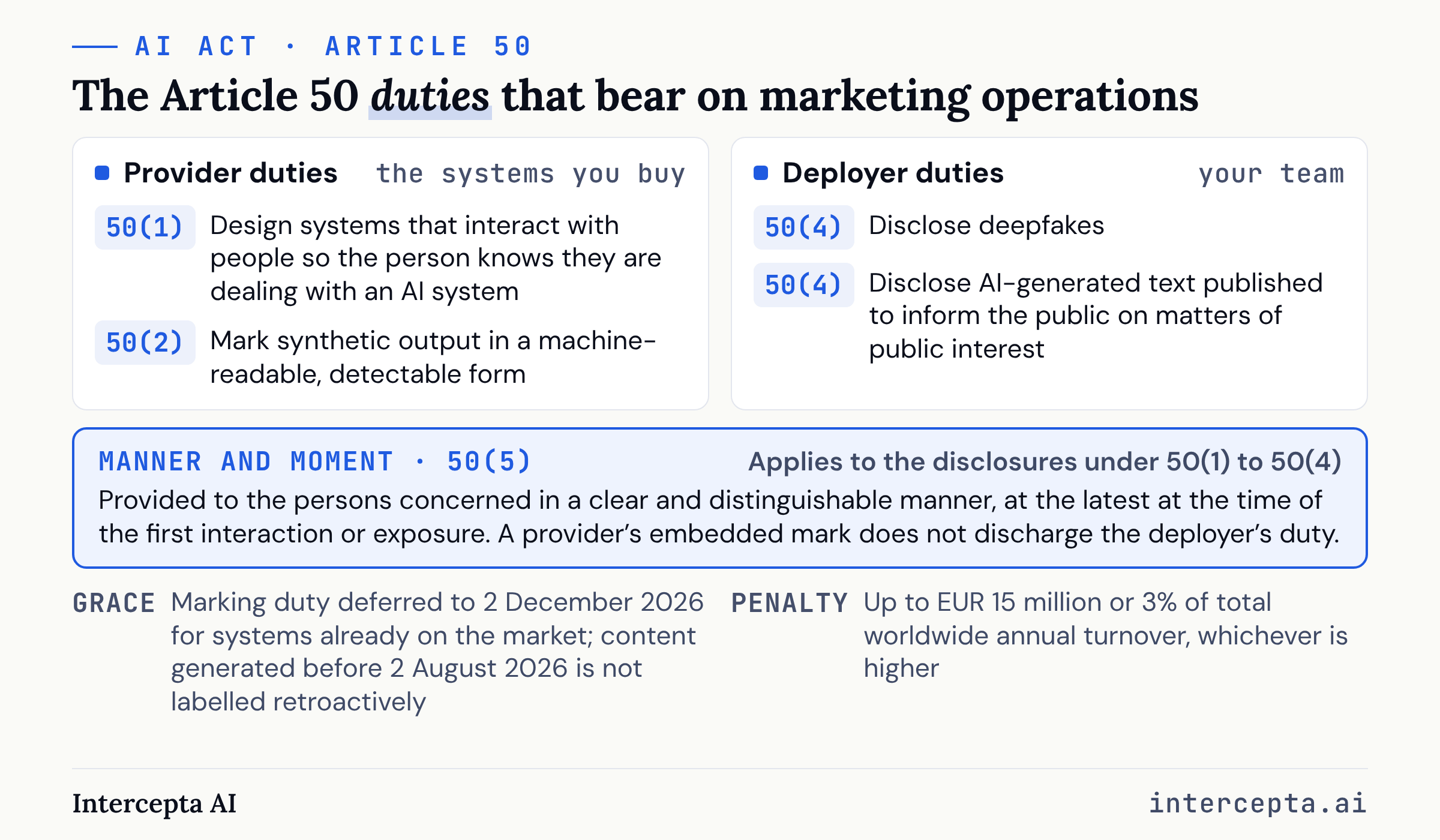
The transparency obligations in Article 50 of the AI Act, Regulation (EU) 2024/1689, have applied since 2 August 2026, and enforcement began the same day. Four of the article’s duties bear on marketing operations, two of them on the technology suppliers teams buy from and two on the teams themselves as deployers. Providers of generative AI systems must mark outputs so they can be detected, providers of systems that interact directly with natural persons must design them so users know they are dealing with an AI system, and deployers must disclose both deepfakes and certain AI-generated text.
The provider duties belong mainly to the technology industry. Article 50(2) requires providers of AI systems that generate synthetic audio, image, video or text content, general-purpose systems included, to ensure that outputs are "marked in a machine-readable format and detectable as artificially generated or manipulated", and it requires, in the article’s own words, that their "technical solutions are effective, interoperable, robust and reliable as far as this is technically feasible". The obligation does not apply to the extent that a system performs an assistive function for standard editing, or does not substantially alter the input data provided by the deployer or the semantics of that input. The carve-out is measured by what the system does to the content rather than by any class of exempt system. Article 50(1) adds the interaction duty. Providers of systems intended to interact directly with people must design them so that a person is informed of dealing with an AI system, unless that is obvious from the point of view of a person who is "reasonably well-informed, observant and circumspect", taking into account the circumstances and the context of use.
The deployer duties belong to marketing teams, and they applied from 2 August 2026 with no grace period. Under Article 50(4), a deployer whose AI-generated or manipulated image, audio or video content constitutes a deepfake must "disclose that the content has been artificially generated or manipulated", and where the content forms part of an "evidently artistic, creative, satirical, fictional or analogous work" the duty is limited to disclosure "in an appropriate manner that does not hamper the display or enjoyment of the work". Article 50(4) also requires disclosure where AI-generated or manipulated text is published "with the purpose of informing the public on matters of public interest", unless, in the words of the article, the text "has undergone a process of human review or editorial control" and "a natural or legal person holds editorial responsibility for the publication of the content". The Commission’s guidelines read that exemption narrowly. Human review means substantive examination by someone with relevant knowledge of the subject, editorial control means authority to approve, alter or reject the text on substantive grounds, and superficial correction of spelling or grammar qualifies as neither. Article 50(5) fixes the manner and the moment, requiring disclosure "in a clear and distinguishable manner at the latest at the time of the first interaction or exposure". The Commission’s published questions and answers on Article 50 add a point of real operational weight, which is that a deployer cannot rely on the machine-readable marks a provider embeds in the content to meet its own disclosure duty, because the label must be perceivable by the person exposed to it.
The guidance around the article was published in final form only weeks before the date. The European Commission published the final Code of Practice on Transparency of AI-generated Content on 10 June 2026, a voluntary framework drawn up by independent experts in a process facilitated by the AI Office, covering the marking and labelling duties in Article 50(2), (4) and (5). The Commission and the European Artificial Intelligence Board confirmed the code adequate as a voluntary route to demonstrating compliance, in an opinion published on 9 July 2026. The final guidelines on the transparency obligations followed on 20 July 2026, clarifying scope, definitions and exemptions with practical examples, after a draft published on 8 May 2026 had gone through public consultation. A first list of more than 180 signatories to the code was published on 31 July 2026, alongside a set of EU icons that deployers may use to label AI-generated content. The Commission’s position is that signatories may rely on the code’s measures to demonstrate compliance with the marking and labelling duties, while providers and deployers that comply by other means will have to demonstrate that those measures are adequate, assessed individually by the market surveillance authorities. Adherence stays voluntary. One grace period exists, and it is tightly drawn. Providers of AI systems placed on the market before 2 August 2026 have until 2 December 2026 to meet the marking-and-detection duty in Article 50(2), and content generated before 2 August 2026 does not need to be labelled retroactively. The grace period does not extend to the deployer duties.
The penalty layer is set at Union level and applied nationally. Article 99(4) of the AI Act sets the fine for non-compliance with the Article 50 transparency obligations at up to EUR 15 million or, for an undertaking, up to 3% of total worldwide annual turnover for the preceding financial year, "whichever is higher". For small and medium-sized enterprises, including start-ups, Article 99(6) applies whichever of the two figures is lower. Member States write their own penalty rules within those ceilings, and day-to-day enforcement of Article 50 belongs mainly to national market surveillance authorities. The AI Office is competent for the narrow class of systems built on a general-purpose AI model where the same entity provides both, and for AI systems integrated into very large online platforms or very large online search engines designated under the Digital Services Act.
The provenance argument does not need re-arguing here. Intercepta AI’s analysis of the California AI Transparency Act, which reached its operative date on the same 2 August 2026, sets out why provenance disclosure is one part of marketing compliance rather than a substitute for it, and the analysis of New York’s synthetic performer disclosure law examines the closest state-level analogue to the deepfake duty. The point of this section is practical. The obligation is live and the guidance is final, and the deployer disclosure duties on published content reach a narrower set of assets than the general commentary suggests, namely content that constitutes a deepfake and text published to inform the public on matters of public interest. Content generated before 2 August 2026 does not have to be labelled retroactively. The operational task is identifying which live and forthcoming assets those two triggers actually reach, and validating the disclosures on them before an authority asks.
The Empowering Consumers Directive applies from 27 September 2026
Directive (EU) 2024/825, on empowering consumers for the green transition, was adopted on 28 February 2024 and entered into force on 26 March that year. Member States had until 27 March 2026 to transpose it, and it applies from 27 September 2026. The instrument does not create a new regime of its own. It amends two directives that already govern marketing, the Unfair Commercial Practices Directive and the Consumer Rights Directive, and the amendments that matter most to marketing teams go into Annex I of the Unfair Commercial Practices Directive, the blacklist of practices prohibited in all circumstances. A blacklisted practice is unfair whatever the context, so an authority does not have to show that consumers were misled or that purchasing behaviour was distorted. Establishing that the practice occurred is enough.
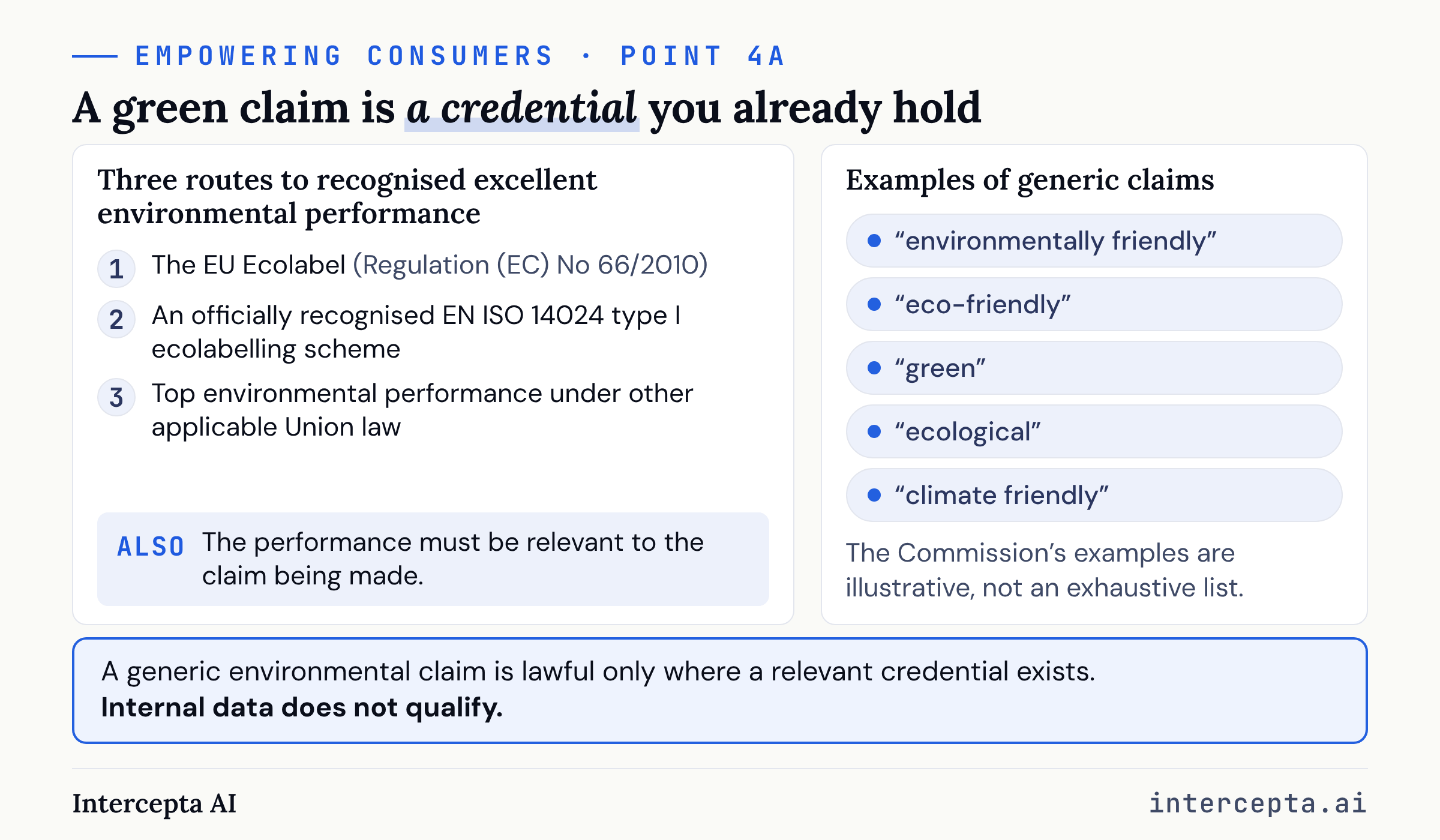
Three additions to that blacklist reach the claims marketing teams routinely write. Point 4a prohibits "making a generic environmental claim for which the trader is not able to demonstrate recognised excellent environmental performance relevant to the claim". Point 4c prohibits "claiming, based on the offsetting of greenhouse gas emissions, that a product has a neutral, reduced or positive impact on the environment in terms of greenhouse gas emissions". Point 2a prohibits displaying a sustainability label unless it is based on a certification scheme or established by public authorities, and a certification scheme relied on, meaning a third-party verification scheme, must meet minimum conditions of transparency and credibility.
Point 4a repays a closer look, because the test it sets is compliance with a recognised standard rather than a body of evidence a trader assembles. The Commission’s guidance gives examples of generic environmental claims, among them "environmentally friendly", "eco-friendly", "green", "ecological" and "climate friendly". Recognised excellent environmental performance is defined in Article 2, point (s), of the Unfair Commercial Practices Directive, as amended, as "environmental performance compliant with Regulation (EC) No 66/2010 of the European Parliament and of the Council or with national or regional EN ISO 14024 type I ecolabelling schemes officially recognised in the Member States, or top environmental performance in accordance with other applicable Union law". Regulation (EC) No 66/2010 is the EU Ecolabel Regulation. The performance also has to be relevant to the claim being made, whether that claim is about the product or about the business. Teams who read point 4a as an invitation to substantiate one of those claims with their own data have misread it, because unless a benchmark is met, the generic claim is unavailable whatever the internal evidence shows.
The offsetting prohibition is the one most likely to be misread, in both directions. The Commission’s services have published questions and answers on the Directive, and they draw two boundaries around point 4c. The prohibition does not reach a claim of neutral, reduced or positive impact that rests on the product’s own actual emissions footprint across its value chain and lifecycle, because such a claim is a statement about the product rather than about a purchase of offsets. It also does not reach claims made at company level rather than product level, though those remain subject to the rest of the Unfair Commercial Practices Directive and can still be deemed misleading. Point 4c prohibits one specific practice, buying offsets and then describing the product itself as climate neutral on that basis. Teams reading the prohibition as a ban on any mention of offsetting have read it too widely, and teams treating a company-level neutrality claim as exempt have read it too narrowly.
The Commission does not accept the grandfathering marketing teams might expect for existing inventory, because the Directive itself contains no provision on old stock. In its guidance, the Commission addresses old stock products directly, meaning goods or packaging already manufactured, ordered, distributed or displayed on retailers’ shelves before the application date, and its position is that the new rules apply to those products from 27 September 2026 as well. The national authorities in the Consumer Protection Cooperation Network have agreed a common understanding on how to enforce in those situations, and the practical remedies the Commission points to are corrective, such as covering or correcting a claim with a sticker or adding supplementary information at the point of sale. None of those remedies grandfathers an existing printed claim; the claim must still be corrected. The same logic reaches marketing assets published before the date and still live afterwards. A commercial practice under the Directive includes any "representation" or "commercial communication including advertising and marketing" directly connected with the promotion of a product, so what is assessed is the representation still being made to consumers, whatever date it was created.
The direction here is visible in what regulators have already been doing without the benefit of a blacklist. Intercepta AI’s analysis of the rulings the United Kingdom’s Advertising Standards Authority (ASA) published on 15 July 2026 examined two airlines whose advertising told customers they could offset the emissions of their flights, in one case up to all of them. The regulator found the claims misleading because the evidence did not show that the emissions from any particular flight would be neutralised, and it rejected the argument that a campaign aimed at business professionals on a professional network should be judged by a more informed standard. Reaching that outcome took a substantiation analysis, ruling by ruling. From 27 September 2026, an equivalent product-level claim resting on offsetting is prohibited by its type in every Member State that has transposed the point, and the quality of the trader’s evidence has no bearing. Under the Unfair Commercial Practices Directive, a product is any goods or service, so a flight is within the prohibition. The ASA (UK) reached its outcome through substantiation. The European Union has gone further, setting a rule that forbids the claim type whether or not the evidence would have satisfied a substantiation test.
Transposition itself has been uneven, which changes the practical enforcement picture without changing the date. On 28 May 2026, the European Commission opened infringement procedures against 20 Member States that had not communicated complete transposition, sending letters of formal notice and giving each two months to respond before it considers a reasoned opinion. The date is fixed, but its practical force in each Member State depends on what that state has transposed. A directive binds Member States, not traders directly. A point that a Member State has not transposed by 27 September 2026 therefore cannot be enforced against a trader in that market. National courts must still interpret existing national law consistently with the Directive so far as possible, and the Member State itself remains exposed to infringement proceedings. For marketing teams, the planning position is unchanged, because a campaign reaching consumers in several Member States is assessed in each market only against the points that market has transposed. The variable is which national authority is ready to enforce first.
The Digital Fairness Act is still an announcement for the fourth quarter of 2026
The third date is different in kind from the first two because the Digital Fairness Act does not exist as a text. The European Parliament’s Legislative Train, which tracks the progress of every file, records it with the status "Announced" and a Commission work programme indicative date in the fourth quarter of 2026. In the Parliament’s own taxonomy, an announced initiative is one expected from the European Commission and still entirely for the Commission to bring forward, while a tabled proposal is one Parliament has formally received and can begin to consider, and the Train marks the change between those two states as significant. The Digital Fairness Act remains at the announced stage. Nothing in the Digital Fairness Act imposes an obligation on anyone yet, and marketing teams who rebuild a process this quarter in anticipation of it are responding to a policy announcement rather than a legal instrument.
The announced scope is worth reading closely all the same, because it names the practices the European Union has decided are worth legislating on. The Commission’s 2026 work programme puts the initiative under the priority of protecting democracy and upholding values, and the initiative is expected to reach dark patterns, marketing by social media influencers, the addictive design of digital products, and unfair personalisation practices, especially where consumer vulnerabilities are exploited for commercial purposes. A second pillar has the opposite aim, streamlining obligations for business by reviewing certain consumer information requirements in certain types of contracts. Reading only the first pillar produces a picture of an initiative that only adds duties, which is incomplete.
The initiative has a documented origin in earlier review and institutional calls. A fitness check (the European Commission's term for a full evaluation of existing law) of three consumer protection directives in 2024 concluded that the core European consumer laws remain relevant but have achieved their objectives only in part. The European Parliament had already called for legislation on addictive design and related practices in a resolution of December 2023, and the Council, in conclusions of May 2024, invited the Commission and Member States to encourage responsible behaviour by influencers and to take account of the effect influencers have on minors. A public consultation on the Digital Fairness Act closed on 24 October 2025, and the responses divided along predictable lines, with consumer-protection organisations calling for tighter rules and online platforms arguing that the need for further intervention is very limited. The concerns the initiative names, among them dark patterns, influencer marketing and addictive design, have backing across the Commission, Parliament and Council, so the European Union is likely to legislate on them in some form even if this particular instrument is delayed, narrowed or reshaped. The scope is the open question, and it is exactly what the disagreement is about.
For marketing operations, the useful reading is what the list of targets indicates about direction. Dark patterns, influencer marketing and addictive design are questions of presentation rather than of evidence. They concern how an offer is framed, how an interface steers a choice, and whether a commercial relationship behind a recommendation is apparent to the person reading it. Intercepta AI’s analysis of hidden advertising examines this axis in detail and does not need repeating in this piece. The relevant observation here is that the European Union is preparing to legislate further on presentation, having already reached parts of it through the Unfair Commercial Practices Directive, which treats as misleading a practice that deceives in any way "including overall presentation", having legislated on evidence through the Empowering Consumers Directive, and having legislated on provenance through Article 50.
Teams waiting for the Digital Fairness Act to make influencer disclosure a legal requirement have misread the present position. Article 7(2) of the Unfair Commercial Practices Directive already treats it as a misleading omission where a trader "fails to identify the commercial intent of the commercial practice if not already apparent from the context". The omission must cause or be likely to cause the average consumer to take a transactional decision they would not otherwise have taken. In practice, national authorities and self-regulatory bodies have been enforcing against undisclosed commercial relationships for years. The Digital Fairness Act, if it takes the announced form, would consolidate and sharpen rules that already bind. The exposure exists now.
The Green Claims Directive has no date, because it has not become law
The fourth entry on the 2026 calendar is the one that did not happen. The Green Claims Directive was the instrument that would have required environmental claims to be proved before they were made. The Commission adopted the proposal on 22 March 2023. It would have required the substantiation of explicit environmental claims to rest on recognised scientific evidence assessed from a life-cycle perspective, and, decisively, it would have introduced verification of environmental claims and labelling schemes in advance by an officially accredited independent body. A trader would have needed the evidence assessed by a third party before communicating the claim to a consumer.
The proposal reached a late stage before it stalled. Parliament adopted its first reading position on 12 March 2024, by 467 votes to 65 with 74 abstentions, and the Council agreed its general approach on 17 June 2024. Negotiations between the institutions opened with a first meeting on 28 January 2025 and a second on 24 April 2025. On 20 June 2025, the Commission announced that it intends to withdraw the proposal, and the third negotiating meeting, scheduled for 23 June 2025, was cancelled.
The status must be stated precisely, because an intention to withdraw is not a withdrawal. The 2026 Commission work programme, adopted on 21 October 2025, lists the proposal as pending. Parliament’s Legislative Observatory, consulted at the end of August 2026, still records the procedure as awaiting the Council’s first reading position. The proposal is therefore pending but not advancing, and any account that describes the Green Claims Directive as withdrawn is ahead of the record. Teams building a compliance calendar should keep it under watch rather than on the calendar.
The consequence for marketing operations may easily be underestimated, because the Empowering Consumers Directive did not leave every green claim to the misleading test. Its blacklist additions prohibit some outright, without any need to show them misleading. It also amended Article 6 of the Unfair Commercial Practices Directive. Under Article 6(2)(d), a claim about future environmental performance is to be regarded as misleading where it is not supported by clear, objective, publicly available and verifiable commitments and targets set out in a detailed and realistic implementation plan, verified by an independent third-party expert whose findings are made available to consumers. The limb is governed by the Article 6(2) test, so it applies where the claim, in its factual context and taking account of all its features and circumstances, causes or is likely to cause the average consumer to take a transactional decision they would not otherwise have taken. For that class of claim, the evidence and the verification have to exist when the claim is made. The general version has not become law, meaning a duty to substantiate every environmental claim in advance and have it verified before publication, which is what the Green Claims Directive would have imposed.
Outside that class, the horizontal provision that remains is Article 12 of the Unfair Commercial Practices Directive, headed "Courts and administrative authorities: substantiation of claims", which requires Member States to give courts and administrative authorities the power, in the civil or administrative proceedings provided for in Article 11, to require a trader "to furnish evidence as to the accuracy of factual claims in relation to a commercial practice" where, "taking into account the legitimate interest of the trader and any other party to the proceedings, such a requirement appears appropriate on the basis of the circumstances of the particular case", and to "consider factual claims as inaccurate if the evidence demanded in accordance with (a) is not furnished or is deemed insufficient by the court or administrative authority".
Read closely, this provision lets a court or an authority put a trader to proof without advancing the moment at which the evidence must exist. The power belongs to a court or an authority, is exercised inside proceedings and is discretionary, so it operates once a claim is already published and already questioned. Nothing in Article 12 obliges a trader to hold substantiation before publication. For the claims it covers, this is in one respect harder to plan for than a prove-it-first regime. A prove-it-first regime carries a deadline a company can prepare for. Under the regime that actually exists, the demand comes without warning, and a trader who cannot produce the evidence then may find the claim treated as inaccurate.
The sectoral rules never needed a date
The developments this piece has tracked took one of four shapes, a rule that took effect, a rule that changed, an initiative announced, or a proposal that stalled, and these are the ones that draw coverage. The sectoral law governing food, cosmetics and medicines carries no 2026 date, yet in several respects, it demands more than the dated instruments, requiring some claims to be authorised before use and the evidence for others to be kept on file for years. Marketing teams who have spent this year reading about Article 50 and the Empowering Consumers Directive can still be in breach of a regime whose claims rules have not changed since 2013.
Health claims on foods are the clearest case, because the regulator answers the evidence question before the claim is published rather than after. Regulation (EC) No 1924/2006 provides that health claims "shall be prohibited unless they comply with the general requirements in Chapter II and the specific requirements in this Chapter and are authorised in accordance with this Regulation and included in the lists of authorised claims". Authorisation follows a scientific assessment by the European Food Safety Authority (EFSA), which the Regulation requires to verify that the proposed phrasing of the claim "is substantiated by scientific data", to consider whether that phrasing complies with the criteria the Regulation lays down, and to advise whether it is "understandable and meaningful to the average consumer". The opinion is made public. Note what is being assessed, which is not the underlying science alone but the sentence marketing teams may propose to use. The European Commission maintains a register of permitted nutrition claims and of health claims both authorised and non-authorised, so a team can confirm the status of its proposed phrasing. Little else in European marketing law offers a definitive answer in advance.
The cosmetics rules differ, and are worth a meticulous reading, because the substantiation duty is evidential while the record-keeping duty around it is procedural. The common criteria in Commission Regulation (EU) No 655/2013 require that claims for cosmetic products, "whether explicit or implicit", be supported by "adequate and verifiable evidence". The word implicit is doing real work there, since an impression created by an image or a juxtaposition needs support just as a sentence does. The evidence also has a designated home. Regulation (EC) No 1223/2009 requires the responsible person to keep a product information file for each cosmetic product placed on the market, to keep it for ten years after the last batch was placed on the market, and to make it readily accessible to the competent authority of the Member State where it is kept. Among the contents the file must hold, where justified by the nature or the effect of the product, is "proof of the effect claimed for the cosmetic product". The same criteria also exempt hyperbole and statements of an abstract nature that no average end user would take literally. A third provision is a prohibition. Claims indicating that a product has been authorised or approved by a competent authority within the Union are not allowed at all, so a trader cannot imply official endorsement of a cosmetic product’s claims. Authorisation is what makes a health claim on a food lawful, and in cosmetics it is the claim of authorisation that makes the claim unlawful.
Medicines mark the outer boundary in one line, because Member States are required to prohibit the advertising of prescription-only medicines to the general public.
Placed beside Article 12 of the Unfair Commercial Practices Directive, two of the sectoral regimes differ in the timing of the evidence, and both require it earlier than the horizontal rule demands it. For health claims on foods, the evidence must exist before publication, assessed in public through the proposed wording, while nutrition claims are drawn from a permitted list. For cosmetics, it must exist when the product is placed on the market, held privately in a file an authority may call for at any time, kept for ten years after the last batch is placed on the market. Under the horizontal rule, it is demanded only once proceedings have started.
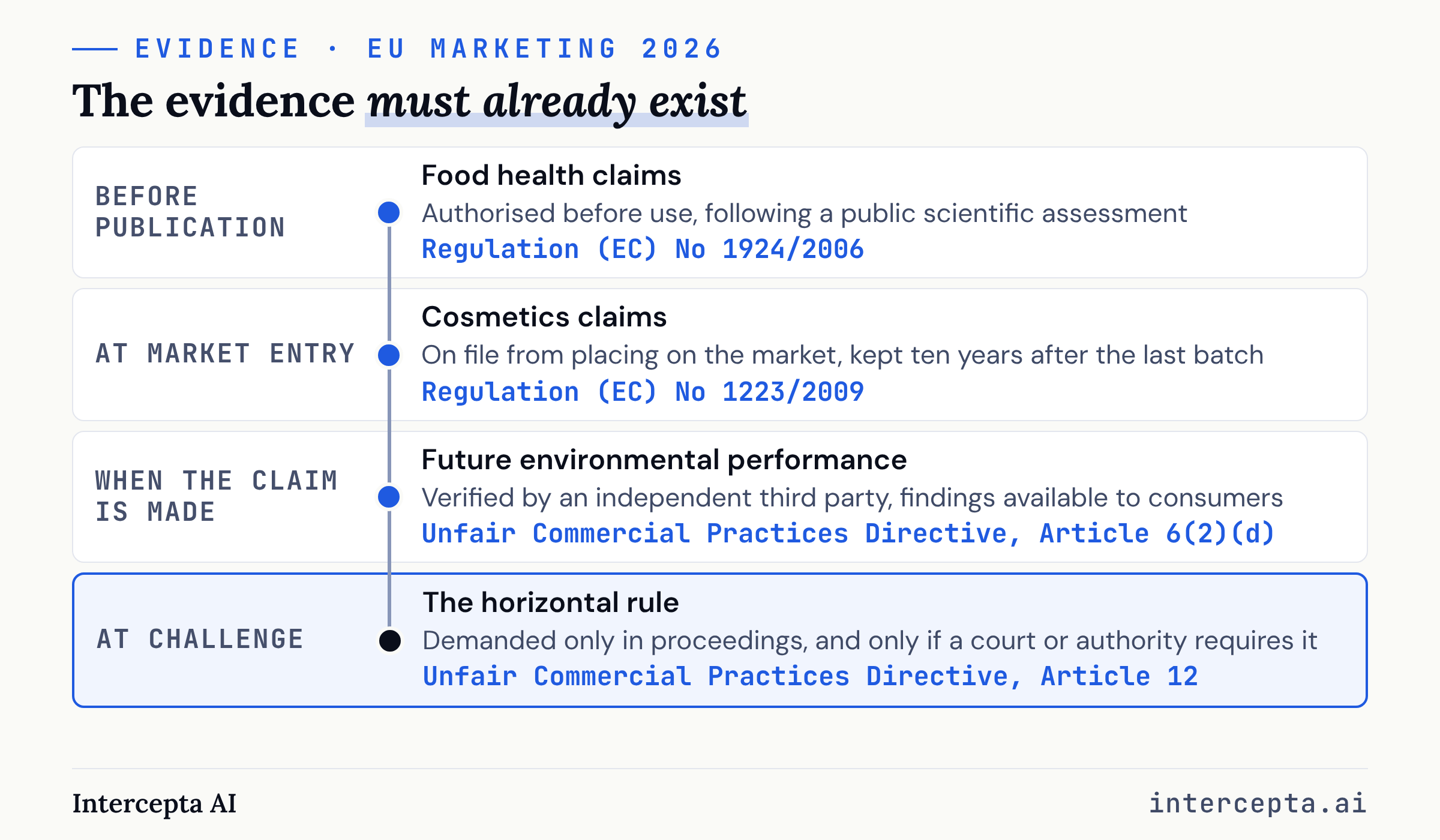
Any team that treats the horizontal timing as its deadline for a health claim on a food or an efficacy claim on a cosmetic is exposed from market entry, because the authorisation was due before publication, or the evidence at market entry, not at the point of challenge.
Financial services is a further sector this piece does not address. The horizontal rules apply to financial-services marketing as they do to any sector, subject to the Unfair Commercial Practices Directive’s Article 3(9), which allows Member States to impose stricter national rules for it. Its own sectoral rules, from the Markets in Financial Instruments Directive (MiFID II) to the new Consumer Credit Directive that applies from 20 November 2026, follow separate timetables.
One thread connects the sectoral regimes and the dated instruments. Both apply the same benchmark, a person reasonably well-informed, observant and circumspect, though each qualifies that person differently. The cosmetics criteria judge a claim by how it reads to the "average end user", while the AI Act excuses disclosure where an AI interaction is already obvious to a "natural person". The same question is stated in two instruments, eleven years apart and addressing entirely different subject matter. The question is what a reasonably observant reader would take from the content as published, and none of the dates changes it.
Evidence, presentation and provenance
Three questions are common to marketing compliance in every market, and the European Union instruments of 2026 divide neatly between them. Article 50 governs provenance, which is where the content originated and whether the reader has been told. The Empowering Consumers Directive governs evidence, and it does so in more than one way. Under point 4c, no amount of evidence makes a claim lawful where it asserts a neutral, reduced or positive environmental impact on the basis of offsetting. Under point 4a, a generic environmental claim is lawful only where the trader can demonstrate recognised excellent environmental performance, which the Directive ties to the EU Ecolabel, to officially recognised type I ecolabelling schemes, or to top environmental performance under other applicable Union law, rather than to evidence a trader assembles. The Digital Fairness Act, if it applies in the announced form, will govern presentation, which is how an offer is framed and whether the commercial relationship behind it is apparent. The Green Claims Directive would have governed evidence earlier and more strictly, but it has not become law.
The timing differs in each case, and none of it waits for a marketing team to be ready. Article 50 applied on 2 August 2026, with the marking duty on systems already on the market deferred to 2 December 2026, and its disclosure duties attaching to in-scope content published from 2 August 2026. The Empowering Consumers Directive reaches packaging printed and shelved well before 27 September 2026. Under the national measures transposing Article 12 of the Unfair Commercial Practices Directive, a court or an authority may put a trader to proof once proceedings have begun, about an asset already in the market. Each date is the point from which content is measured against a new standard.
An obligation that attaches at publication and then persists is the substance of Intercepta AI’s analysis of compliance debt, and the European year is a worked example of it. An asset validated against the rules in force on the day it was published is not validated against the rules in force today, and the rules change twice in the course of this year, with a further change announced for the fourth quarter.
The practical consequence is a discipline in two parts rather than a date in a diary. Content is validated against every regime that reaches it before publication, and validated again while it stays live, because the standard it was cleared against is not the standard by which it will be judged. One test recurs across most of it, stated in the cosmetics common criteria and in Article 50 alike, which is what a reasonably observant reader would take from the content as published. The blacklist points are the exception, because they apply whatever the reader would take from the claim. The dates change who applies this test, and when. The test itself is constant.
Validation does not pause between the dates
The test does not change, but a company must satisfy it claim by claim, which is what makes the year a standing task rather than a row of deadlines. The instrument that reads most like a deadline, the Digital Fairness Act, is the one that does not yet exist, so the obligations to organise around are the ones already in force.
For marketing teams, the task is concrete. It is to know, for every claim, which instrument governs it, in which market, and at which moment the evidence has to exist. A claim that is compliant in one Member State can be exposed in another, and an asset that was lawful when it was published can remain subject to an obligation that persists while the content remains live.
One caveat matters here. The rules mapped in this piece are European Union-level instruments, and the analysis works at that level. It does not extend to how each Member State has transposed them, or which national authority enforces first.
Try Intercepta AI
Intercepta AI validates marketing content, draft or already published, against more than 1,100 regulatory rules across the United States, United Kingdom, European Union, Canada, Australia and New Zealand, surfacing the claims that carry a compliance obligation and mapping each to the rule that governs it, for the compliance team to review. European Union coverage is at Union level and does not yet extend to national transposition.
Cross-references
- For the provenance layer and the common 2 August date, see the analysis of the California AI Transparency Act.
- For the closest state-level analogue to the Article 50 deepfake duty, see the analysis of New York’s synthetic performer disclosure law.
- For the substantiation route regulators took before the blacklist, see the analysis of the Advertising Standards Authority rulings of 15 July 2026.
- For the presentation axis the Digital Fairness Act takes up at Union level, see the analysis of hidden advertising.
- For the obligation that attaches at publication and then persists, see the analysis of compliance debt.
Sources
European Union instruments
- Regulation (EU) 2024/1689 (Artificial Intelligence Act), Articles 50 and 99.
- Directive (EU) 2024/825 on empowering consumers for the green transition, amending Directives 2005/29/EC and 2011/83/EU.
- Directive 2005/29/EC (Unfair Commercial Practices Directive), Articles 3(9), 7(2) and 12, and Annex I points 2a, 4a and 4c; consolidated text as applicable from 27 September 2026 (CELEX 02005L0029-20260927).
- Regulation (EC) No 1924/2006 on nutrition and health claims made on foods, Articles 2(2)(7), 10(1) and 16.
- Commission Regulation (EU) No 655/2013 laying down common criteria for the justification of claims used in relation to cosmetic products, Annex.
- Regulation (EC) No 1223/2009 on cosmetic products, Article 11 (product information file).
- Directive 2001/83/EC on the Community code relating to medicinal products for human use, Article 88(1), as substituted by Directive 2004/27/EC.
- Directive 2014/65/EU on markets in financial instruments (MiFID II).
- Directive (EU) 2023/2225 on credit agreements for consumers (Consumer Credit Directive), repealing Directive 2008/48/EC, Article 48 (measures apply from 20 November 2026).
- Regulation (EU) 2017/2394 on consumer protection cooperation.
European Commission guidance and questions and answers
- European Commission, Guidelines on transparency obligations for providers and deployers of certain AI systems (final, 20 July 2026).
- European Commission, Code of Practice on Transparency of AI-generated Content (final, 10 June 2026).
- European Commission, opinion on the assessment of the Code of Practice on Transparency of AI-generated Content (9 July 2026).
- European Commission, questions and answers on the transparency obligations under Article 50 of the AI Act (updated 24 July 2026).
- European Commission, Commission starts enforcing AI Act rules and new transparency requirements on 2 August (press release, 31 July 2026).
- European Commission, Directorate-General for Justice and Consumers, questions and answers on the Directive on empowering consumers for the green transition (June 2026, updated with the Consumer Protection Cooperation Network common understanding on old stock).
- European Commission, sustainable consumption pages, covering the adoption, transposition and application dates of Directive (EU) 2024/825.
- European Commission, Consumer Protection Cooperation Network.
- European Commission, Unfair Commercial Practices Directive pages, and the 2021 Commission Notice on its interpretation and application.
- European Commission, Nutrition and Health Claims, and the EU Register of Nutrition and Health Claims.
- European Commission, infringement package of 28 May 2026, Commission takes action to ensure complete and timely transposition of EU directives, letters of formal notice to 20 member states over Directive (EU) 2024/825.
Legislative records
- European Commission work programme 2026, COM(2025) 870, adopted 21 October 2025.
- European Parliament, Legislative Train Schedule, Digital Fairness Act.
- European Parliament, Legislative Train Schedule, Substantiating and communicating green claims.
- European Parliament, Legislative Observatory, procedure file 2023/0085(COD), Green Claims Directive.
- European Commission, proposal for a directive on substantiation and communication of explicit environmental claims, COM(2023) 166, 22 March 2023.
- European Commission, public consultation on the Digital Fairness Act, Have Your Say initiative 14622.
- European Parliament resolution of 12 December 2023 on addictive design of online services and consumer protection in the EU single market, 2023/2043(INI).
- Council of the European Union, conclusions on support for influencers as online content creators, 14 May 2024.
Regulator rulings
- Advertising Standards Authority (United Kingdom), rulings published 15 July 2026 concerning airline environmental claims, CAP Code (Edition 12) rules 3.1, 3.7, 11.1 and 11.3. Carried anonymised under house policy through the published Intercepta AI analysis.