On one day, the Advertising Standards Authority upheld findings against companies in three sectors, two of them inside its ongoing work on weight-loss promotion. Each breach was different, and in each case a company had wrongly assumed that a particular audience, channel, or format was outside the rules.
On 15 July 2026, the Advertising Standards Authority (ASA) published a run of rulings that, read together, mark how far the reach of marketing regulation now extends. Among them, the ASA ruled against companies in three sectors, air travel, a digital pharmacy, and health supplements. One advertiser could not substantiate an environmental claim. Another promoted prescription-only medicines to the public. A third presented a supplement as a medicine. Two of the three belong to the ASA's sustained enforcement on weight-loss promotion, and the third to a separate line of work on aviation green claims. A single assumption runs through all three, one each company had made.
A specialist audience did not lower the bar
The first advertiser had told customers they could offset the carbon emissions of their flights, in one case up to all of them. A claim like that carries a high bar, because offsetting is contested ground. Paying into a scheme that funds carbon savings elsewhere is not the same as removing the emissions a particular flight has already produced. A promise to offset a specific flight must therefore be backed by evidence that the emissions from that flight are actually neutralised, and the more absolute the wording, the stronger that evidence must be. The ASA found the claims misleading and held two airlines to the same standard of proof that day.
One of the two airlines had a programme to point to and did so. It offered an offsetting scheme developed with an industry body, its carbon credits verified and used only once. The ASA accepted that the scheme existed and operated. The evidence did not show that the emissions from any specific flight a customer had booked would be fully offset through it, or that the flight's environmental impact was reduced at all. Proof that an offsetting programme runs is not proof that a given flight has been neutralised, and neutralising the flight was what the advertising had promised.
The same airline pushed for a narrower reading of who its adverts were for. It had run a LinkedIn campaign that was aimed at business professionals who, it argued, understood carbon offsetting well enough to be judged by a more informed standard. The ASA did not accept the argument. Non-specialists could see the same adverts, so the claim had to hold for everyone who did. The audience a company pictures does not set the standard its claim is measured against.
The advert copy did not break the rules. The page behind it did.
The second advertiser was a digital pharmacy. Prescription-only medicines must not be advertised to the public. The rule keeps the decision to use them with a prescriber rather than with marketing. Its advert stayed clear of that line, or seemed to. It promoted a weight-management service, named a monthly price, referred to clinical support, and named no medicine.
The breach was further on, in the pages behind the advert. Clicking the advert did not lead straight to the medicine. It opened an intermediate page that asked the reader to choose between two routes, and each route led to a landing page that named specific prescription-only weight-loss medicines. The advertiser's defence rested on that structure. It argued the medicine lay behind a series of deliberate choices rather than a single click, so a casual browser would not reach it by accident.
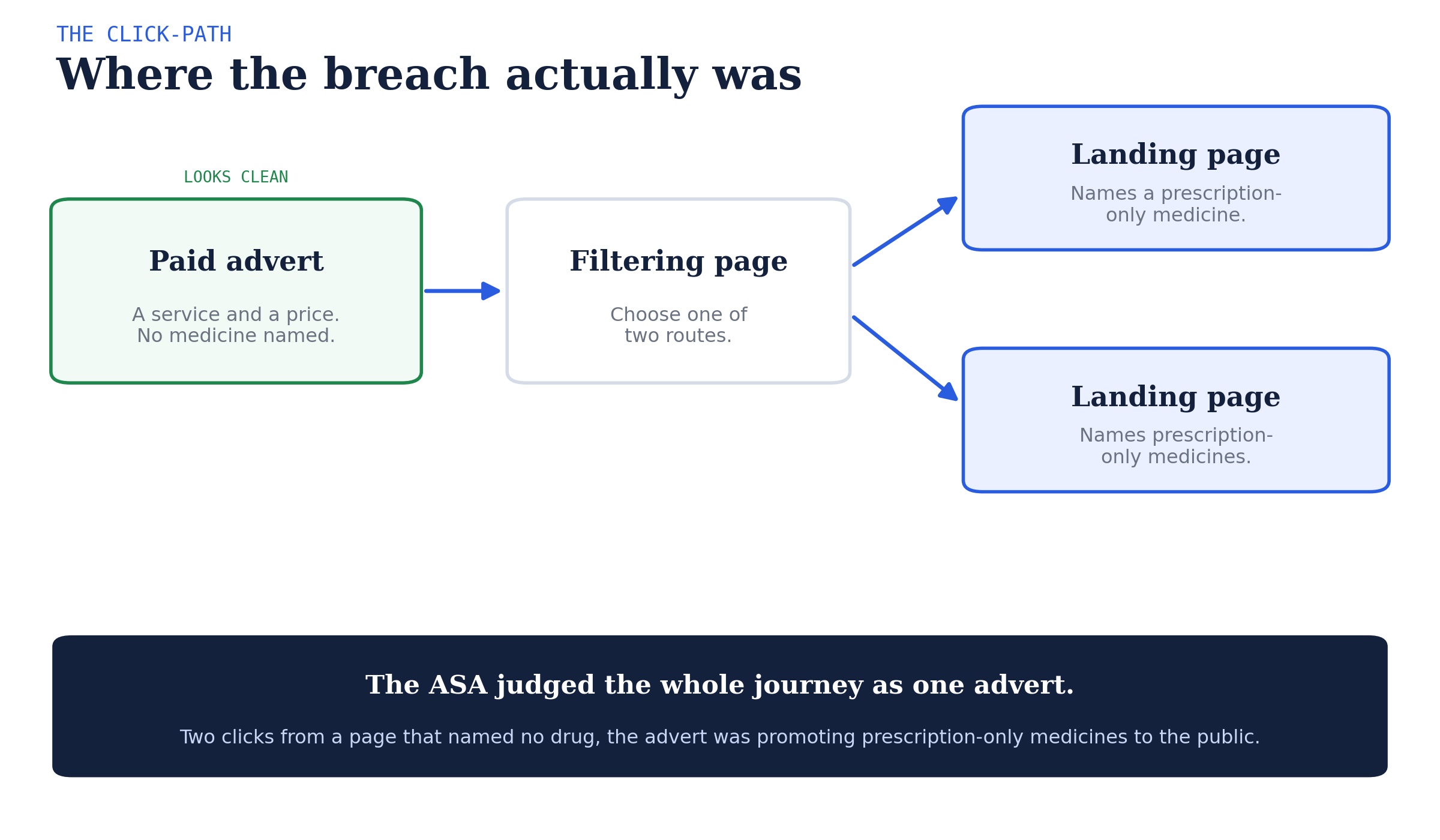
The ASA did not treat the destination as separate from the advert. Guidance from the Medicines and Healthcare products Regulatory Agency (MHRA), which the ASA applied, holds that a website home page should focus on the condition and the service, and must not name specific prescription-only medicines. Deeper pages a consumer chooses to open may carry non-promotional information about particular medicines, but only as part of a fair overview of the treatment options. The ASA reasoned that a landing page reached from a paid advert works like that home page, and these pages did not read as a neutral overview. They named the medicines, and the ASA, after taking advice from the MHRA that the advert was likely to lead someone to use a prescription-only medicine, concluded that the advert as a whole promoted those medicines to the public. Two clicks from an advert that named no drug, the advertiser was promoting one. The complaint was upheld.
The advert sold a supplement as though it were a prescription drug
The third advertiser sold a supplement, in the form of a patch. The problem was that its advertising presented the patch as working in the same way as a prescription-only weight-loss injection. Under the rules, a product becomes a medicine not only by what it contains but by how it is presented. If advertising makes a product read as equivalent to a licensed medicine, it is treated as a medicine for the purposes of the rules, and a medicine may not be marketed at all without MHRA authorisation, which this product did not have.
Three features of the advert worked together to make the patch read like the medicine. The patch was named for the same biological pathway the injections act on, its claims spoke of controlling cravings and staying fuller for longer, and the advertising set the patch against the inconvenience of a weekly injection. The ASA read all of it as presenting the supplement as equivalent to the prescription medicine, and so as a medicinal claim the maker was not authorised to make. The maker had not written the advert. An affiliate had produced and posted it without the maker's prior sign-off, but the maker carried the breach under the Code all the same. In its response, the maker argued the claim was never medicinal. The ASA read it as exactly that. Classification followed what the advertising said the product did, not how anyone described it afterwards.
The same advert drew a second finding. Its on-screen text addressed new mothers, and breastfeeding mothers in particular. It promoted the product to an audience the maker itself would not endorse using it without medical advice, and framed weight loss as something a new mother should be prioritising. The ASA found that the advert exploited insecurities about body image at a vulnerable time, and that it was socially irresponsible and included a harmful gender stereotype.
The common thread is reach, not technique
Set beside each other, the three rulings share no common fault. An unsubstantiated green claim, a medicine reached through a landing page, and a supplement dressed as a drug are not variations on one mistake. Two connections run through them. Behind all three is the same regulator, running more than one enforcement drive at once, weight-loss promotion in two of the cases and aviation green claims in the third. Behind all three is the same error, companies that each mistook the edge of the rules for a line further out than it was.
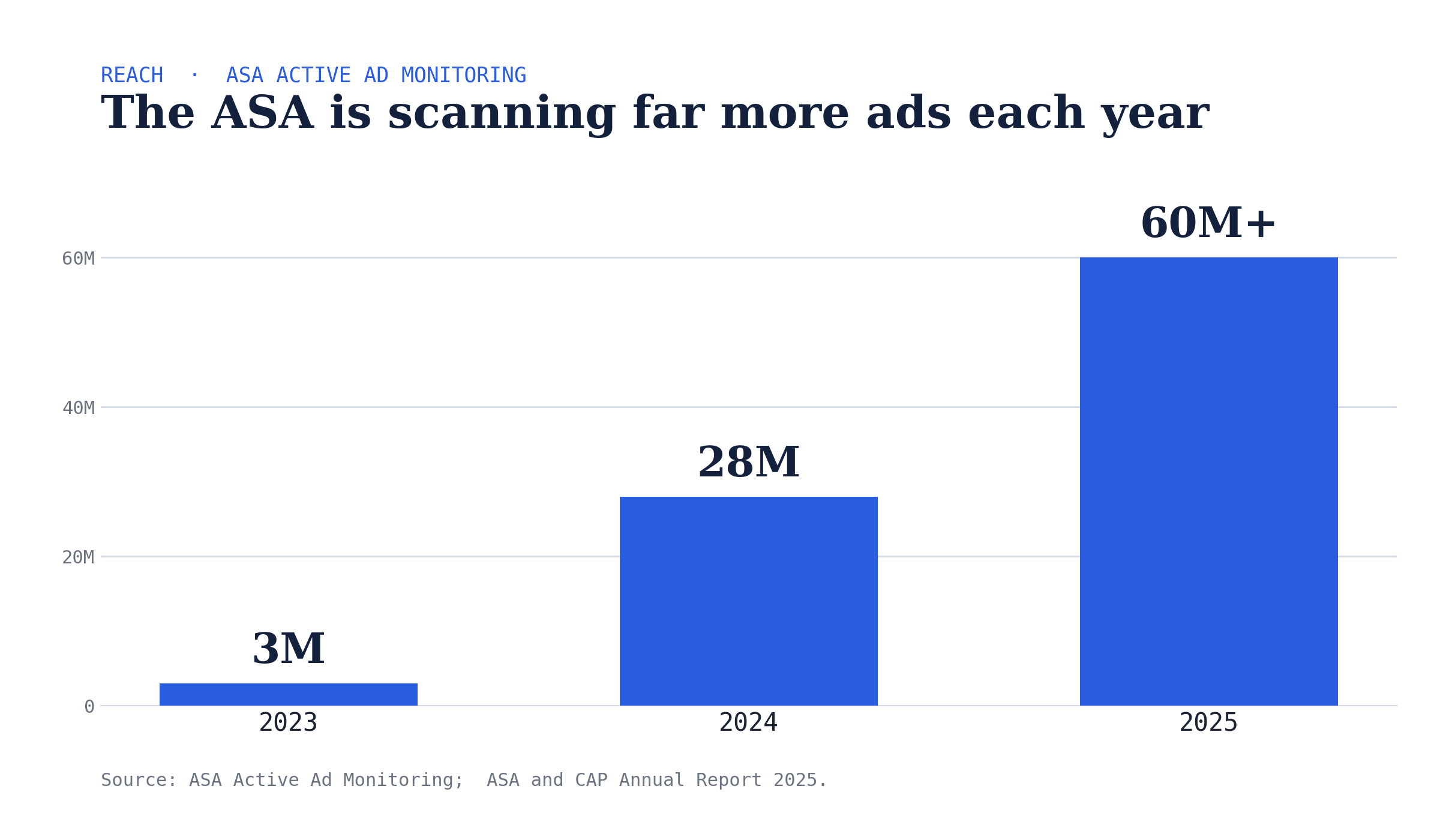
The ASA can see more than it once could. It runs an AI-based monitoring system that sweeps online advertising for claims that may breach the rules, and it has said the system now forms part of how it polices weight-loss promotion. More of what a company publishes is being read, and read sooner, than at any point before.
In each case, reading the advert copy was not enough
The ASA ruled against all three advertisers, and in each case only after the advert had run and the breach was already public. Reading the advert alone would not reveal it. The airline claims had to be tested against the evidence behind them, to a standard that rises as the wording grows more absolute. The pharmacy breach was two clicks on, in landing pages the advert copy never mentioned. The supplement breach turned on the impression the whole post created, in content the brand had never approved. A breach can be in the evidence, in the page behind the advert, or in an implication no single line states outright, and it can appear across every format a team now publishes. Generative AI has made content faster to produce, and a review that reads the advert copy alone will miss the breach.
This is where validation before publication earns its place. Validation covers each piece of marketing content, the pages it leads to, and the posts affiliates and influencers publish in the brand's name. Each is validated against the specific rules that apply, across every jurisdiction it reaches. A marketing team gets a defensible basis for release, and a compliance team gets a documented, per-rule record of what was assessed and what was found. It does not replace the compliance officer. It hands them a first pass that has already followed the links and read the destination, so their judgement goes where it is needed.
The company that assumes its channel is outside the rules is the one most likely to publish the breach that proves otherwise.
Validate before you publish. Keep the record.
Intercepta AI validates marketing content against 1,100+ regulatory rules across the United States, United Kingdom, European Union, Canada, Australia and New Zealand. A single scan covers every jurisdiction the content reaches and returns a documented report that maps each issue to the specific regulation it references, with remediation guidance for your compliance team to review. Marketing teams validate before publication. Compliance teams hold a documented regulatory record. Every decision on every finding stays with your compliance team.
AI built the content. AI should validate it before your team reviews it.
No payment method required.
Sources:
- Advertising Standards Authority, rulings published 15 July 2026 concerning environmental claims by two airlines: paid advertising stating that customers could offset the carbon emissions of their flights, in one case up to 100 per cent of a flight's emissions, was found misleading because the claims were not adequately substantiated. The argument that advertising targeted at a knowledgeable business audience on LinkedIn justified a lighter interpretation was not accepted. CAP Code (Edition 12) rules 3.1 (Misleading advertising), 3.7 (Substantiation), 11.1 and 11.3 (Environmental claims).
- Advertising Standards Authority, ruling published 15 July 2026 concerning a digital pharmacy: a paid social advertisement for a weight-management service that named no medicine was found to promote prescription-only medicines to the public, because the landing pages reached from the advert referred to prescription-only medicines. The ASA applied MHRA guidance on website content and took advice from the MHRA. CAP Code (Edition 12) rule 12.12.
- Advertising Standards Authority, ruling published 15 July 2026 concerning a health supplement: advertising that implied a supplement had effects equivalent to a prescription-only weight-loss medication was found to present the product as an unauthorised medicinal product (CAP Code rules 12.1 and 12.11), and was separately found socially irresponsible and to contain a harmful gender stereotype (CAP Code rules 1.3 and 4.9).
- Advertising Standards Authority, Active Ad Monitoring: an artificial-intelligence-based system used by the ASA to identify online advertising that may breach the advertising rules, cited by the regulator as part of its enforcement in areas including weight-loss prescription-medicine advertising.