The fourth Marketing Rule Risk Alert covers whether disclosure is present and prominent, and whether the firm can show why it believed the content complied.
In December 2025, the examination staff at the Securities and Exchange Commission (SEC) set out where advisers did not appear to comply with the Marketing Rule on testimonials, endorsements, and third-party ratings. These findings matter to SEC-registered investment advisers, and to the compliance and marketing teams responsible for content, such as an influencer link that points clients to the firm, a rating badge on the homepage, or a client review reposted from another site. The cost is already real. In September 2024, the Commission settled with nine advisers over marketing that did not comply, for combined penalties of $1,240,000.
The findings appear in a Risk Alert, ‘Additional Observations Regarding Advisers’ Compliance with the Advisers Act Marketing Rule,’ issued on 16 December 2025 by the Division of Examinations. It creates no new obligations, because it is examination staff describing what they found rather than a new rule or a decision by the Commission itself. The underlying Marketing Rule has applied since November 2022, and this is the fourth Risk Alert the Division has published on it. The first two, in September 2022 and June 2023, set out the areas staff intended to examine. The two since, the April 2024 alert and this one, report what staff observed. The alert covers two provisions, the Testimonials and Endorsements Provisions under Rule 206(4)-1(b) and the Third-Party Ratings Provisions under Rule 206(4)-1(c).
The rule underlying the alert
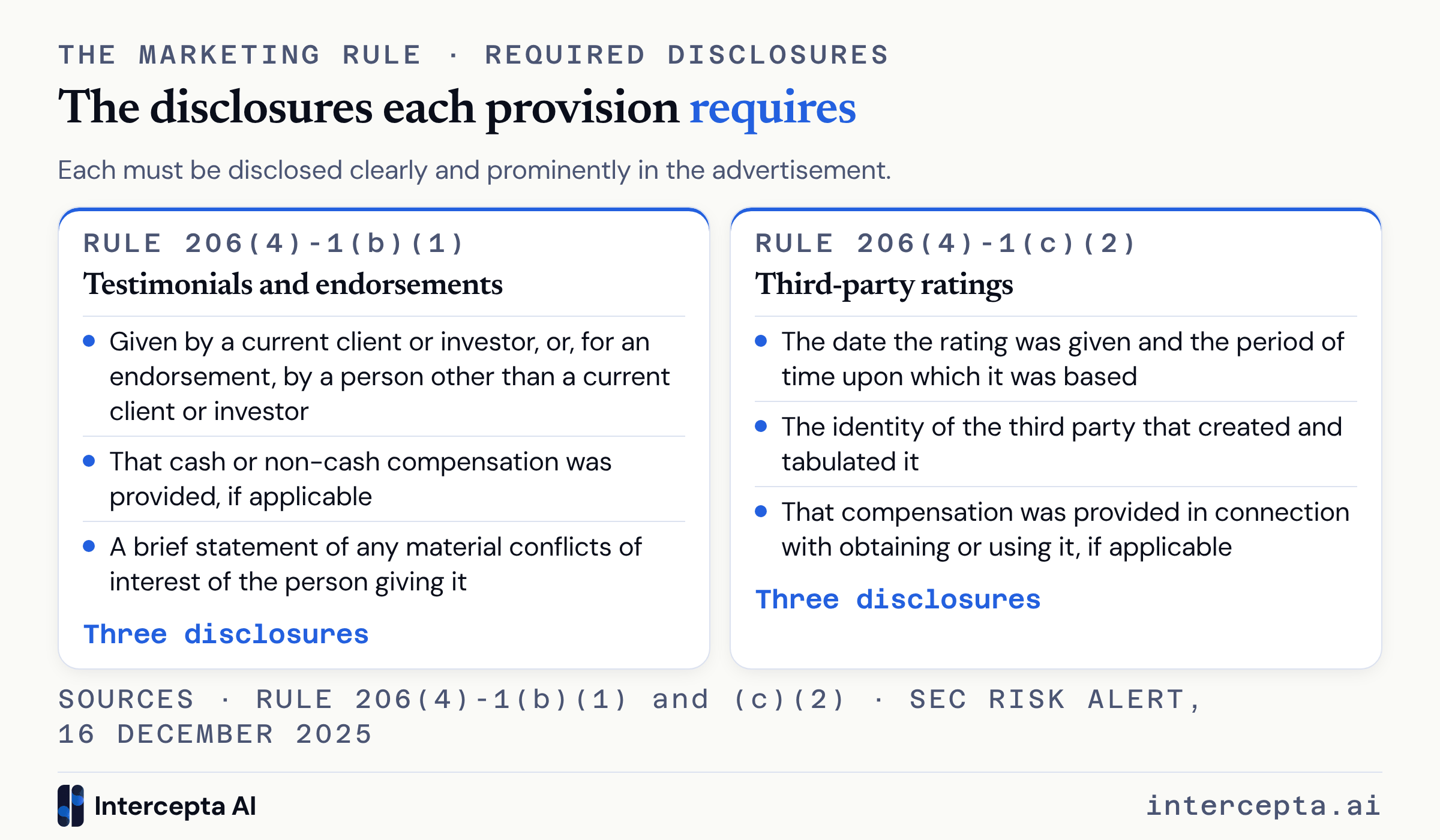
In December 2020, the SEC adopted the Marketing Rule, officially Rule 206(4)-1 under the Investment Advisers Act of 1940. Advisers had to start following it by November 2022. Two of its provisions are in scope here, one for testimonials and endorsements, the other for third-party ratings. An adviser can only use a testimonial or endorsement in an advertisement if the arrangement is properly overseen, and it cannot pay anyone made ineligible by past legal or regulatory problems to provide one. Under Rule 206(4)-1(b)(1), the advertisement must clearly and prominently disclose ‘that the testimonial was given by a current client or investor, and the endorsement was given by a person other than a current client or investor’, ‘that cash or non-cash compensation was provided for the testimonial or endorsement’, and ‘a brief statement of any material conflicts of interest on the part of the person giving the testimonial or endorsement’. For a third-party rating, the adviser needs good reason to believe the survey or questionnaire used to prepare it was built fairly. Under Rule 206(4)-1(c)(2), the advertisement must clearly and prominently disclose ‘the date on which the rating was given and the period of time upon which the rating was based’, ‘the identity of the third party that created and tabulated the rating’, and, where applicable, ‘that compensation has been provided directly or indirectly by the adviser in connection with obtaining or using the third-party rating’.
Both of those rules turn on the same phrase, a reasonable basis for belief. A separate rule requires the adviser to document that reasonable basis. Rule 204-2(a)(15)(ii), part of what is called the Books and Records Rule, says an adviser has to keep documentation substantiating it had that reasonable basis, both that a testimonial or endorsement complies with Rule 206(4)-1 and that a third-party rating complies with Rule 206(4)-1(c)(1), in the same sentence of the rule. In other words, the adviser has to be able to show why it was satisfied the content complied with the rule.
Testimonials and endorsements were published without the required disclosures
The most common problem staff found was that advisers published testimonials and endorsements without the required disclosures in place. The alert lists several ways this happened. Some advisers put the disclosure behind a hyperlink, which the SEC has already stated does not meet the clear and prominent standard, since a disclosure must be within the testimonial or endorsement itself. Others used a font for the disclosure that was smaller or lighter than the testimonial it was attached to, making it easy to miss. Some copied client reviews from third-party websites onto their own site without saying the reviewer was a current or former client. Some paid clients in gift cards to leave reviews elsewhere, without appearing to have a basis for believing those reviews carried the disclosures a paid testimonial requires.
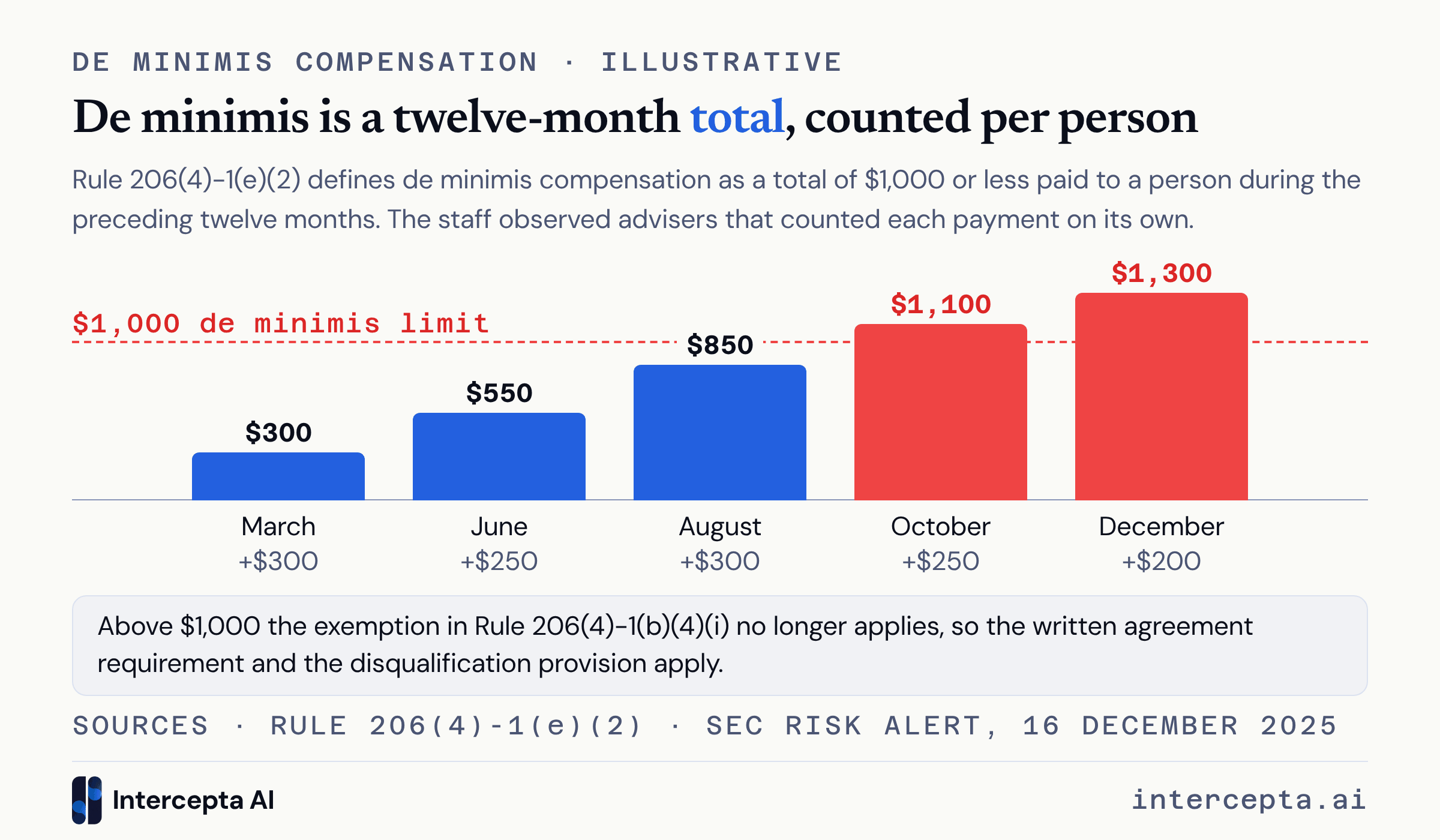
The alert points to lead-generation firms, social media influencers, adviser referral networks, and refer-a-friend schemes that offer clients small amounts of compensation, plus advertisements run through an adviser’s separate trading names. Some advisers did not realise these arrangements counted as a testimonial or endorsement. The rule treats very small payments as de minimis compensation, which relieves the adviser of certain requirements, including the written agreement, but only where the total paid to the same person is $1,000 or less across the preceding twelve months. Some advisers miscounted, treating each individual payment as exempt without adding up what that person was paid over the preceding twelve months, which in some cases pushed the true total over the line.
Staff observed advisers who could not show they had a reasonable basis for believing an endorsement complied, because their policies, their written agreements with promoters, or their other records did not establish that basis. Some advisers had no written agreement with paid promoters at all. Others had an agreement, but it did not fully describe what the promotion involved or how the person was being paid.
The alert flags two further problems specific to endorsements. The Marketing Rule bars advisers from paying certain people to provide them at all, people made ineligible by their disciplinary histories, and staff observed advisers who compensated promoters they knew or should have known were disqualified by state securities regulators. Staff also found advisers whose promoters were connected to the firm itself, where that affiliation was not apparent when the endorsement was disseminated and became known only later, as a prospective client was being introduced to the adviser. The rule exempts an affiliated promoter from parts of the disclosure and agreement requirements, but only where the connection is clear at the point the endorsement is disseminated.
Third-party ratings needed evidence of due diligence
The rule on third-party ratings has its own due diligence requirement. Before using a rating, an adviser needs good reason to believe the survey or questionnaire used to prepare it was built fairly, meaning it was just as easy to give a bad answer as a good one, and was not designed to produce a predetermined outcome. The alert describes three ways advisers typically carried out that diligence. First, they reviewed publicly disclosed information about the rating provider’s methodology. Second, they obtained a copy of the actual questionnaire or survey used. Third, they secured representations from the rating provider about how it was designed, structured, and administered.
The advisers that did not appear to have enough information to form a reasonable basis had generally neither adopted policies and procedures for this diligence nor taken other steps to meet the requirement, such as obtaining or reviewing a copy of the questionnaire or survey. A separate group of problems was about disclosure rather than due diligence. Some ratings were shown without saying what date or period they covered, sometimes even referencing a year in which the adviser had not won the award. Some rating logos did not make clear who had created and calculated them. Payments to rating providers, for using their logo, for better placement, or for referral links, were not disclosed where the ratings themselves appeared.
The pattern across both provisions
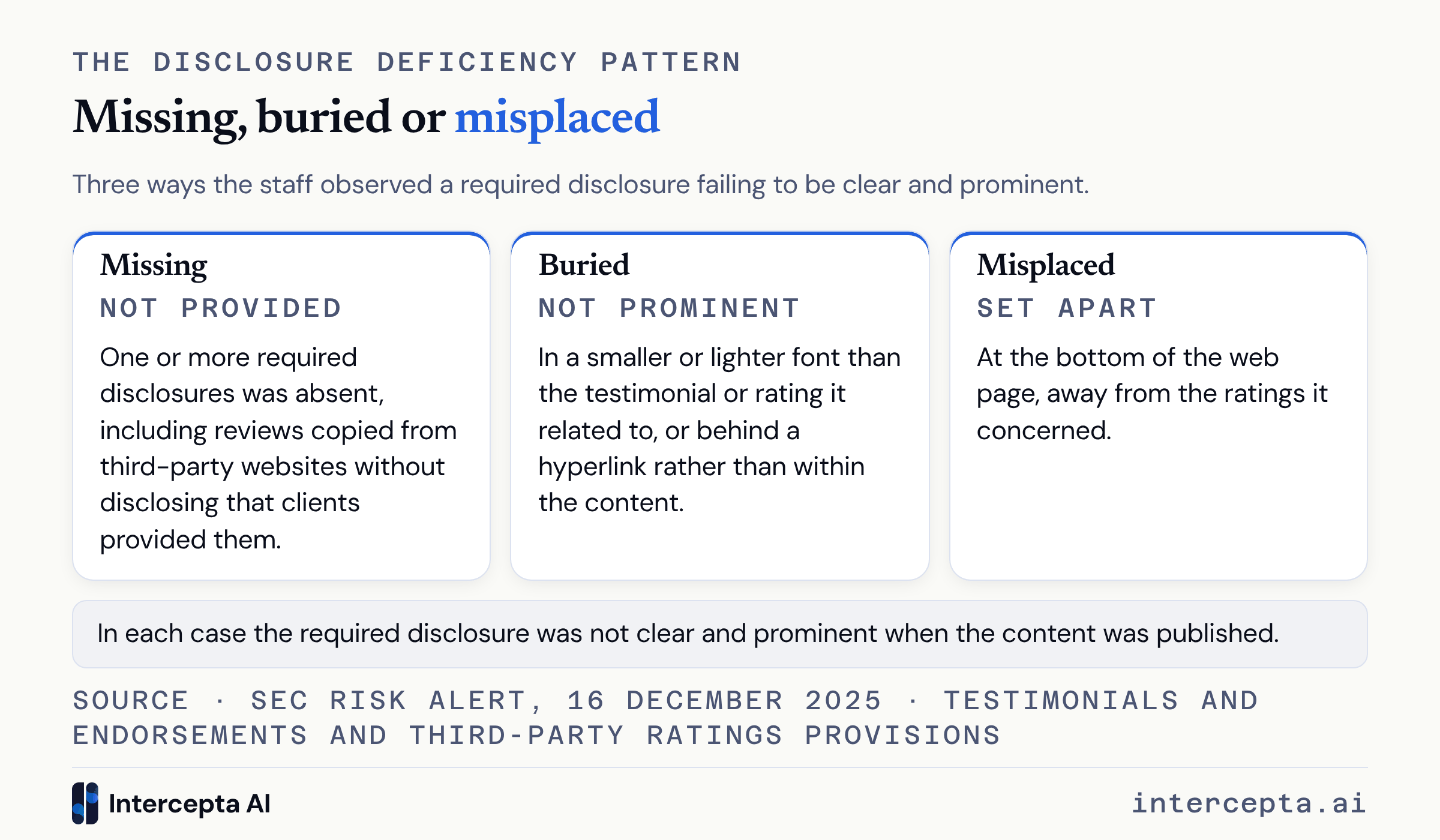
Across testimonials, endorsements, and ratings, the disclosure deficiencies share a common pattern. The required disclosures were missing, buried, or placed away from the content they should accompany, at the point it was published. A disclosure was behind a hyperlink, or in a lighter font, or was absent from a review copied off another site. A promoter’s connection to the firm became known only after the endorsement was published. A rating had no date, or a logo that did not say who produced it, or a payment that went undisclosed. In each case, the disclosure the rule requires was not present and prominent when the content was published.
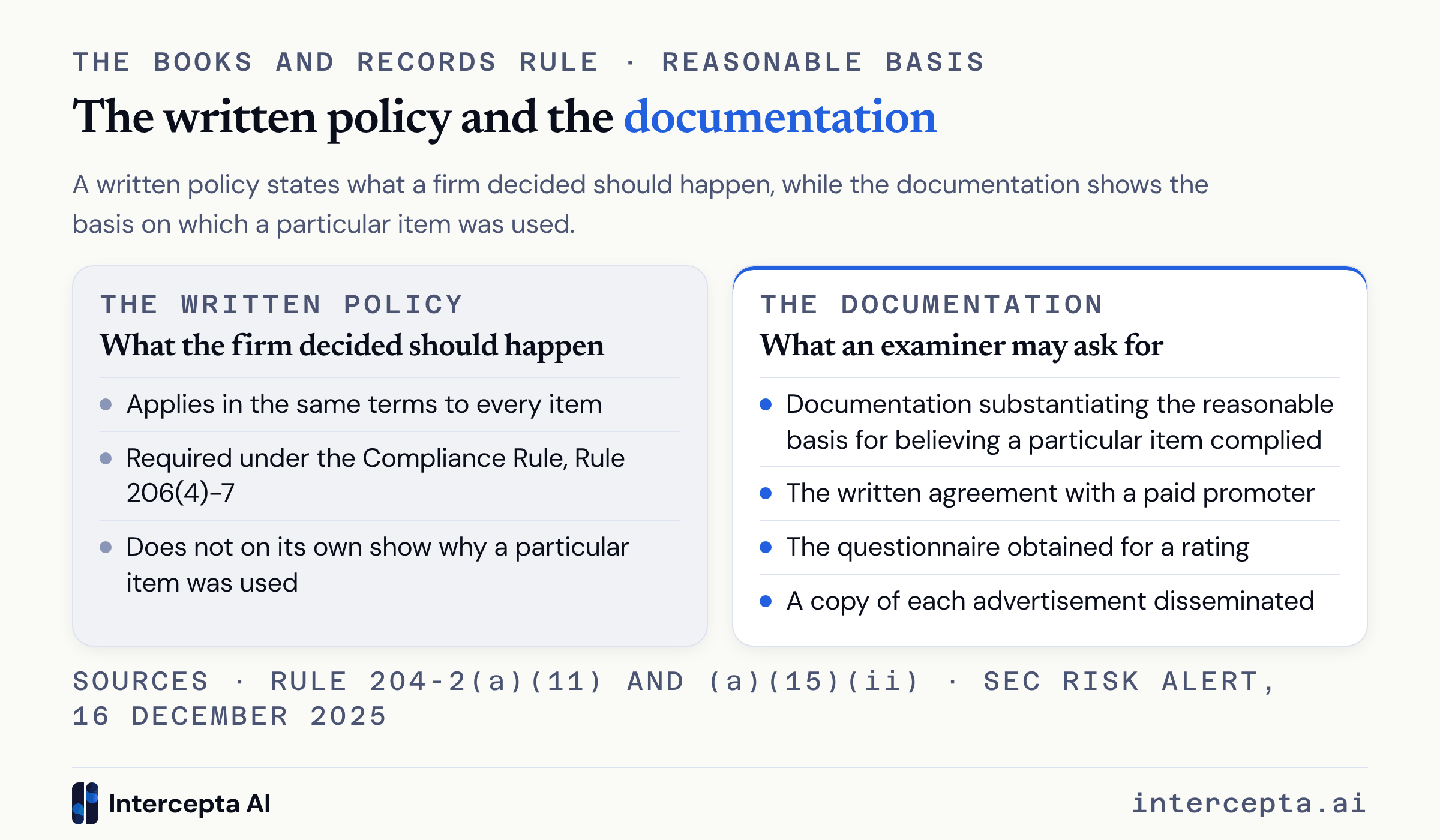
The alert addresses a second, less visible problem for both provisions, namely what the adviser can show about its own basis for using the content. Rule 204-2(a)(15)(ii), part of the Books and Records Rule, requires an adviser to make and keep documentation substantiating its reasonable basis for believing a testimonial, endorsement, or rating complied. The staff observed advisers that could not demonstrate that basis for their testimonials and endorsements, because their policies, their written agreements with promoters or their other documentation did not establish it, and advisers that did not appear to have enough information about the questionnaires behind third-party ratings to form one. A written policy states what a firm decided should happen, while the documentation shows the basis on which a particular item was used.
Two of the alert’s findings, seen earlier, are not about the content at all. Paying an ineligible promoter is a question of who a firm compensates. The due diligence a rating requires is met by vetting the survey behind it. Both fall within the compliance team’s remit, and neither is settled by solely validating the content itself.
What firms can do now, since the rule already applies
There is no rulemaking here to comment on, and no deadline attached to this alert, because none of it is new. This is the second time since November 2022 that staff have published their observations under the rule. As the nine advisers penalised in September 2024 show, the exposure is already real.
The obligation itself has not changed. The variable is what a firm can be asked to produce, at any point after a testimonial is published or a rating gets used, and how quickly it can produce it. The practical response is to treat every testimonial, endorsement, and third-party rating as something that generates its own record at the point it is used, tied to the specific provision it falls under.
In practice, that record does not need to be complicated. For a testimonial or endorsement, it would reasonably include the date the content was published, the exact disclosure text used, and confirmation that the disclosure was within the testimonial itself, not behind a hyperlink, in a smaller font, or added afterward. For a third-party rating, the due diligence side, which of the three methods was used, and the questionnaire copy or provider representation behind it, is a separate record, kept wherever that diligence is actually carried out. Both share the same discipline, creating the record at the point content is published, rather than pointing to a policy after the fact.
Why this matters, for marketing and for compliance
For a marketing team, the deficiencies in the alert are matters of execution. They concern how a disclosure was presented, its size, its placement, whether a reposted review was labelled at all, and these choices are the responsibility of marketing rather than legal. Compliance of content depends heavily on how marketing produces and publishes it. An otherwise sound testimonial or rating can fail on a single formatting decision. The rule requires the disclosure to be clear and prominent within the content itself when the item is published. Once such an item is published without that disclosure, it is already deficient.
For a compliance team, a risk alert from the Division of Examinations is a signal of where examiners are looking. In an examination, the question is what the firm can produce on request. Rule 204-2 requires a copy of each advertisement the adviser disseminated, a record of any required disclosure that was not included in the advertisement itself, and the documentation substantiating the adviser’s reasonable basis for believing that a particular testimonial, endorsement or rating complied. A firm that can describe its process but cannot produce those records for a particular item is in the position the staff described for advisers unable to demonstrate their reasonable basis. The compliance team must ensure they can produce the records when examiners ask for them.
Before you publish
Pre-publication validation of testimonials, endorsements, and ratings produces a per-item record of whether the required disclosures were present and prominent in each item before publication.
Intercepta AI validates marketing content against more than 1,100 regulatory rules across the United States, United Kingdom, European Union, Canada, Australia and New Zealand, surfacing the claims that carry a compliance obligation and mapping each to the rule that governs it, for the compliance team to review. The decision on every finding stays with them.
Sources
- SEC Division of Examinations, Risk Alert, ‘Additional Observations Regarding Advisers’ Compliance with the Advisers Act Marketing Rule’ (16 December 2025).
- SEC Division of Examinations, Risk Alert, ‘Initial Observations Regarding Advisers Act Marketing Rule Compliance’ (17 April 2024).
- SEC Division of Examinations, Risk Alert, ‘Examinations Focused on Additional Areas of the Adviser Marketing Rule’ (8 June 2023).
- SEC Division of Examinations, Risk Alert, ‘Examinations Focused on the New Investment Adviser Marketing Rule’ (19 September 2022).
- Advisers Act Rule 206(4)-1 (the Marketing Rule); Investment Adviser Marketing, Advisers Act Release No. 5653 (22 December 2020).
- Advisers Act Rule 204-2(a)(15)(ii) (Books and Records Rule).
- Advisers Act Rule 206(4)-7 (Compliance Rule).
- SEC Press Release 2024-121, ‘SEC Charges Nine Investment Advisers in Ongoing Sweep into Marketing Rule Violations’ (9 September 2024).