Employee advocacy is sold to marketing as amplification. Marketing writes one post and employees publish it to their personal accounts. The scripted origin is what triggers the regulatory obligations, because the post can be attributed to the firm and the employment relationship must be disclosed. The reach and the exposure come from the same design.
Employee advocacy, named and current
Employee advocacy turns a company’s workforce into a distribution channel, with employees sharing the company’s marketing content from their own social media accounts. It is valuable precisely because it is scalable. One post, written once, is published across many employee accounts and reaches audiences a brand page cannot.
In regulated industries, the practice is already established and the architecture is visible. The Bank of Montreal built compliance into the programme itself. Single Sign On and Active Directory integration automatically redirect regulated employees and sales teams into separate specialised programmes, while the broader workforce shares pre-approved content in two clicks through an integration with BMO’s SharePoint intranet. According to trade coverage, BMO consolidated its social media operations onto a single platform in 2019.
The same design recurs across sectors. J.P. Morgan runs Corporate and Investment Bank Ambassador programmes on LinkedIn through a Global Social Media team, which maintains editorial content calendars, publishes on ambassadors’ behalf, and secures approvals under the firm’s employee social media policy. In healthcare, DaVita fields more than 200 LinkedIn ambassadors sharing pre-approved recruitment and culture content, and athenahealth has run a gamified Sociabble programme rewarding employees for resharing brand content, with the platform’s case study reporting 1,900 global roles filled over the period it ran alongside a brand-refresh campaign. American Family Insurance, in a regulated industry, set up a fixed disclosure hashtag in its advocacy programme for employees to carry on their posts. State Farm takes the opposite approach, with roughly 19,000 independent-contractor agents nationally, many of whom maintain a social media presence under the State Farm name rather than run through a single scripted programme.
The exposure is equivalent in outcome, because the firm’s supervision obligation follows both the scripted post and the agent who posts under its name. The pattern reaches consumer brands too. Gap Inc. opened a cross-brand creator and advocacy programme to employees in July 2026, Walmart launched Spotlight in 2020 with about 500 salaried associates and a stated ambition to extend it across its United States workforce of roughly 1.5 million, and Starbucks, Ulta Beauty and others run programmes of their own.
The practice is real, current, cross-sector and growing, and its economics are sound. The exposure it carries is real but manageable, because it has a single point of origin. The templated post is written once, and the controls belong there, before it reaches a single account.
How employee advocacy works and why it spreads
Organic social media is the most-used content distribution channel in business-to-business (B2B) marketing, used by 89 per cent of marketers, and LinkedIn is rated the highest-value platform by 85 per cent of them (Content Marketing Institute, B2B Content Marketing: Outlook for 2025). Employee advocacy extends that distribution by turning every participant’s personal network into a channel. Marketing writes one approved post and distributes it to employees, who publish it to their own networks. The mechanic is simple and the reach is large. It is an established software category. Platforms in this space include Sprinklr, Sprout Social, Hootsuite Parliament, EveryoneSocial and Sociabble, each with clients in regulated industries.
The software makes the practice trackable. Several of these platforms advertise the ability to capture, review and archive social media activity for employees in regulated industries, built to meet the requirements of the Financial Industry Regulatory Authority (FINRA), the Securities and Exchange Commission (SEC), the Financial Conduct Authority (FCA) and others. The record-keeping exposure is a recognised, productised concern.
The pivot
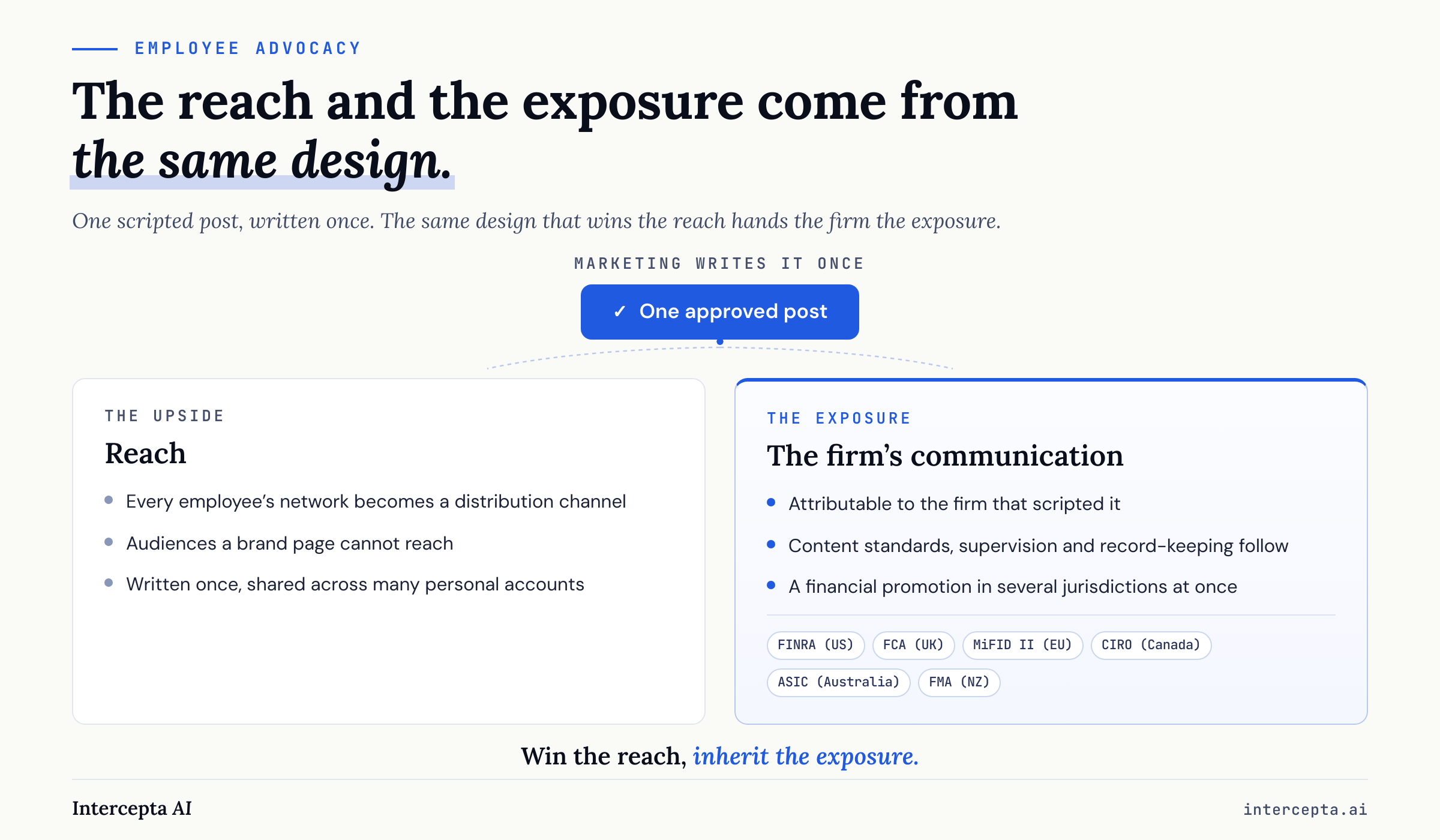
The scripted origin is where the exposure begins.
Marketing wrote the post, not the employee who published it. The words, the framing and the claims were composed centrally and distributed outward. A centrally written post distributed at scale is not the casual, unscripted content that makes attribution difficult. Under FINRA Rule 2210’s entanglement doctrine (Regulatory Notice 17-18), the FCA’s “make or cause to be made” test (FG24/1), and rules to the same effect in four further jurisdictions covered in this piece, it is the type of content regulators treat as the firm’s own.
This is the distinction that matters. A spontaneous post by an employee, written in their own words and on their own initiative, is harder for a regulator to attribute to the firm. A scripted post, written by the firm’s marketing team and pushed out through an advocacy platform, is far harder to separate from the firm. The same design choice that makes advocacy scalable is the one that makes it attributable.
The disclosure obligation that reaches every brand
One obligation reaches every employer running an advocacy programme, regardless of industry, and it applies before any rule specific to regulated financial firms.
In the United States, the Federal Trade Commission (FTC) treats the employment relationship, and any payment or commission, as a “material connection” that must be disclosed “clearly and conspicuously”. A line buried in an employee’s bio is not enough. On Instagram, the disclosure must appear above the “more” cut-off, visible without a tap. The FTC’s Endorsement Guides, codified at 16 CFR Part 255, set out this standard, and it applies to every platform and every sector.
Some firms do this deliberately. American Family Insurance built a fixed disclosure hashtag, #iWork4AmFam, into its advocacy programme so employees carry the disclosure in the post itself, visible on LinkedIn rather than tucked into a profile. A pushed-out post, by contrast, builds in nothing unless the firm deliberately does so.
For regulated financial firms, the post becomes the firm’s own communication
For a regulated financial firm whose content promotes a regulated product, the exposure is not limited to disclosure. The firm’s content standards, supervision obligations and record-keeping requirements now follow the post.
In the United States, FINRA Rule 2210 makes firm-prepared content the firm’s own communication. A firm-scripted post an associated person distributes is directly the firm’s retail communication, because an associated person’s business communications are the firm’s. The same applies to a third party such as an influencer or affiliate, because content a firm helped prepare becomes the firm’s own under the entanglement doctrine. This is the standard set out in Regulatory Notice 17-18 and traced to Notice 10-06 on blogs and social networking sites. Either way, the post carries content standards, supervision requirements and record-keeping obligations. The content standards require it to be fair and balanced and to give a sound basis for evaluating the facts about the security or service. A centrally written, platform-distributed post is a strong indicator of entanglement, though the determination turns on the specific facts.
In the United Kingdom, the FCA’s financial promotions regime, updated in FG24/1 (March 2024, replacing FG15/4) and technology-neutral, makes firms responsible for the compliance of every promotion they “make or cause to be made”, and applies the same framework to influencer arrangements, affiliate marketing and employee sharing. If a firm prepares the content and an employee or affiliate distributes it, the firm has caused the promotion to be made, and every promotion must then be identifiable as such, fair, clear and not misleading, with appropriate risk warnings, within the character constraints of the format. A centrally written post distributed through an advocacy programme is the firm’s financial promotion, subject to the full regime.
This is enforced, not theoretical. Following FG24/1, the FCA reviewed 411 social media promotions across 21 firms in 2024, part of a wider standards programme that led to 1,633 promotions being amended or withdrawn, 8 per cent of the 19,766 amended or withdrawn across all authorised firms that year, up 97.5 per cent on 2023. Those figures cover financial promotions broadly, not employee advocacy specifically.
This section is scoped to firms selling regulated financial products; the DaVita, athenahealth and other non-financial examples above illustrate the practice’s reach, not the entanglement rule. A healthcare company running an advocacy programme for recruitment content faces different questions. The obligation to disclose the employment relationship still applies, enforced by the consumer-protection and advertising regulators in each of the six jurisdictions, from the FTC to the United Kingdom’s Advertising Standards Authority and Competition and Markets Authority. Its remaining exposure is a matter of employment and anti-discrimination law on how roles are advertised, and, where the content moves from hiring to clinical services or patients, of healthcare-advertising and patient-privacy rules, rather than of the financial-promotion and entanglement rules this section addresses.
The same principle, four further jurisdictions
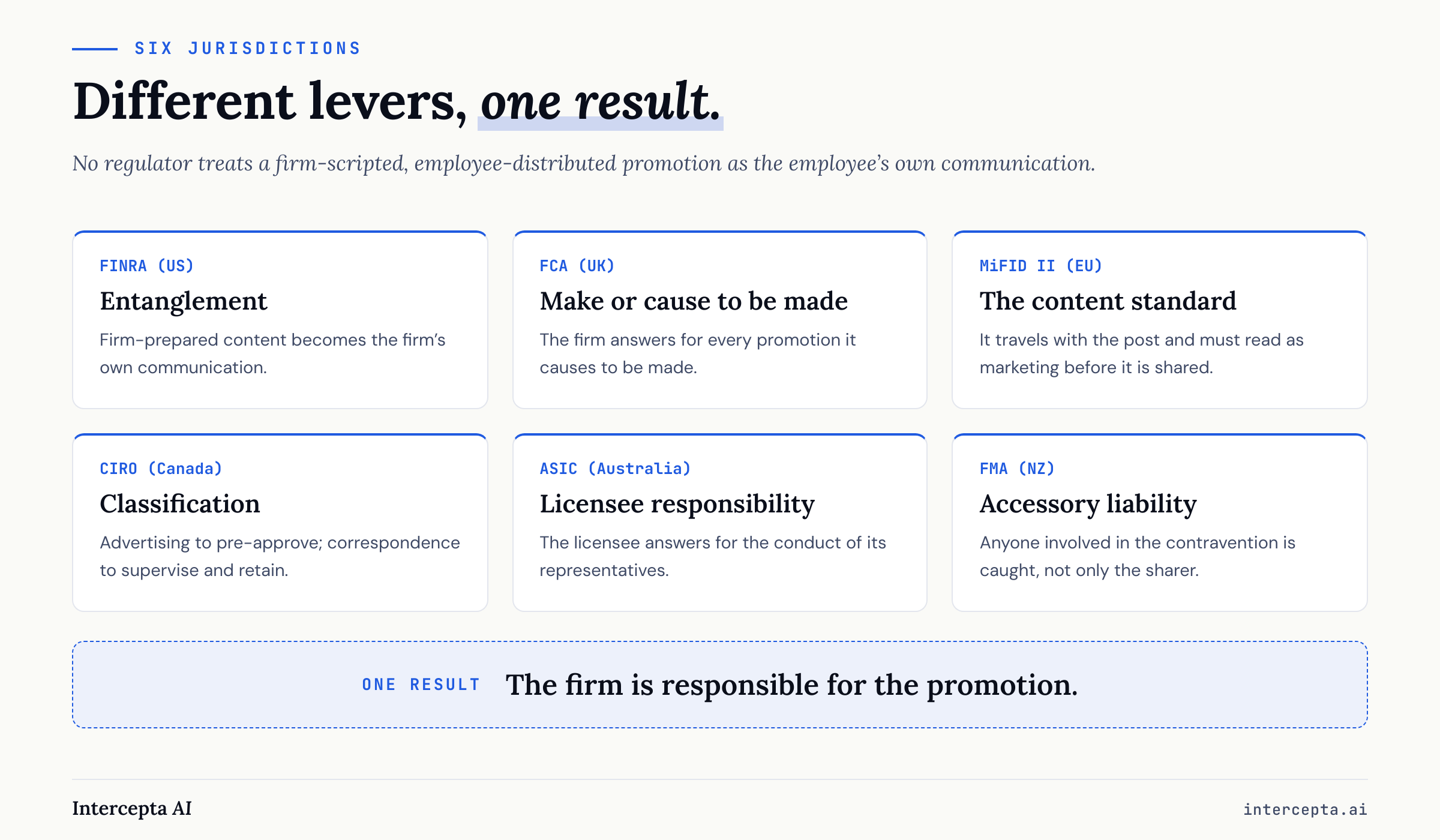
The rule that a firm is accountable for promotional content made on its behalf is not confined to the United States and United Kingdom. Four further jurisdictions reach the same result, each pulling a different lever to decide whether a firm must pre-approve, supervise or retain a templated post before it reaches employee accounts.
Social media does not respect the borders a compliance regime is written for. The same templated post, distributed once, is read wherever the firm’s employees have connections, and it can be a financial promotion in more than one jurisdiction at the same time. A firm cannot scope its review to its home regulator alone, because each jurisdiction the post reaches can apply its own rules.
In the European Union, the lever is the content standard itself, which travels with the post. Under the Markets in Financial Instruments Directive (MiFID II), Article 24(3), and Delegated Regulation (EU) 2017/565, Article 44, a marketing communication must be fair, clear and not misleading and clearly identifiable as marketing regardless of how it is distributed. For a firm running an advocacy programme, the templated post has to meet those standards and read as marketing before it reaches a single employee account, and the European Securities and Markets Authority expects the firm to design, oversee and monitor the distribution so it happens as approved. The obligation attaches to the content, not to whoever clicks share.
In Canada, the lever is classification. The Canadian Investment Regulatory Organization (CIRO) sorts the content rather than re-attributing authorship. A templated post an Approved Person places on a profile is advertising, which the dealer must pre-approve before it is published; a post that invites comments and replies is correspondence, which the dealer must supervise and retain. For such a firm, the post cannot reach employee accounts without the dealer’s sign-off and a kept record, and this is not hypothetical, because CIRO’s 2025 Compliance Report singles out weak controls over exactly these business-purpose accounts as a current examination concern.
In Australia, the lever is licensee responsibility. The Australian Securities and Investments Commission (ASIC) states in Information Sheet 269 (INFO 269, March 2022) that the same laws governing the promotion of financial products offline apply online, and Regulatory Guide 234 requires that advertising of financial products not be misleading or deceptive whatever the medium. A licensee answers for the conduct of its representatives and those acting on its behalf, so a misleading templated post that staff distribute is the licensee’s breach, not the individual employee’s problem, and the licensee’s supervision duty follows the post through their accounts.
In New Zealand, the lever is accessory liability. The Financial Markets Authority (FMA) applies the fair dealing provisions in Part 2 of the Financial Markets Conduct Act 2013, which prohibit misleading or deceptive conduct in relation to financial products and are channel-neutral, reaching social and professional networking posts. Liability there extends to anyone “involved in the contravention”, those who procured the communication or were knowingly concerned in it, so the marketing team that scripted the post and the firm that distributed it are caught, not only the employee who shared it.
The mechanisms differ, yet the result is the same. Across all six jurisdictions this piece reviews, no regulator treats a firm-scripted, employee-distributed promotion as the employee’s personal communication, and every one holds the firm responsible for it.
Control belongs before distribution
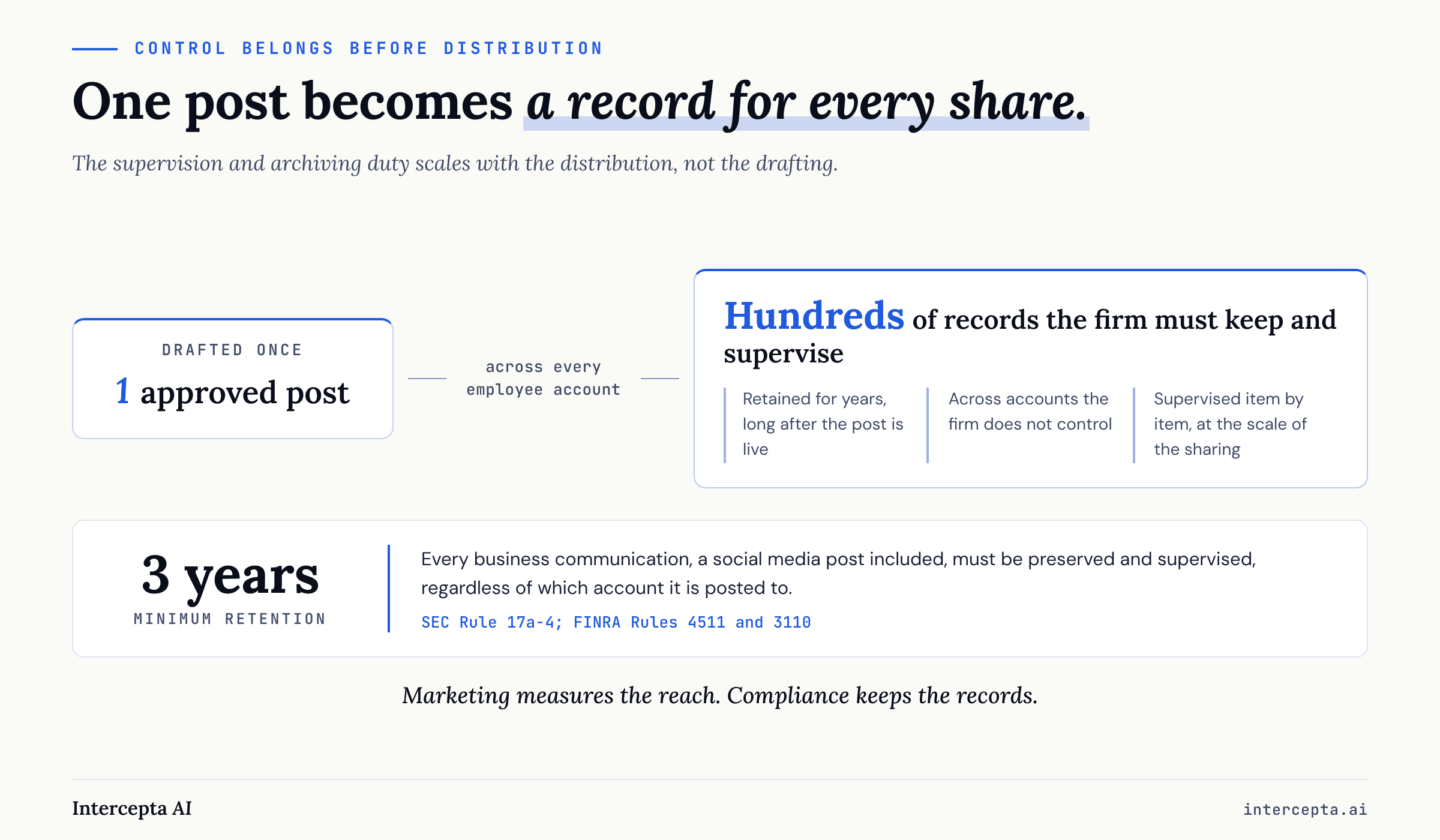
The firm’s responsibility does not end with the content. Once a post is a controlled communication, the retention and supervision requirements follow it regardless of whether it appeared on LinkedIn, Instagram or TikTok. The obligation turns on the content, not the channel. A templated post pushed out through an advocacy platform to dozens or hundreds of employee accounts generates a supervision and archiving obligation at the scale of the distribution, not the scale of the drafting. Each of those shares is a record the firm must retain and supervise, for years and across accounts it does not control. FINRA enforces this. In 2024, it fined one firm $850,000 after paid influencers posted content on its behalf that was not fair and balanced, and the firm failed to review, approve or retain those communications, in breach of FINRA’s content, supervision and record-keeping rules. The programme used influencers rather than employees, and the firm supplied the graphics and guides behind the posts, but the supervision and retention obligations are the ones a scripted employee post carries as well.
The feature that makes advocacy worth running is the feature that makes it a compliance event, but that exposure can be mitigated when the templated post is built to carry the required disclosures and meet the applicable content standards at the source, before the post is distributed across every account it reaches.
Advocacy platforms can lock a post so employees only reshare it, or let them edit it and add their own voice. Marketing best practice favours the second, because advocates who sound like themselves reach and engage more. Yet an edited post carries employee-authored content under the firm’s brand, and the edit can remove the disclosures built in at the source or add a claim no one reviewed.
Regulated content must meet the rules that govern it. Pre-publication validation of the templated post can produce a per-item record, before distribution, of whether the required disclosures were present and the content met the applicable standard. It covers the post at the source, the firm’s own draft, not the version an advocate may edit before sharing.
Marketing measures the reach. Compliance answers for every share.
Before and after you publish
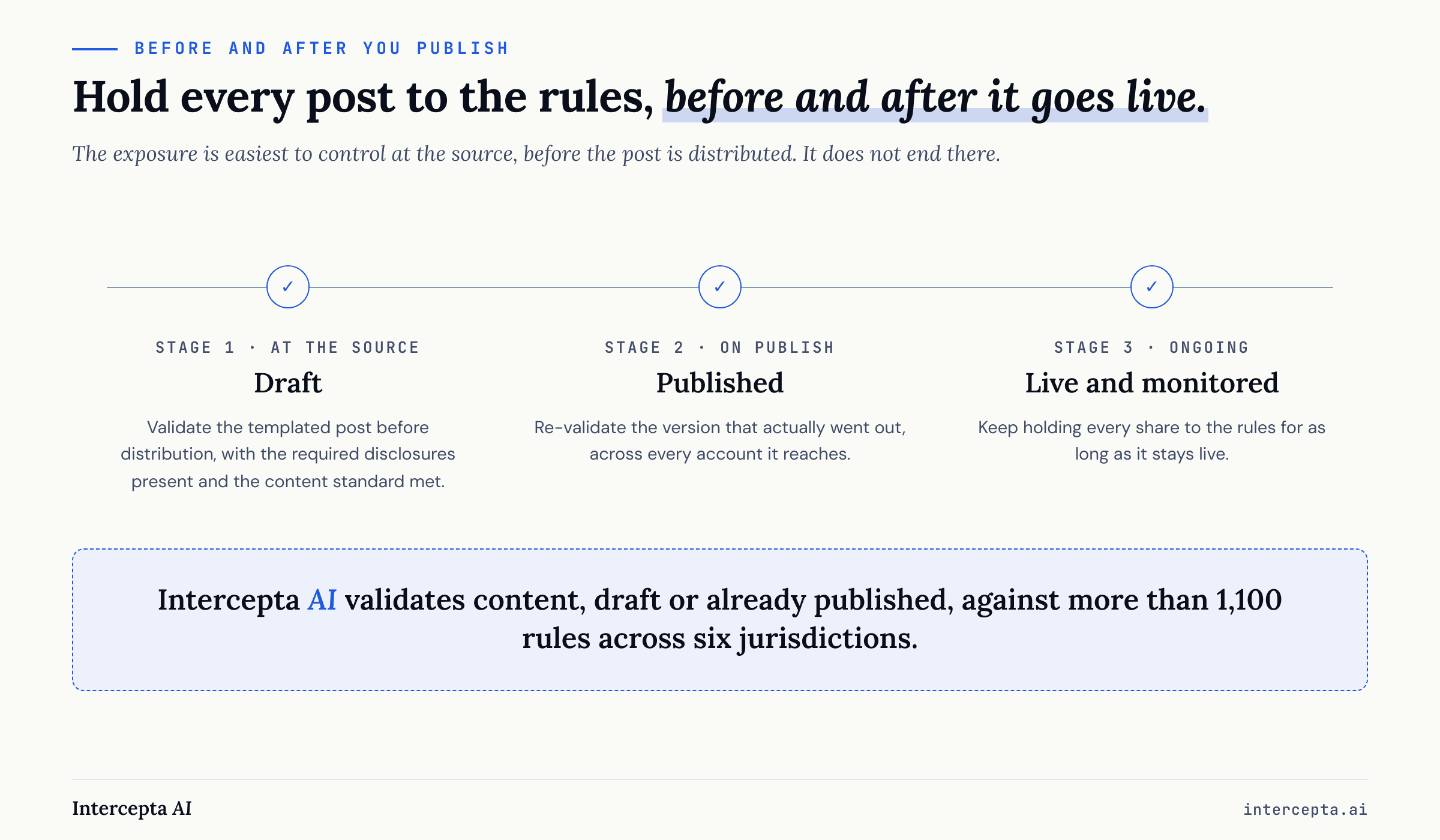
The exposure is easiest to control at the source, before the post is distributed, but it does not end there. A firm needs to hold every post to the rules at scale, and to keep holding it once the post is live.
Intercepta AI validates marketing content, draft or already published, against more than 1,100 regulatory rules across the United States, United Kingdom, European Union, Canada, Australia and New Zealand, surfacing the claims that carry a compliance obligation and mapping each to the rule that governs it, for the compliance team to review.
Cross-references
For depth on the shift away from pre-use approval, see FINRA Proposes Risk-Based Review Under Rule 2210. The Burden Shifts to the Firm.
For depth on the SEC Marketing Rule and third-party testimonials, endorsements and ratings, see What the SEC’s Fourth Marketing Rule Alert Flagged on Testimonials, Endorsements, and Ratings.
Sources
Regulatory and legal sources
- FINRA Rule 2210, Communications with the Public.
- FINRA Regulatory Notice 17-18, Guidance on Social Networking Websites and Business Communications (April 2017).
- FINRA Regulatory Notice 10-06, Guidance on Blogs and Social Networking Web Sites (January 2010).
- FINRA, Letter of Acceptance, Waiver and Consent No. 2021072581101 (March 2024).
- FCA, FG24/1, Financial Promotions on Social Media (March 2024).
- MiFID II, Directive 2014/65/EU, Article 24(3).
- Delegated Regulation (EU) 2017/565, Article 44.
- ESMA, 2023 Common Supervisory Action on the application of MiFID II marketing requirements (May 2024).
- CIRO, Advertising, Sales Literature and Correspondence Rules; CIRO 2025 Compliance Report.
- ASIC, INFO 269, Discussing Financial Products and Services Online (March 2022).
- ASIC, Regulatory Guide 234, Advertising Financial Products and Services (Including Credit).
- FMA, Advertising Offers of Financial Products Under the FMC Act (New Zealand).
- Financial Markets Conduct Act 2013 (New Zealand), Part 2 (fair dealing) and section 533 (involvement in contraventions).
- FTC, Endorsement Guides, 16 CFR Part 255.
Data and research
- FCA, Financial Promotions Data 2024, published 7 February 2025.
- Content Marketing Institute and MarketingProfs, B2B Content Marketing Benchmarks, Budgets, and Trends: Outlook for 2025.
Company programmes
- Sprinklr, BMO and Sprinklr co-create the future of secure, scalable employee advocacy (customer story).
- American Banker, How BMO built an employee-driven social media strategy.
- J.P. Morgan (JPMorganChase), Global Social Media team recruitment postings for the Employee Advocacy Social Media Manager and Vice President roles, which the firm posts on a recurring basis and which describe the Corporate and Investment Bank Ambassador programmes, editorial content calendars, publishing on ambassadors’ behalf, and approvals under the firm’s employee social media policy. Re-findable via JPMorganChase careers or LinkedIn.
- Hootsuite, DaVita employee advocacy case study, a 200-plus ambassador programme run on Hootsuite Parliament (formerly Amplify).
- Sociabble, athenahealth case study, 1,900 global positions filled through employee advocacy alongside a brand-refresh campaign.
- EveryoneSocial, American Family Insurance Empowers Their Brand Advocates Online, the #iWork4AmFam programme.
- State Farm, 19,000 State Farm Agents Are Here to Help (newsroom), with the agent-force figure corroborated in 2026 trade coverage.
- Gap Inc., Debuts Cross-Brand Content Creator and Social Media Advocacy Program (8 October 2025) and Expands Cross-Brand Creator and Social Advocacy Program to Employees (22 July 2026).
- Walmart, Spotlight employee-influencer programme, as reported by Tubefilter (15 December 2020).
- Axios, Ulta Beauty, Starbucks tap employees and creators as retail ambassadors (7 February 2026).
- Sprinklr, Hootsuite and EveryoneSocial, employee advocacy compliance and archiving product documentation for regulated industries.