On 9 July 2026, the Financial Industry Regulatory Authority (FINRA) published Regulatory Notice 26-14 and opened for comment a proposal that would change how member firms supervise their retail communications. At its centre is a single question. Should a qualified principal be required to approve every retail communication before it is used? Under the proposal, the answer becomes no. Each firm would instead design its own risk-based system for deciding which communications require pre-use approval and which do not.
The change is not yet in force. Notice 26-14 is a request for comment, and any amendment would require a separate rule filing with, and approval by, the Securities and Exchange Commission. The comment window closes on 11 September 2026. It still merits attention now, because the capability the proposal points to, reviewing marketing content against the rules that apply to it and keeping evidence of that review, serves the compliance obligation firms already carry and prepares them for where supervision is heading.
What the proposal actually changes
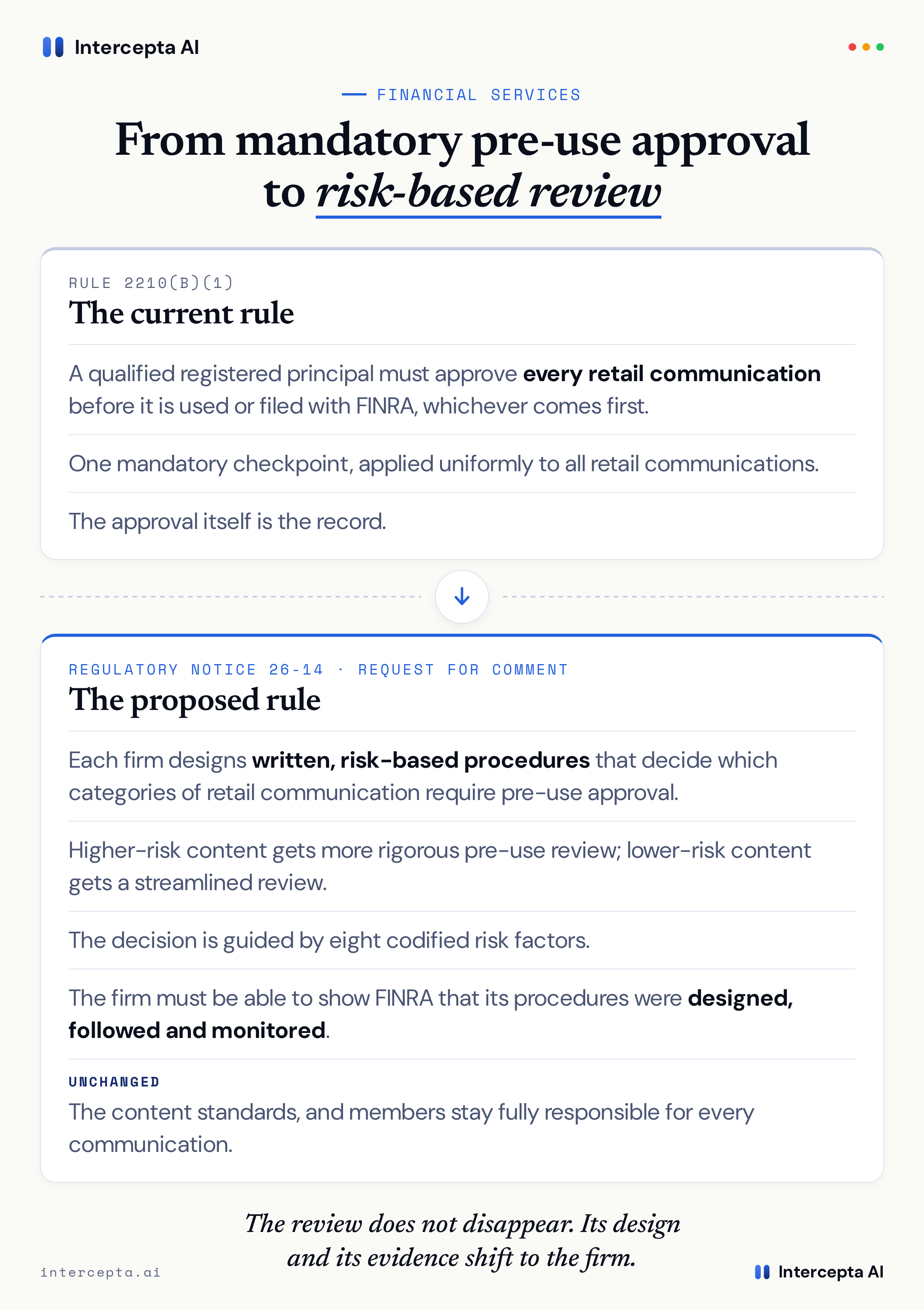
Under the current rule, an appropriately qualified registered principal must approve each retail communication before it is used or filed with FINRA, whichever comes first. A retail communication is any written or electronic communication distributed or made available to more than 25 retail investors within any 30-calendar-day period. Today, that approval is the control every retail communication must clear before it goes out.
Notice 26-14 would replace it. Firms would be required to establish written procedures, appropriate to their business, size and structure, that determine which categories of retail communication require pre-use approval. The procedures would have to be reasonably designed to ensure that communications comply with the applicable content standards. Where a firm’s procedures do not require review of all retail communications before first use, they would need to provide for the education and training of the people preparing content, documentation of that training, and surveillance and follow-up to confirm the procedures are being applied. Firms would also have to keep evidence that the procedures were implemented and carried out, and make that evidence available to FINRA on request.
The substantive standards themselves would not move. Communications would still have to be fair and balanced, and firms would remain prohibited from making any false, exaggerated, unwarranted, promissory or misleading claim. FINRA is explicit that members would remain fully responsible for the content of their communications, including communications that were not reviewed before use.
Why FINRA is revisiting pre-use approval now
FINRA ties the proposal directly to how communication has changed since Rule 2210 was written, naming both social media and generative artificial intelligence (AI). The notice explains that applying a pre-use approval requirement to AI-generated retail communications has become difficult in practice, in part because of the speed and the volume at which such content can now be produced. Commenters responding to FINRA’s rule-modernisation review, launched on 12 March 2025, told FINRA that a prescriptive pre-use approval requirement sits awkwardly alongside the extensive use of AI to supervise, review or approve communications.
The proposal is part of FINRA Forward, the regulator’s broader effort to modernise its rules. It also moves broker-dealer communication standards closer to the principles-based approach that already governs investment advisers, a convergence FINRA has pursued in parallel through a separate filing on performance projections.
Removing the checkpoint does not remove the work
On its face, this looks like less work. A firm producing a high volume of retail communications could reserve principal sign-off for the content that carries the most risk, rather than clearing every piece before release. FINRA anticipates operational efficiencies for firms in exactly that position.
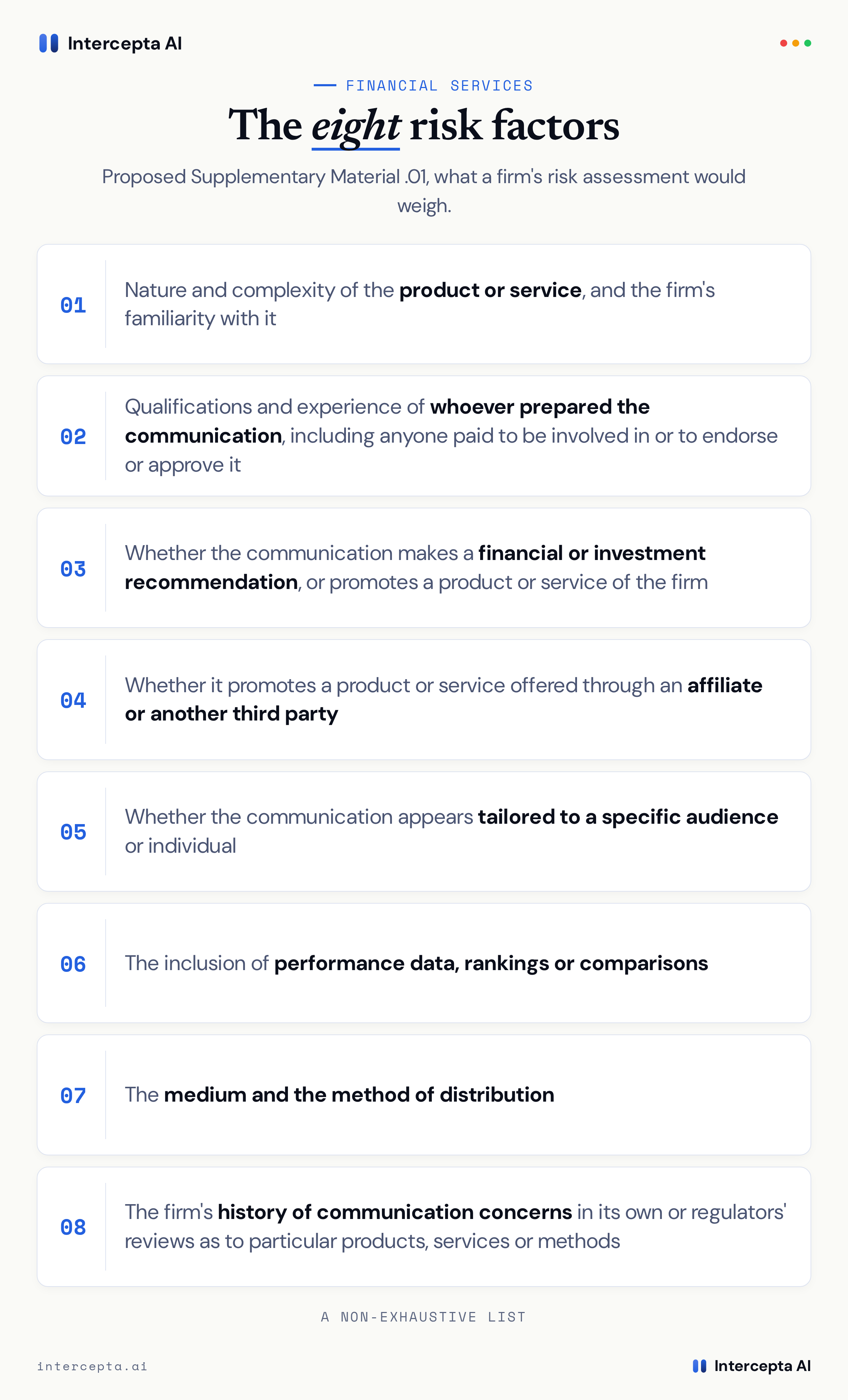
The work does not disappear. It moves. Deciding which content is higher or lower risk, building the procedures that make those decisions consistent, training the people who apply them, and keeping the evidence that all of this happened are now the firm’s responsibility to design and to defend. To guide that judgment, FINRA would codify a non-exhaustive list of eight factors in proposed Supplementary Material .01. A firm’s risk assessment would weigh:
- the nature and complexity of the product or service the communication concerns, and the firm’s familiarity with it;
- the qualifications and experience of whoever prepared the communication, including anyone paid to be involved in or to endorse or approve the content;
- whether the communication makes a financial or investment recommendation, or otherwise promotes a product or service of the firm;
- whether it promotes a product or service offered through an affiliate or another third party;
- whether the communication appears tailored to a specific audience or individual;
- the inclusion of performance data, rankings or comparisons;
- the medium and the method of distribution; and
- the firm’s history of communication concerns identified in its own or regulators’ reviews as to particular products, services or methods.
Several of these factors describe exactly the material a marketing team produces day to day. At the higher-risk end of the list FINRA has drawn sit performance comparisons in a paid social media post, product claims tailored to a particular audience segment or landing pages promoting an affiliate’s fund, and each would need a review robust enough to justify how it was handled.
The evidence becomes the deliverable
Under the current rule, the evidence of supervision is a single approval attached to a single communication. Under a risk-based model, the evidence is the system itself. A firm must be able to show FINRA not only that a given piece of content was reviewed, but that its procedures for deciding what to review were reasonably designed, were followed, and were monitored over time.
For AI-generated content, FINRA sets an additional expectation. Where a firm uses an AI tool as part of how it reviews communications, that tool must be vetted, tested and monitored, and the firm should weigh the qualifications and experience of the people responsible for supervising and reviewing it. An automated pipeline that drafts and publishes content with no reviewable record does not meet the standard the proposal describes.
This is where pre-publication validation earns its place. Validating each piece of marketing content against the specific regulations that apply to it serves both sides of a risk-based framework at once. The marketing team gets a defensible basis for releasing lower-risk content quickly. The compliance team gets a documented, per-rule record of what was assessed and what was found, which is the kind of evidence FINRA says firms must be able to produce.
FINRA’s own numbers on pre-publication content
FINRA’s own data makes the case for reviewing marketing content before it reaches the public. In the economic assessment attached to the notice, FINRA reports that between 2023 and 2025, it reviewed 4,501 retail communications that firms had filed before first use, and found 24% of them not fully compliant. FINRA defines that term to cover both substantive and technical shortcomings, so the figure measures content that did not fully meet the standard in some respect rather than content that broke a rule outright. Read conservatively, it still shows that close to a quarter of the material firms submitted for pre-use review carried a compliance problem of some kind before anyone outside the firm had seen it.
The pattern is sharper for new firms. Among first-year members in the sample, roughly 69% of the retail communications filed before first use were not fully compliant. Content problems concentrate where a firm is newest to the standard and least familiar with it, which is also where a risk-based framework would place the heaviest review obligation.
Those figures, though, cover only the content that firms must file with FINRA. Filing is required only for specified categories of retail communication, so much of what firms produce is never sent to FINRA. Firms review it in-house, and for the small share that is filed, FINRA’s review sped up to an average of 17 business days in 2025, from 40 in 2023.
What to do while the window is open
Two implications follow from the notice, and neither needs to wait for a final rule.
The first is the option to be heard. FINRA has asked for comment on eleven specific areas, and one of them asks directly how firms are using AI to generate, supervise, review or approve communications with the public. Firms with a considered view on how risk-based supervision should work for AI-generated content have a formal channel to shape the outcome until 11 September 2026, and FINRA has invited exactly that input.
The second is the capability the proposal rewards regardless of its final form. Whichever way the proposal lands, and whenever it does, the direction is towards supervision that firms design and must evidence themselves, applied in proportion to risk, across content that AI now helps produce at scale. A firm that can validate its marketing content against the regulations that apply to it before publication, and can produce a per-rule record of each assessment, is ready for that model whichever way the wording settles. The firms that will struggle are the ones treating pre-use approval as a manual bottleneck to be removed rather than a control to be redesigned.
Validate before you publish. Keep the record.
Intercepta AI validates marketing content against 1,100+ regulatory rules across the United States, United Kingdom, European Union, Canada, Australia and New Zealand. A single scan covers every jurisdiction the content reaches and returns a documented report that maps each issue to the specific regulation it references, with remediation guidance for your compliance team to review. Marketing teams validate before publication. Compliance teams hold a documented regulatory record. Every decision on every finding stays with your compliance team.
AI built the content. AI should validate it before your team reviews it.
No payment method required.
Sources
- FINRA Regulatory Notice 26-14, “FINRA Requests Comment on Proposed Changes to Modernize Rule 2210 (Communications with the Public)” (published 9 July 2026; comment period expires 11 September 2026). Preliminary Economic Impact Assessment sample period 1 January 2023 to 31 December 2025, covering 4,501 retail communications filed prior to first use and 172,898 filed after first use across 593 member firms.
- FINRA Rule 2210 (Communications with the Public; content standards and approval requirements for retail communications, correspondence and institutional communications).
- FINRA Forward (FINRA rule modernisation initiative; Regulatory Notice 25-04 of 12 March 2025, and Regulatory Notices 25-06 and 25-07 of 2025).
- Securities Exchange Act Release No. 104877 (20 February 2026), Notice of Filing of File No. SR-FINRA-2026-004 (FINRA proposal to align Rule 2210 with investment adviser standards for communications presenting performance projections).