In the European Union, a buy now, pay later banner offering three instalments at 0% interest through a partner lender needs no warning under the first Consumer Credit Directive. The same banner may need a warning on the cost of borrowing, with a representative example, once the second Consumer Credit Directive (CCD2) applies from 20 November 2026, or later based on when a Member State transposes it into its national law.
In a 2021 sweep coordinated by the European Commission, authorities flagged 30% of the consumer credit websites they examined for advertising that potentially did not give all the standard information in a clear, concise and prominent representative example. Potential breaches were found on 44% of the 27 websites examined on smartphones. Those authorities applied the national rules giving effect to the first directive. Under CCD2, an advertisement that shows an interest rate or a cost figure still needs the representative example, with the same elements at EU level. Among the new requirements, every advertisement for credit within its scope needs the warning on the cost of borrowing. Each Member State must prohibit some claims in credit advertising, such as a statement that existing loans make little or no difference to the assessment of an application. In some markets, the banner’s claim that credit is approved in seconds may also have to be removed. This piece shows a personal loan email and the banner before and after, then the preparation marketing teams and their agencies need to meet the requirements of CCD2.
Two edits your approved loan email will need
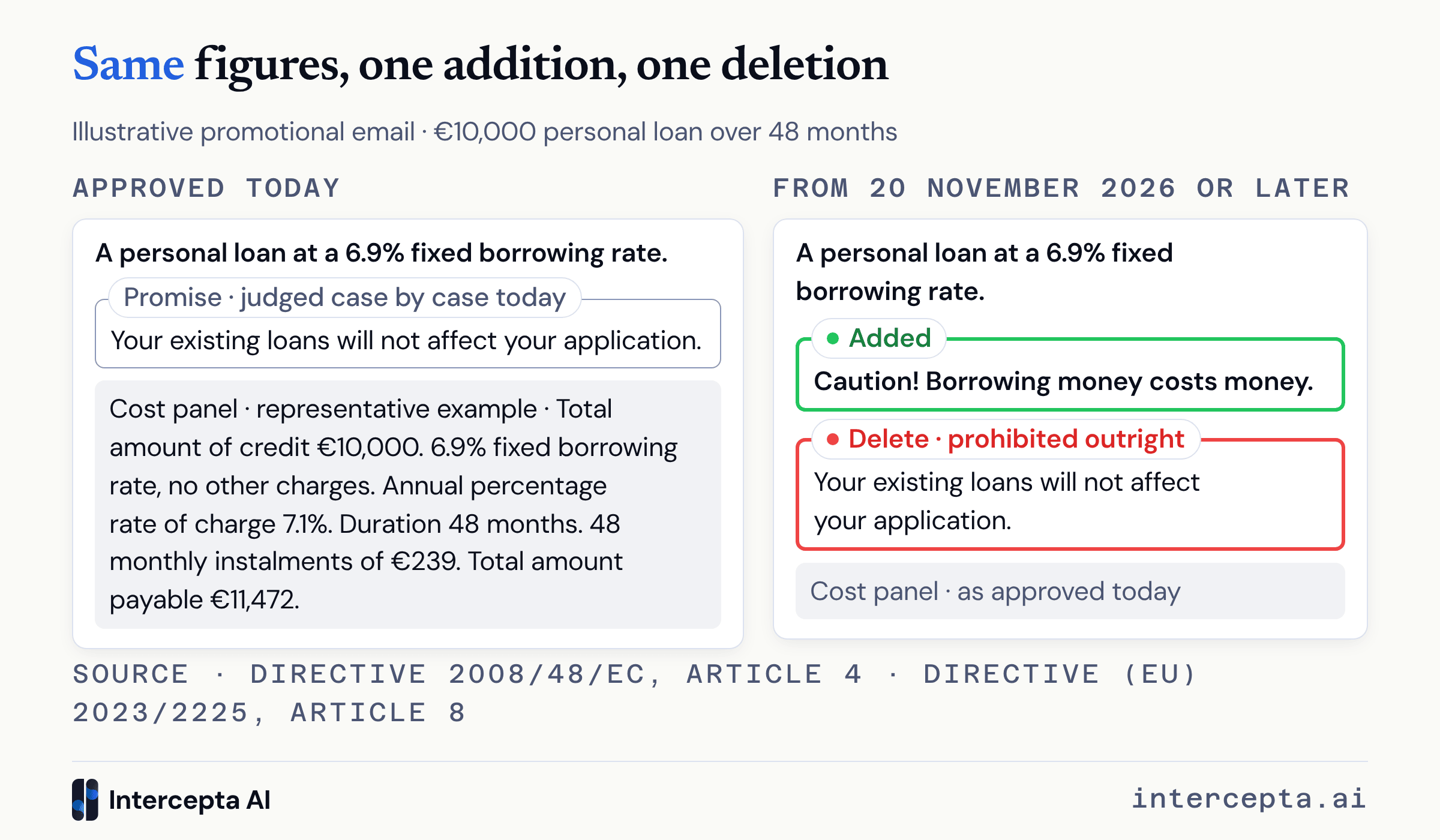
Picture an automated email in your personal loan sequence, headed “A personal loan at a 6.9% fixed borrowing rate”, with the promise “Your existing loans will not affect your application”. Below the copy, a cost panel known in the rules as the representative example shows what borrowing €10,000 over 48 months costs. Your compliance team approved it. Your team still sends it to new leads every week. From 20 November 2026, or later in a country whose national law is not in place by that date, the same email can be in breach twice without a word of it being edited.
The first breach is the missing warning “Caution! Borrowing money costs money”, or the equivalent, in the language and exact words each market requires or accepts. The second breach is the promise about existing loans, which is prohibited outright, even where it is true. At EU level, the cost panel needs no change. The marketing team adds the warning and deletes the promise before the next send.
What changes on your banner
Consider a banner on a product page, beside an item priced at €120, with the copy “Pay in 3. 0% interest. Approved in seconds”. A partner lender provides the plan. The consumer pays nothing at checkout and repays €40 a month for three months, the first instalment due one month after purchase. The plan and all copy in this piece are illustrative and drawn from no particular firm. Today the banner needs neither a warning nor a cost panel under the first directive, since the plan is free of interest and charges, and below €200. General rules on misleading practices still apply to it. National law in some markets may already require a warning or a cost panel. The marketing team should ask the compliance team whether such a rule already applies to the banner where it is published.
Once the national measure transposing CCD2 applies in a market, the banner can count as credit advertising. It then needs the warning, with the cost panel known as the representative example, since “0% interest” can be read as indicating an interest rate. A Member State may shorten the cost panel to three elements for some kinds of credit, among them interest-free offers with no other charges and amounts below €200. A plan like this one can therefore qualify in any Member State that selects either category. On this banner, the shorter panel would read “0% fixed borrowing rate, no charges. Total amount of credit €120. Annual percentage rate of charge 0%”. The warning is required in full either way. A Member State may also prohibit wording that stresses how quickly credit is obtained, and “Approved in seconds” can be read that way. The marketing team should prepare a version of the banner without the speed claim for any Member State that adopts this prohibition.
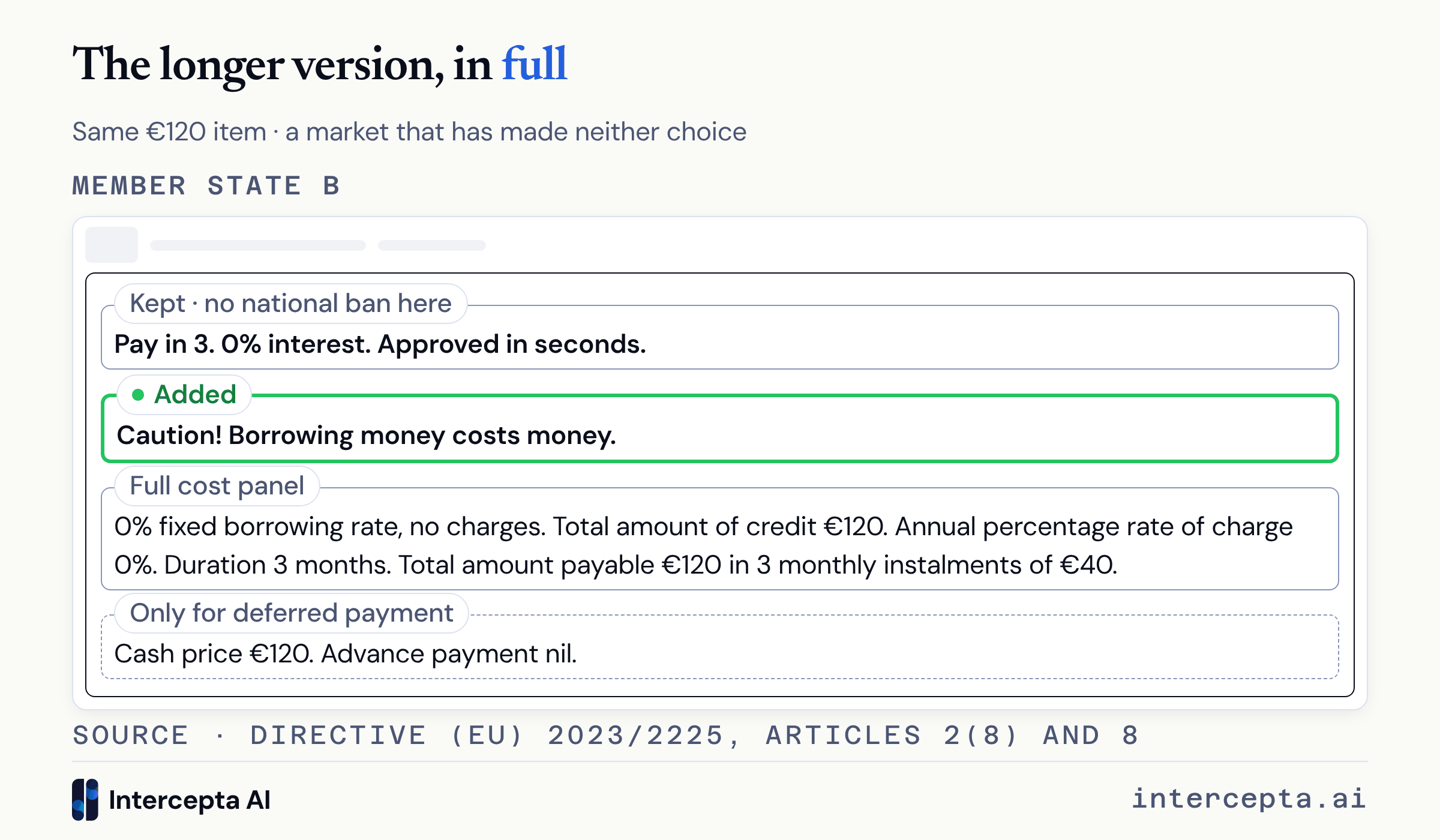
In a market that allows the shorter cost panel and prohibits speed claims, the banner could read “Pay in 3. 0% interest. Caution! Borrowing money costs money. 0% fixed borrowing rate, no charges. Total amount of credit €120. Annual percentage rate of charge 0%”. In a market that does neither, it could read “Pay in 3. 0% interest. Approved in seconds. Caution! Borrowing money costs money. 0% fixed borrowing rate, no charges. Total amount of credit €120. Annual percentage rate of charge 0%. Duration 3 months. Total amount payable €120 in 3 monthly instalments of €40”. The longer version also shows the cash price of €120 and an advance payment of nil where the plan is treated as deferred payment for specific goods or services. The marketing team should place the warning clearly and prominently on the banner itself, with the cost panel beside it.
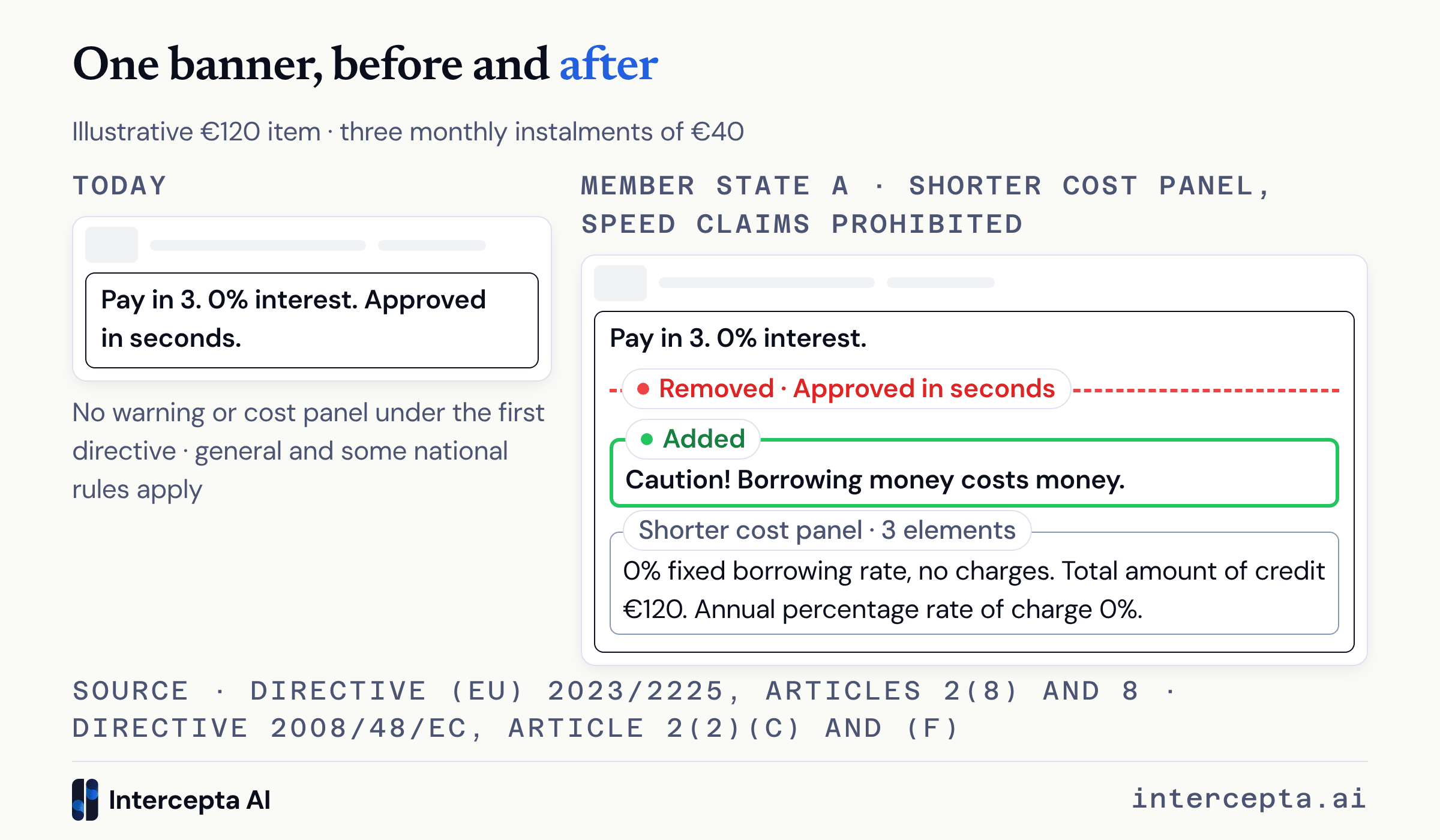
The banner that runs to eight words today may need 27 to 49 once the new rules apply, without its speed claim in some markets. A single version of the banner copy will therefore not be suitable for every market a retailer sells into. Conversion benchmarks set on the eight-word version may not hold for the longer one, so the marketing team should plan a test of the new layout in each market. The design team should build a layout with room for the longer version, including the cash price and advance payment, then fill it with each market’s copy before the national measure applies there.
On a small mobile placement, the total amount payable with the instalments, and any cash price and advance payment, may be made accessible by a click, a scroll or a swipe, in specific and justified cases only. The warning and every other element of the cost panel must be shown on the banner itself. The marketing team should build the mobile screens so that the consumer is presented with all the standard information, including any element behind a click, before opening the offer.
The longer banner on a small screen
| On the banner | Behind a click, scroll or swipe |
|---|---|
| Caution! Borrowing money costs money. | Total amount payable €120 in 3 monthly instalments of €40 |
| 0% fixed borrowing rate, no charges | Cash price €120 · advance payment nil |
| Total amount of credit €120 | |
| Annual percentage rate of charge 0% | |
| Duration 3 months |
Note · Illustrative €120 banner for a market that has made neither choice · items in the right-hand column may sit behind a click, a scroll or a swipe in specific and justified cases only · the cash price and advance payment apply only to deferred payment for specific goods or services.
Source · Directive (EU) 2023/2225, Article 8, recital 33
 Intercepta AI
Which of your products and messages can count as credit advertising
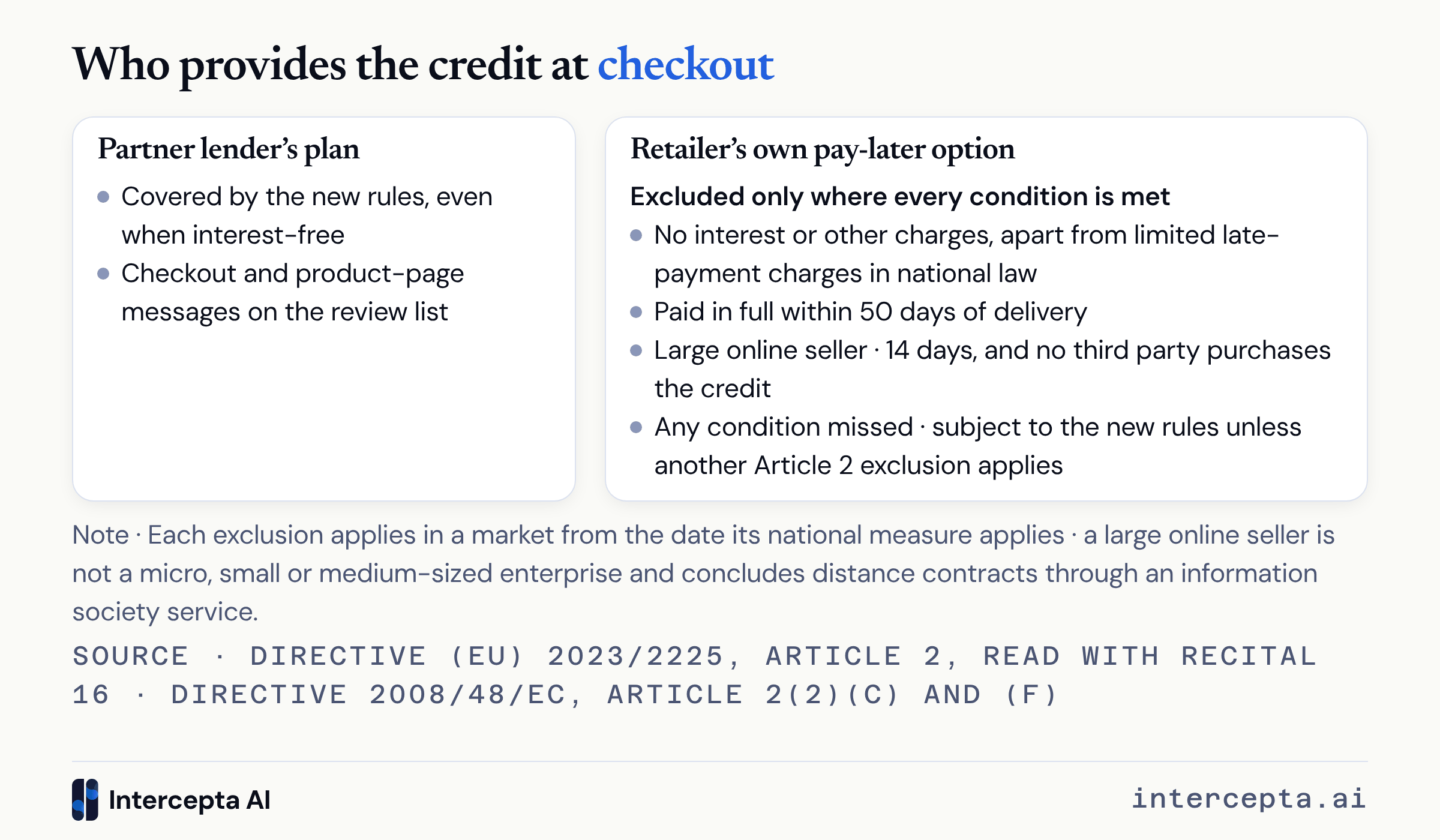
A lender’s review list should include its interest-free plans with no other charges and its loans below €200, with the on-site messages it supplies to merchants to promote them. Credit repayable within three months with only insignificant charges belongs on the list too. A retailer’s list should include the checkout and product-page messages for any plan a partner lender provides, even an interest-free one. All three kinds of credit are excluded from the first directive and covered by the second, whose introductory text names buy now, pay later schemes among its reasons. A lender should give each merchant a version of those messages approved for each market where the merchant publishes them, for use once the national measure applies there.
A retailer’s own pay-later option, with no third party offering credit, can be excluded from the new rules on narrow conditions. The price must be paid free of interest and of other charges, apart from limited late-payment charges set in national law. Payment in full is due within 50 days of delivery, or within 14 days for a large online seller, which must meet further conditions. The figure below shows every condition. The marketing team should confirm each one with the compliance team before leaving any message off the list.
The warning and cost panel, format by format
An awareness campaign for a personal loan, with no rate and no other figure, needs no warning under the first directive, although some national rules already require one. Once the national measure applies in a market, the same campaign needs the warning there, whether or not it shows a figure. The creative team should build the warning into the template for every format, video and outdoor included.
An advertisement that shows an interest rate or any figure for what the consumer pays for the credit still needs the cost panel, with the same elements as today, alongside the warning. Each element must be clear and prominent, and easy to read or, in audio, to hear. The marketing team should keep the cost panel on every rate-led asset.
A radio script that mentions a rate needs the full cost panel today. Once the national measure applies, every credit script needs the warning. In specific and justified cases, since information cannot be shown visually on radio, the total amount payable with the instalments may be dropped, as may any cash price and advance payment. Copywriters should add the warning to every script and keep the rest of the panel wherever a rate or a cost figure is mentioned.
Suppose a social media version of the loan email keeps the 6.9% headline without the cost panel. It is exposed today, since the national rules giving effect to the first directive require that panel wherever a rate or a cost figure is shown. Under the new rules, a version for a small mobile screen could read “A personal loan at a 6.9% fixed borrowing rate. Caution! Borrowing money costs money. Total amount of credit €10,000. 6.9% fixed borrowing rate, no other charges. Annual percentage rate of charge 7.1%. Duration 48 months”. The total amount payable and the instalments may then be made accessible by a click, a scroll or a swipe, in specific and justified cases only, as on the banner. The social media team should rebuild the cost panel in every shorter version.
Copy you can no longer run once the new rules apply
Under CCD2, every Member State must prohibit certain messages in credit advertising. The existing-loans sentence in the email above is one of them, since it indicates that credit already held will make little or no difference to the assessment. A loan advertisement presenting borrowing as a way to “take control of your finances” is exposed to the same prohibitions. It can be read as encouraging consumers to apply by suggesting credit would leave them better off financially. Today, both are judged case by case under the general rules on misleading and aggressive practices and national law. The marketing team should delete the first before the national measure applies. It should rewrite the second, for example as “Spread the cost of a planned purchase in fixed monthly instalments”, shown with the warning and used only where the instalments are fixed.
A third prohibited message falsely suggests that credit can replace savings or raise a consumer’s standard of living. A false suggestion of greater financial resources is covered as well. The compliance team assesses whether such a suggestion is false, so the marketing team should refer copy of this kind to it before publication.
Each of the other prohibitions applies only where a Member State adopts it. A Member State can also prohibit kinds of copy the directive does not list. A checkout widget offering “5% off when you pay in instalments” may be barred in a Member State that adopts the option on discounts available only with credit, so a promotion planned across several markets can need a second version. Some national rules may already prohibit such copy today. The table below shows how it can appear in search, checkout and push copy. The teams running those channels should have every promotion approved for each market where it is published.
Copy that depends on the market
| Channel | Example copy | From the national measure | What the marketing team does |
|---|---|---|---|
| Search advertisement headline | “Approved in seconds” | Prohibited where the Member State adopts the speed or ease option | Hold a version without it |
| Checkout widget | “5% off when you pay in instalments” | Prohibited where the Member State adopts the option on discounts available only with credit | Hold a version without it |
| Seasonal push notification | “No repayments for four months” | Prohibited where the Member State adopts the option on more than three months with no instalments payable | Hold a version without it |
| Any channel | Further kinds a national measure adds | Prohibited in that market | Approve per market |
| Any channel | A suggestion that credit can replace savings, raise a consumer’s standard of living or increase financial resources | Mandatory in every market · prohibited whenever the suggestion is false | Refer to the compliance team |
Note · Today the first directive lists no prohibited messages, so such copy is judged case by case under the general rules on misleading and aggressive practices and national law · some national rules may already prohibit it · row 5 is a mandatory prohibition in every market and is described without example copy, since example copy would need a judgement on falsity.
Source · Directive (EU) 2023/2225, Articles 7 and 8 · Directive 2005/29/EC, Articles 6 to 9
Intercepta AICopy free of every listed message must still be fair, clear and not misleading, including about the availability or cost of the credit and the total amount payable. The marketing team should keep every claim about what the consumer pays for the credit, or about its availability, consistent with the figures in the cost panel.
Cross-sell copy that ties a loan to insurance
A product page promoting a “Personal loan with payment protection cover, in one application” describes bundling, which is permitted where the loan is also available without the cover, even on different terms. Copy presenting the loan as available only with the cover suggests tying, which the new rules prohibit. Credit offered with the goods themselves, or with delivery or installation, is not a package of financial products or services under these rules. The marketing team should have the compliance team confirm that the loan is available on its own or, where the Member State permits a required policy, with a policy from another supplier, before cross-sell copy is published.
A Member State may permit a lender to make the loan conditional on a relevant insurance policy, such as payment protection cover. Even then, cross-sell copy should never present the lender’s own policy as the only way to get the loan, since the lender must accept a policy from another supplier with an equivalent level of cover, on the same credit terms. The consumer must also have at least three days to compare insurance offers, which remain unchanged for that period. A policy can be taken out sooner only at the consumer’s explicit request. A national measure may also permit a lender to ask the consumer to open or keep a payment or savings account used only for defined purposes, such as repaying or servicing the credit. Any email sequence promoting a policy the lender requires should be timed to allow for those three days.
One campaign, two markets on different dates
Take a campaign for a retailer’s late-November sale, launched on 1 November 2026 in two markets, one whose national measure applies from 20 November 2026 and one in a Member State that has not yet transposed. The same assets must meet the new rules in the first market from 20 November, while they are still live in the run-up to the sale or during it. In the second market, the rules already in force continue to govern them until its national measure applies. Live and evergreen assets, such as a product-page instalment widget or an always-on search advertisement, need the same review, since the directive contains no transitional period for advertising. The marketing team should set a review date for each market before launch.
Under Article 48 of the second directive, Member States had to adopt their measures by 20 November 2025 and must apply them from 20 November 2026. On 1 October 2026, the European Commission sent a formal request to comply, known as a reasoned opinion, to each of 16 Member States that had not notified it of complete national measures. In those markets, any rule adopted after 20 November 2026 takes effect only from its own start date, with the State in breach of that deadline. National measures can differ in wording and in the choices each Member State makes. Some Member States may also set stricter general marketing rules for financial services. The marketing team should confirm with the compliance team when each national measure applies, and the choices each Member State has made, before launch.
What a breach can mean for your business
For a banner published without the warning, or a rate-led email lacking its cost panel, the firm can face a penalty set by the Member State concerned, with no maximum in either directive. From the date each national measure applies, the bodies enforcing it can generally publish administrative penalties. A breach in one campaign can then be made public as well as penalised, so it can also become a reputational matter for the brand. Authorities already examine credit advertising for its representative example. In a 2021 sweep by authorities in 13 Member States and 2 European Economic Area countries, 35 of 118 consumer credit websites (30%) were flagged for advertising that potentially did not give all the standard information in a clear, concise and prominent representative example. On smartphones, 12 of the 27 websites examined (44%) were flagged for potential breaches. The marketing team should therefore validate each credit placement on a phone screen as well as on desktop.
National authorities can act together against a campaign published in several markets, where a breach can amount to a widespread infringement under the EU regulation on cooperation between consumer protection authorities. From the date each national measure applies, penalties in such an action must include the possibility of fines. Penalties under the new rules must be effective, proportionate and dissuasive, as under the first directive. The marketing team should therefore treat the warning, and the cost panel wherever it is required, as fixed parts of every layout for a credit advertisement.
Four documents to prepare, including the agency brief
Four documents should be in place before 20 November 2026. The first is an inventory of every credit asset on the review lists, dated by the day each market’s national measure applies. The table below shows the task for each kind of asset, as a template for that inventory.
What changes on your credit assets
| Asset | Today | From the national measure | What the marketing team does |
|---|---|---|---|
| Rate-led personal loan email | Full representative example | Warning added · cost panel unchanged · existing-loans sentence prohibited | Add the warning · delete the sentence |
| Checkout banner for a partner lender’s interest-free plan | Plan excluded from the first directive · general rules and national law apply | Warning · cost panel where a rate such as 0% is shown, shorter in some markets | Treat it as a new credit advertisement |
| Awareness advertisement with no figures | No warning under the first directive · some national rules require one | Warning | Build the warning into templates |
| Radio advertisement | Full cost panel wherever a rate or a figure for what the consumer pays for the credit is mentioned | Warning in every credit script · total payable, instalments, cash price and advance payment may be dropped in specific and justified cases | Add the warning to every script |
| Social media version of a rate-led email, cost panel removed | Exposed, since the rate is shown without it | Warning and cost panel | Rebuild the cost panel |
| “Take control of your finances” | Judged case by case under general rules and national law | Exposed in every market | Rewrite, for example as “Spread the cost of a planned purchase in fixed monthly instalments” · with the warning · only where the instalments are fixed |
| “Approved in seconds”, “no repayments for four months” | No first-directive rule · some national rules may prohibit such copy | Prohibited where the Member State adopts the option | Hold a version without it |
| “Personal loan with payment protection cover, in one application” | A seller distributing the cover already has to offer the loan on its own | Tying prohibited, subject to national derogations · three-day comparison period where a policy is required | Confirm the loan is available on its own |
Note · “Today” means the national rules giving effect to the first Consumer Credit Directive, Directive 2008/48/EC, which Member States had to apply from 11 June 2010 · each market’s old rules are replaced once its new national measure applies · whether a checkout message counts as advertising depends on national law and the facts.
Source · Directive (EU) 2023/2225, Articles 2, 7, 8, 14, 44 and 47 · Directive 2008/48/EC, Articles 2(2)(c) and (f), 4 and 27(1) · Directive 2005/29/EC, Articles 6 to 9 · Directive (EU) 2016/97, Article 24
Intercepta AIThe second is a creative standard for the warning in every format, in the language and exact words each market requires or accepts. It also describes the cost panel wherever one is required, with the mobile and radio allowances. The inventory and the creative standard should be ready first, since in-house teams and agencies need them to remediate a campaign still live when each national measure applies.
The third is a market list showing, for every market where a campaign is published, the date the national measure applies and the choices made there. Each entry should show the person who confirmed it and the date, so in-house teams and agencies work from one approved list.
One approved market list
| Question | Market 1 | Market 2 | Market 3 |
|---|---|---|---|
| Date the national measure applies | |||
| Warning wording in this market | |||
| Speed or ease claims prohibited? | |||
| Discounts only for credit customers prohibited? | |||
| More than three months with no instalments prohibited? | |||
| Other kinds of copy prohibited | |||
| Shorter cost panel permitted for small or interest-free credit? | |||
| Lender may require insurance or an account? | |||
| National rule on the annual percentage rate of charge in place of the cost panel? | |||
| Stricter rules for financial services marketing? | |||
| Checkout messages treated as advertising? (retailers) | |||
| Credit sold only in a package? (lenders) | |||
| Confirmed by, and date |
Note · On 1 October 2026 the Commission sent a formal request to comply, known as a reasoned opinion, to each of 16 Member States that had not notified it of complete national measures · the shorter cost panel may cover any of interest-free credit with no other charges, credit below €200 and credit repayable within three months with only insignificant charges · a required policy must be relevant and proportionate, an equivalent policy from another supplier must be accepted on the same credit terms, and the consumer has at least three days to compare insurance offers · where national law requires the annual percentage rate of charge in advertising with no rate or cost figure, the representative example duty does not apply and what that rule requires is included instead · stricter rules are subject to the limit in Article 42(1) of the second directive.
Source · Directive (EU) 2023/2225, Articles 2(8), 8, 14, 42 and 48 · Directive 2005/29/EC, Article 3(9) · European Commission INF/26/1760
Intercepta AIThe fourth is an agency brief, since the obligations attach to the advertising whoever builds it. For each market, the brief shows the exact warning in the local language and its position in every format, with any cost panel calculated by the client’s compliance team. Creators and affiliates who make content for the client should receive the same brief, since Article 8 contains no provision on who publishes the advertising. The marketing team should ask the compliance team how each national measure treats creator content.
With the inventory, the creative standard, the market list and the brief in place, the marketing team should validate each credit asset before publication against the national rules in every market where it will appear. Those rules include the measure transposing CCD2 and any stricter national rule on financial services marketing. Each validation covers the required elements and the prohibited messages. Cross-sell copy is also reviewed for any offer of the loan only together with another product, such as insurance. Under the directive, assets already published have no exception once a national measure applies, so the team should reassess each asset while it remains live.
Validate before you publish. Keep the record.
Under CCD2, the required content of every asset in your inventory, from a checkout banner to a social media post, can differ by market and by date. Intercepta AI’s platform flags exposure in credit advertising, radio scripts included, against the directive’s rules, so marketing teams see it while the copy can still be remediated. The platform also covers the rules on credit advertising in force in the Republic of Ireland when each scan runs, including any Irish measure transposing CCD2 from the date it applies. In other markets, your compliance team applies the national measure, including each Member State’s choices, from the approved market list.
The platform is built to assess content against the rules of the markets where you publish. Each scan returns a documented report that maps every issue to the specific regulation it references, with remediation guidance for your compliance team to review. Marketing teams validate copy before publication, while compliance teams hold a documented regulatory record and keep the final decision on every finding.
Paid plans also cover audio and video, and the free scans cover text and websites.
No payment method required.
Cross-references
For the rules that apply to marketing in every sector, credit advertising included, and the other dates of the European marketing year, see EU marketing compliance in 2026: what applies and when.
For the obligation that attaches at publication and then persists, see The Compliance Debt Hiding in Your Content Library.
Sources
European Union
- Directive (EU) 2023/2225 of 18 October 2023 on credit agreements for consumers and repealing Directive 2008/48/EC (the second Consumer Credit Directive, CCD2), Articles 2, 3, 7, 8, 14, 42, 44, 47 and 48 and recitals 15, 16 and 33, with national measures due to apply from 20 November 2026 (OJ L, 2023/2225, 30 October 2023).
- Directive 2008/48/EC on credit agreements for consumers (the first Consumer Credit Directive), Article 2(2)(c) and (f), Articles 4 and 23, Article 27(1) as corrected by the corrigendum at OJ L 207, 11.8.2009, p. 14 (application from 11 June 2010), and recitals 10 and 18, repealed with effect from 20 November 2026 by Article 47 of Directive (EU) 2023/2225.
- Directive 2005/29/EC concerning unfair business-to-consumer commercial practices in the internal market (the Unfair Commercial Practices Directive), Articles 3(9) and 6 to 9.
- Directive (EU) 2016/97 on insurance distribution (the Insurance Distribution Directive), Article 24.
- Regulation (EU) 2017/2394 of 12 December 2017 on cooperation between national authorities responsible for the enforcement of consumer protection laws and repealing Regulation (EC) No 2006/2004, Article 3, point (3), Article 21 and Annex, point 14.
- European Commission, “October infringements package: key decisions”, INF/26/1760, 1 October 2026.
- European Commission and national consumer protection authorities, results of the 2021 mini-sweep on consumer credit (118 websites, 13 Member States and 2 EEA countries), Daily News MEX/21/1803, 16 April 2021, and the Commission’s sweeps page.