In July 2026, an Australian court ordered a consumer finance provider to link to a notice of its case from its website home page for at least 90 days, after finding that a national advertising campaign for an interest-free payment method was misleading. Three months earlier, court orders in the United States had required sellers of consumer products to inform their own customers of their settlement with the Federal Trade Commission. Regulators in the United Kingdom, the United States, Canada, New Zealand and Australia, the five jurisdictions covered here, can name the advertiser when they announce the outcome of a case about its marketing, and a business in any of them can also be required to issue a notice about its own case. This piece sets out how each jurisdiction makes these outcomes public and how a marketing team can use its existing pre-release review to reduce the likelihood of a published finding. The European Union (EU) is outside its scope, since consumer law there is enforced mainly by national authorities in each member state, with coordinated action through the Consumer Protection Cooperation Network.
A marketing team works to control how the brand is presented and how it is perceived. Part of that control is lost should a regulator or a court find that an advertisement breached the rules that apply to it, since the finding can be made public under the name of the business, as can a settlement, even where the business admits no breach. Once the wording is fixed by the regulator, the court or the terms of a settlement, the marketing team cannot edit it, and in some cases the business must publish it through its own channels. In the cases described below, those channels have included product packaging, emails to customers, a pop-up on the business’s website and a link from its home page.
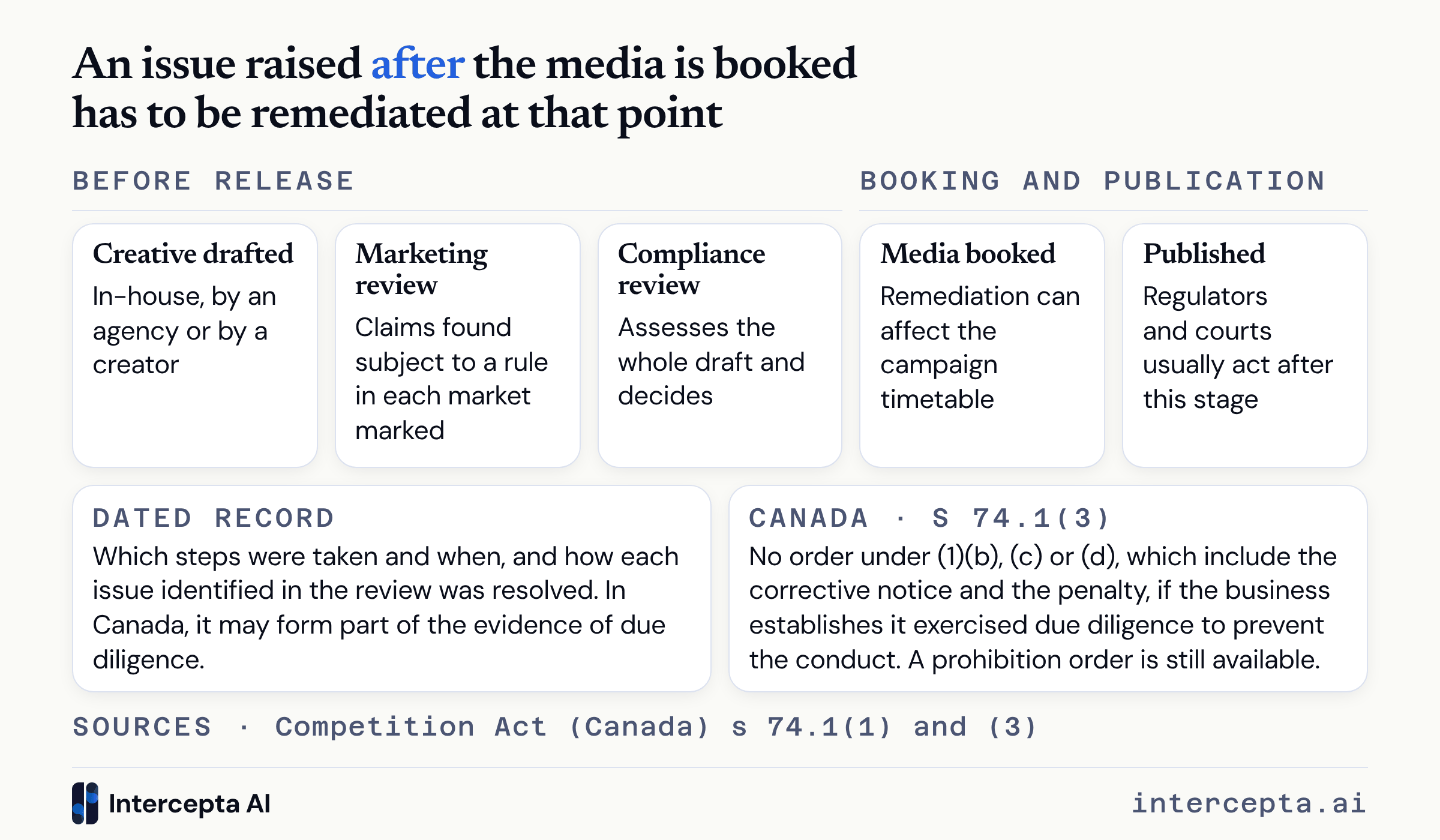
For a marketing team, the review that already takes place before release, for tone and for consistency of visual identity across channels, can also be used to identify and remediate the claims a regulator could act on in each market where the content will be published. Agency and creator work needs the same scrutiny, since the commissioning advertiser can be named in a finding on it, as with material produced in-house. A review by the marketing team before the compliance team makes the final decision may leave fewer issues to resolve after the creative is approved and the media is booked.
In the United Kingdom, the business is named in advertising rulings and can be named in the financial regulator’s final notices
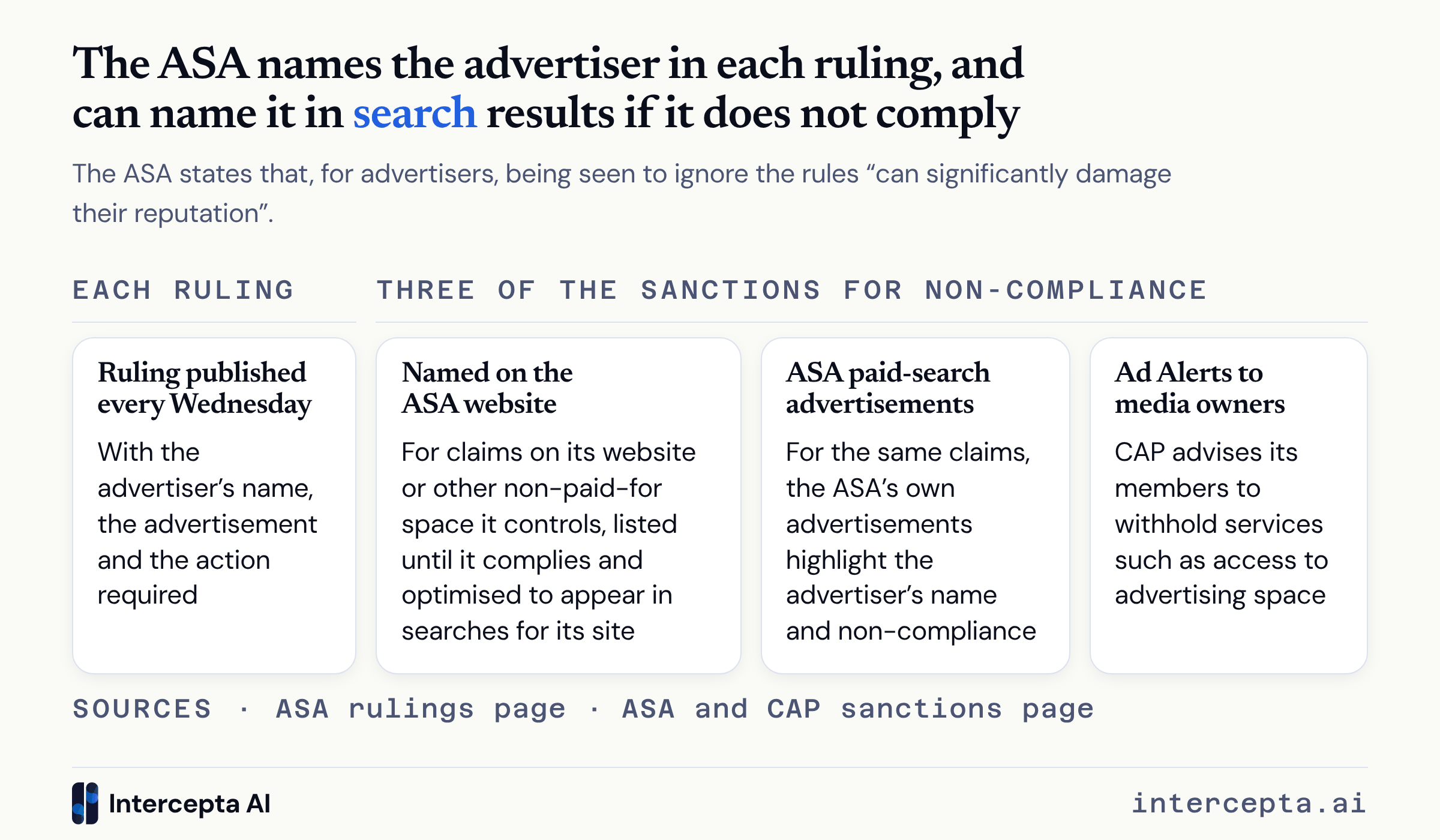
The Advertising Standards Authority (ASA) administers two advertising codes, the non-broadcast code written by the Committee of Advertising Practice (CAP) and the broadcast code of the Broadcast Committee of Advertising Practice. Every Wednesday, the ASA publishes its rulings under the name of the advertiser concerned, and its rulings page shows the date, medium and outcome of each. A ruling describes the advertisement and the issue investigated, then sets out the advertiser’s response, the ASA’s assessment, the action required and the code rules that applied. Anyone reading it can see what the advertisement said and whether, and why, the ASA found that it breached the applicable code. After the ASA upholds a complaint, the advertisement must not appear again in the form complained of. According to the ASA, 22,383 advertisements were amended or removed through its work in 2025. The figure covers all of that activity and is wider than the set of rulings. Companies and organisations that agree to amend or withdraw an advertisement without a formal ruling are named on a separate list.
The sanctions the ASA and CAP list for an advertiser that does not comply with a ruling include two forms of publicity, in organic and paid search, and a third measure involving the media owners from which it buys advertising. For non-compliant claims on the advertiser’s own website or in other non-paid-for space under its control, such as its social media accounts, the ASA can name the advertiser, with details of the problem, in a section of its website kept for advertisers that have not complied. The entry remains until the advertiser complies, and the ASA uses search engine optimisation so that it appears in search results for the advertiser’s website. It can also place its own paid-search advertisements to highlight the advertiser’s name and non-compliance. CAP can issue Ad Alerts advising its members to withhold services such as access to advertising space. The ASA’s sanctions page states that, for advertisers, being seen to ignore the rules “can significantly damage their reputation”.
Financial promotions by authorised firms are subject to rules made by the Financial Conduct Authority (FCA). For 2024, the FCA reported that 19,766 financial promotions were amended or withdrawn following its intervention, although its published data on those cases are aggregate and do not name the firms concerned. Once the FCA has given a decision notice or a final notice in an enforcement case, section 391 of the Financial Services and Markets Act 2000 requires it to publish such information about the matter as it considers appropriate, subject to exceptions, including where, in its opinion, publication would be unfair to the firm, prejudicial to the interests of consumers or detrimental to the stability of the UK financial system. In July 2026, it published a final notice publicly censuring a firm that, between January 2018 and August 2019, had approved promotions for minibonds issued by unregulated firms. Those promotions were, in the FCA’s words, “unfair, unclear and misleading”, because they did not disclose the very high commission fees charged by the firm’s appointed representatives and other introducers or state that those fees would be deducted from investors’ money. The FCA said that, were it not for the court order winding the firm up, it would have imposed a financial penalty of £386,467, after a settlement discount. Under section 137S, the FCA can also direct a firm to withdraw a promotion and, after giving notice that it will not revoke the direction, require the firm to publish details of it. Following the period for representations, the FCA may itself make information about a direction public, even where it has been revoked.
In consumer protection cases, a court in the United Kingdom can also make an enforcement order, on an application by an enforcer, that requires the business to publish a corrective statement (Digital Markets, Competition and Consumers Act 2024, section 156(8), in force since 6 April 2025).
In the United States, the firm can be named in the release and ordered to notify its customers
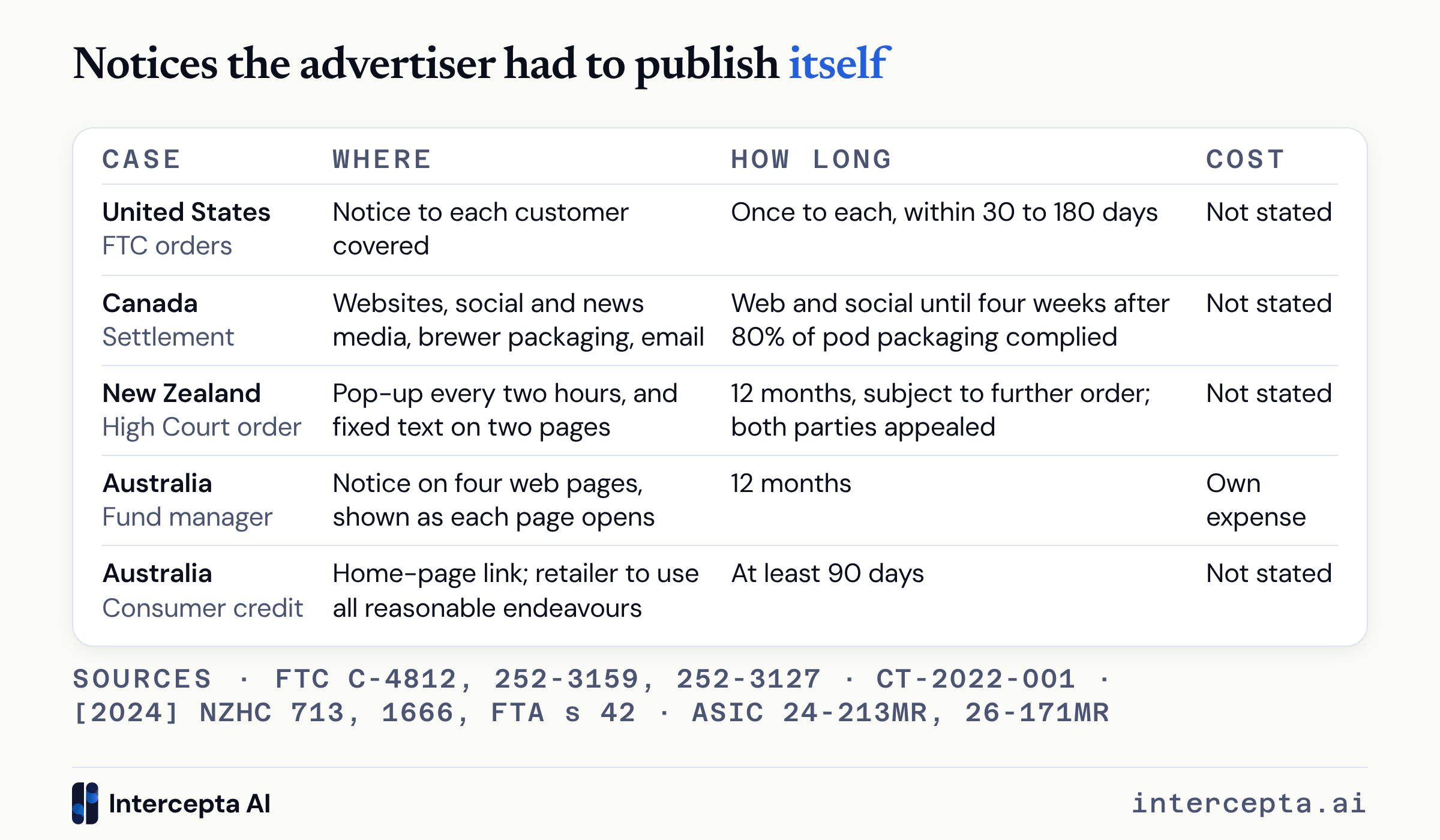
The Federal Trade Commission (FTC) named each company concerned when it announced a sweep of “Made in the USA” claims in April 2026. The sweep included three actions in which the FTC alleged that sellers of electronic dartboards, flags and footwear had falsely claimed that their products were made in the United States. In each action, the defendants agreed to settle on the terms of a proposed court order. Federal judges approved and entered two of those orders in April 2026, and each requires the defendants to send a notice of the settlement with the FTC, in the form attached to the order, to customers who bought the products concerned, as each order defines them (FTC, Matter Nos. 252-3159 and 252-3127). Two of the three actions followed FTC warning letters issued in July 2025. The FTC also closed its investigations of two other companies by closing letter after each agreed to remediate certain of its “Made in USA” representations, and warned both that the Commission reserves the right to monitor and take further action, including potentially filing a federal lawsuit.
A final FTC order can also require the advertiser to tell its own customers about the case. In January 2025, the FTC issued a final consent order against a company that, according to the FTC’s complaint, had claimed its online subscription service operated like a human lawyer, without testing whether the service’s law-related features did so (FTC, Docket No. C-4812). The order required it to pay $193,000 and to send a notice, worded as set out in an attachment to the order, to every new subscriber between 1 January 2021 and 31 December 2023 for whom it had an email address. The subject line of the email refers to a settlement of an “FTC False Advertising Case”, and the notice states that the FTC “claims that some of our advertising was false and not supported by sufficient evidence”, and that the company neither admits nor denies those claims.
The Securities and Exchange Commission (SEC) names the firms charged in many of its enforcement releases. In April 2024, for instance, it announced settled charges against five named investment advisers that, according to its findings, advertised hypothetical performance to the general public on their websites without the policies and procedures that the Marketing Rule requires (SEC, Press Release 2024-46). All five settled without admitting or denying the findings, and the SEC reduced the penalties of four of them to reflect corrective steps they had taken before its staff contacted them.
The Consumer Financial Protection Bureau (CFPB) also names the firms in its enforcement actions. In January 2025, it issued a consent order against a payments firm over what it described as “deceptive marketing disclosures relating to ATM fees leading to ATM fee overcharges” (CFPB, Docket No. 2025-CFPB-0004). In May 2025, an amended order reduced the civil penalty from $2.025 million to $44,955 and kept about $450,000 in consumer redress. The CFPB said the new penalty was consistent with the Consumer Financial Protection Act and with earlier cases involving similar conduct and cooperation. It also cited Executive Order 14219 of February 2025, which sets a policy of focusing federal enforcement resources and directs agencies to review their regulations, and the Bureau’s rescission of guidance that included a circular on deceptive marketing about the speed or cost of remittance transfers. The firm’s name appeared in the title of the release announcing the change.
The Food and Drug Administration (FDA) posts on its website the warning letters and untitled letters it sends to pharmaceutical companies about the promotion of prescription drugs. The date on which a letter citing a company is posted is the event used in one of the three studies described below.
Courts in Canada, New Zealand and Australia can order the advertiser to publish a notice about its own case
In January 2022, the Competition Bureau announced that a coffee pod manufacturer had agreed, in a settlement, to publish corrective notices about the recyclability of its pods on its websites, on social media, in national and local news media, in the packaging of all new brewing machines and by email to its subscribers. The website and social media notices were to remain in place until four weeks after the claims on the packaging of pods representing 80% of the volume it sold, measured on an annualised basis, complied with paragraph 74.01(1)(a) of Canada’s Competition Act. The settlement also included a C$3 million penalty, a donation of C$800,000 to a Canadian charitable organisation focused on environmental causes and C$85,000 for the costs of the Bureau’s investigation. The Bureau had concluded that the manufacturer’s recyclability claims for its single-use pods were false or misleading in areas where the pods were not accepted for recycling, as were its claims about the steps involved to prepare them for recycling in certain municipalities. The manufacturer undertook to enhance its corporate compliance programme as necessary to prevent deceptive marketing issues in the future. The agreement records that the manufacturer does not contest the conclusions of the Commissioner of Competition, who heads the Bureau, that it does not agree with those conclusions, and that nothing in the agreement constitutes an admission. Registered with the Competition Tribunal under section 74.12 of the Act, it has “the same force and effect ... as if it were an order of the court” and is binding for five years from its registration (Competition Bureau, news release of 6 January 2022; Competition Tribunal, file CT-2022-001).
A court can also order a corrective notice. Under section 74.1(1)(b) of the Competition Act, a court that determines a person has engaged in reviewable conduct, which includes making a representation to the public that is false or misleading in a material respect (paragraph 74.01(1)(a)), may order the person to publish a notice to the class of persons “likely to have been reached or affected by the conduct”. The notice must state “the name under which the person carries on business and the determination made under this section”, together with a description of the conduct, the period and area it covered and the media through which the representation was disseminated.
In proceedings brought by the Commerce Commission, the High Court of New Zealand declared in March 2024 that an online ticket resale platform had breached the Fair Trading Act 1986, including its general prohibition on misleading conduct. In June 2024, the court ordered it to publish a corrective statement saying that it is a resale platform, that tickets on it are sold by others, that it is not an authorised seller for events in New Zealand and that it cannot guarantee that tickets bought on the website will let the buyer enter the event. The statement had to appear in a pop-up box on the first page a consumer sees, shown again every two hours, and in a fixed position on the event page and the payment details page. On the desktop site, its font had to be at least 2.5 times larger than the largest font in the cookies box. The orders for publication of the statement were made for 12 months, subject to further order of the court ([2024] NZHC 713 and [2024] NZHC 1666). Both parties appealed the March 2024 judgment.
Section 42 of the Act sets out the power to make such orders. On the application of the Commerce Commission, the court may order a person who has contravened specified provisions, including the prohibitions on misleading conduct, to publish corrective statements at that person’s own expense, in terms that the order specifies.
Australian courts can make an adverse publicity order in financial services cases under section 12GLB of the Australian Securities and Investments Commission Act 2001. In September 2024, the Federal Court ordered a fund manager to pay a penalty of A$12.9 million in a greenwashing case brought by the Australian Securities and Investments Commission (ASIC). The penalty was for misleading statements about the environmental, social and governance exclusionary screens applied to one of its funds (ASIC, Media Release 24-213MR). The fund manager had made the statements in 12 product disclosure statements, in a media release, on its website, in an interview published on YouTube and in a presentation at a fund manager event that was published online. The court also made an adverse publicity order. For 12 months from the date of the orders, the fund manager had to publish, at its own expense, a notice of its misconduct under its own name on four pages of its website, displayed as soon as each page was opened (Federal Court orders published with ASIC, Media Release 24-213MR).
A consumer credit campaign has also resulted in a court-ordered notice. In July 2026, in a case brought by ASIC, the Federal Court ordered a national retailer and a consumer finance provider to pay penalties of A$35 million and A$20 million over a national campaign advertising a 60-month interest-free and no-deposit payment method, which ran in newspapers, on radio and on television between January 2020 and August 2021 (ASIC, Media Release 26-171MR). The court had found in October 2024 that the advertisements failed to disclose that a consumer had to have or enter into a continuing credit contract linked to a credit card, and would have to pay, in addition to the purchase price, ongoing monthly account service fees and, in the period up to 15 March 2021, an establishment fee. The Full Federal Court dismissed both companies’ appeals in September 2025. Together with the penalties, the court ordered the finance provider to publish a notice of the case for at least 90 days, through a link in an immediately visible area of its website home page, and ordered the retailer to use all reasonable endeavours to do the same on its own home page. According to ASIC’s release, the court found that “the compliance processes of both defendants were wholly inadequate to prevent the contravening conduct”.
The Australian Consumer Law contains a comparable power. On an application by the regulator, which at federal level is the Australian Competition and Consumer Commission, a court can impose an adverse publicity order on a company or individual that has contravened certain consumer protection provisions, including the prohibition in section 29 on false or misleading representations about goods or services (section 247). Such an order requires them to disclose information as directed and to publish an advertisement, at their own cost, “in the terms specified in, or determined in accordance with, the order”.
Research on share prices after a published finding, and on customer trust
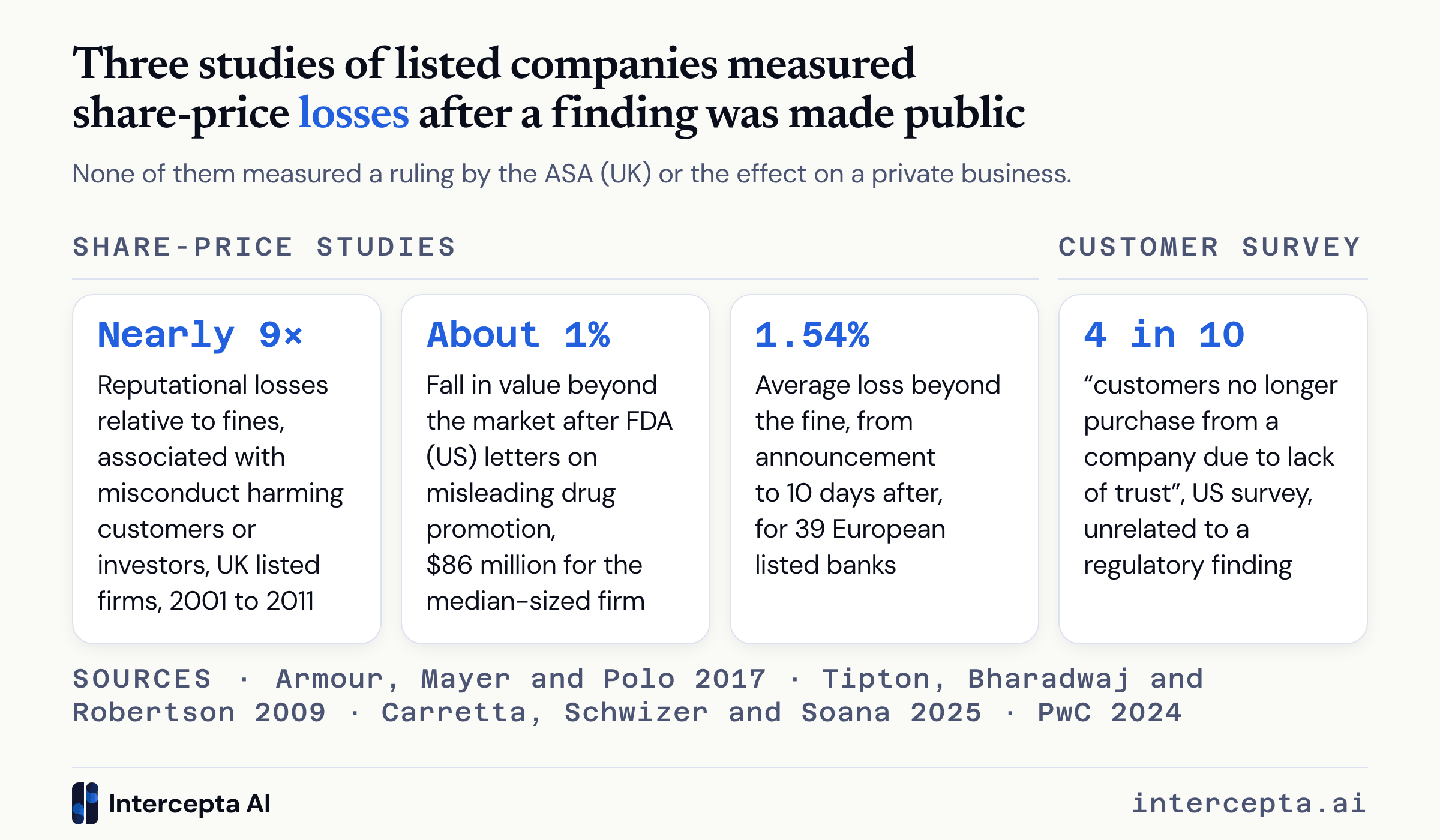
The only study in this section that examines marketing directly was published in the Journal of Marketing in 2009. Martha Myslinski Tipton, Sundar Bharadwaj and Diana Robertson examined 170 letters in which the FDA (US) cited publicly traded pharmaceutical companies for misleading promotion of prescription drugs. They measured the change in each company’s share price around the date the letter was made public by being posted on the FDA’s website, an event the authors call the regulatory exposure of deceptive marketing. Exposure was associated with significant negative abnormal returns of about 1%, a fall in value beyond the movement expected from the market, which the authors calculated as a wealth loss of $86 million for the median-sized firm in their sample. For citations that concerned omitted risk information or unsubstantiated efficacy claims, and for deception in direct-to-consumer advertising, the negative effects were larger for brands with a market share above the median for the sample than for brands below it. The effect was also greater where the deception was more egregious or aimed at vulnerable groups.
In a study published in 2017, John Armour, Colin Mayer and Andrea Polo examined announcements of enforcement action by the UK Financial Services Authority, the predecessor of the FCA (UK) and the Prudential Regulation Authority, and the London Stock Exchange between 2001 and 2011. During that period, the regulators made a case public only once the enforcement process was complete. The authors excluded from their main sample the cases in which information about the case was in the public domain before the regulator’s announcement. They found reputational losses “nearly nine times the size of fines”, measured in the share prices of the listed firms concerned, and they associated those losses with misconduct that harmed customers or investors, finding no comparable loss for misconduct that harmed third parties. The authors placed misleading advertisements, together with the mis-selling of financial products, in the category of misconduct that harms customers, although misleading advertisements accounted for two of the 40 cases in their final sample and the authors did not report a separate result for them.
Alessandro Carretta, Paola Schwizer and Maria Gaia Soana, writing in The Financial Review in 2025, examined 400 fines imposed, between 2009 and 2022, by US and EU regulators on 39 European listed banks, excluding fines imposed by UK and Swiss regulators. After allowing for the fines themselves, they found average abnormal losses of 1.54% in the banks’ shares from the day of an announcement to 10 days after it. The losses were larger for fines imposed by EU regulators (2.86%) than for those imposed by US regulators (1.14%), and the difference was statistically significant. Fines above the median were followed by losses of 1.59%, against 1.49% for fines below it, although the authors found that this difference was not statistically significant.
None of the three studies measured the effect on private businesses or of a ruling by the ASA (UK). The mechanism Armour, Mayer and Polo describe, a change in how the parties who trade with a firm regard it once a breach is public, may also apply to a business whose customers and investors can read the regulator’s decision.
Two surveys that included consumers indicate how much weight people give to trust in a company or brand, although the figures cited here do not concern a regulatory finding. In its Trust in US Business Survey 2024, which covered consumers, executives and employees in the United States, PwC reported that “four in 10 customers no longer purchase from a company due to lack of trust”, and that “90% of business executives think customers highly trust their companies while only 30% of consumers actually do”. In the 2025 Edelman Trust Barometer special report on brands, 88% of respondents, on average across its 15 markets, said that trusting a brand is “important or a deal breaker” in the brands they buy or use, and 85% said the same of a good reputation.
The review before release is a stage the business controls
A marketing team could have written any of the claims in the cases described above. A court found that advertisements for an interest-free payment offer did not disclose the credit contract and fees it involved, and another penalised misleading statements about the screens applied to an investment fund. The Canadian settlement concerned the recyclability of coffee pods, and the FTC (US) alleged, in matters that were settled, false country-of-origin representations for consumer products and untested comparisons between an online legal subscription service and a human lawyer. Each announcement named the business concerned.
Marketing teams generally set brand standards and apply them before content is published. In many organisations, the regulatory exposure in the same content is assessed in a separate review by the compliance team, and the two reviews can take place at different stages of production. The regulators and courts described here usually act on content after publication, and many of their decisions are made public, so a business can lower the risk of a finding against its brand being published by reviewing its material before release.
A marketing team that examines its content for regulatory exposure before submitting it gives the compliance team a draft in which the claims it found to be subject to a rule in each market are already marked. The compliance team still assesses the whole draft and makes the approval decision. An issue raised late in production has to be remediated at that point, so the order in which the two reviews take place can affect the campaign timetable as well as the regulatory exposure.
A business that reviews its content before release can also keep a dated record of that review. In Canada, section 74.1(3) of the Competition Act provides that no order may be made under paragraphs (1)(b), (c) or (d), which include the corrective notice and the administrative monetary penalty, if the person “establishes that the person exercised due diligence to prevent the reviewable conduct from occurring”. The person bears the burden of establishing due diligence, and subsection 74.1(3) does not apply to an order under paragraph (1)(a) prohibiting the conduct. A documented review carried out before publication may form part of the evidence of that diligence.
In the other four jurisdictions, the steps a business takes before publication can also be relevant to how a case is decided or how a penalty is set. The UK Competition and Markets Authority lists infringements “where the party has taken specific active steps tailored to preventing the infringement or infringements of a similar nature” among the factors indicating low culpability when it sets a penalty under its direct consumer enforcement powers. Its guidance states that the Authority will not view generic compliance training as sufficient where that training is not specific to the practice in question, and that a party whose conduct also shows a factor associated with greater culpability is assessed at the more serious level (CMA200, paragraph 7.34, Table 3 and footnotes 175 and 176). In its 1984 policy statement on advertising substantiation, the US Federal Trade Commission reaffirmed the legal requirement “that advertisers and ad agencies have a reasonable basis for advertising claims before they are disseminated”.
In proceedings for an unsubstantiated representation under section 12A of New Zealand’s Fair Trading Act 1986, a court assessing whether the person who made it had reasonable grounds must have regard to all of the circumstances, including “any research or other steps taken by or on behalf of the person before the person made the representation” (section 12B). Australian courts setting a civil penalty have applied factors from a 1990 Federal Court judgment under the Trade Practices Act, including whether the company has “a corporate culture conducive to compliance with the Act”, as evidenced by educational programmes and by disciplinary or other corrective measures in response to an acknowledged contravention ([2022] FCA 1228, paragraph 15). A dated record shows which steps were taken and when, and it is more useful as evidence when it sets out how each issue identified in the review was resolved. The point at which the evidence for an objective claim must be held, or can be required, by six regulators in these five jurisdictions is set out in Advertising substantiation: what six regulators ask for, and when, published on this blog in October 2026.
Validate before you publish. Keep the record.
In all five jurisdictions discussed here, an outcome on content produced in-house or by agencies and creators can be made public, either by a regulator under the advertiser’s name or by the advertiser itself under an order or a settlement. Intercepta AI was built to identify the regulatory exposure in your content, including video and audio, before it is published in any of these markets. Your marketing team can then remediate the findings while the creative is still in production, which can reduce the risk of a late change to the media plan or the launch date. Your compliance team then receives the draft with each finding flagged for its review.
The scanner covers 1,100+ regulatory rules across the United States, United Kingdom, European Union, Canada, Australia and New Zealand, and each scan returns a documented report that maps each issue it identifies to the specific regulation that applies, with remediation guidance for your compliance team to review. Marketing teams validate before publication, and compliance teams hold a dated record of each scan and its findings. The decision to approve the content, together with every decision on every finding, remains in the remit of your compliance team.
No payment method required. Paid plans also cover audio and video, and the free scans cover text and websites.
Cross-references
- For the evidence that six regulators can require for a marketing claim, see Advertising substantiation: what six regulators ask for, and when.
- For a claim approved for one market and published in others, see One compliant claim, exposed in other jurisdictions.
- For the July 2026 ASA (UK) rulings on airline carbon-offsetting claims, see The Edge of the Advertising Rules Is Not Where Companies Think.
Sources
United Kingdom
- Advertising Standards Authority, Rulings.
- Advertising Standards Authority and Committee of Advertising Practice, Sanctions.
- Committee of Advertising Practice, CAP Code (Edition 12), rule 1.8 in section 1 (Compliance).
- Advertising Standards Authority, Annual Report 2025, 14 April 2026.
- Financial Services and Markets Act 2000, sections 137S(1), (2), (4), (8) and (11) and 391(4), (4A) and (6).
- Financial Conduct Authority, “FCA steps up action against misleading financial adverts”, press release, 7 February 2025, with Financial promotions data 2024.
- Financial Conduct Authority, Final Notice of 27 July 2026 and press release of 30 July 2026, public censure under section 205 of the Financial Services and Markets Act 2000. Subject firm anonymised in this piece under house policy; party-naming URLs withheld under the sources-link policy.
- Competition and Markets Authority, Direct consumer enforcement guidance (CMA200), paragraph 7.34, Table 3 and footnotes 175 and 176, 14 March 2025.
- Digital Markets, Competition and Consumers Act 2024, section 156(1), (2) and (8), in force 6 April 2025 (SI 2025/272).
United States
- Federal Trade Commission, press release of 14 April 2026 announcing a “Made in the USA” sweep, and the orders entered in Matter Nos. 252-3159 (S.D.N.Y., 15 April 2026) and 252-3127 (S.D. Fla., 30 April 2026). Subject firms anonymised in this piece under house policy; party-naming URLs withheld under the sources-link policy.
- Federal Trade Commission, Complaint (paragraph 20) and Decision and Order (Sections III and VI and Attachment A), Docket No. C-4812 (File No. 232-3042), both issued 14 January 2025. Subject firm anonymised in this piece under house policy; party-naming URLs withheld under the sources-link policy.
- Securities and Exchange Commission, Press Release 2024-46, 12 April 2024, settled charges under Rule 206(4)-1 under the Investment Advisers Act of 1940. Subject firms anonymised in this piece under house policy; party-naming URL withheld under the sources-link policy.
- Consumer Financial Protection Bureau, Docket No. 2025-CFPB-0004, consent order of 30 January 2025 and amended consent order and release of 15 May 2025. Subject firm anonymised in this piece under house policy; party-naming URLs withheld under the sources-link policy.
- Executive Order 14219, Ensuring Lawful Governance and Implementing the President’s “Department of Government Efficiency” Deregulatory Initiative, 19 February 2025, Federal Register document 2025-03138.
- Food and Drug Administration, Warning Letters and Notice of Violation Letters to Pharmaceutical Companies.
- Federal Trade Commission, Policy Statement Regarding Advertising Substantiation, 23 November 1984.
Canada
- Competition Act, R.S.C. 1985, c. C-34, paragraph 74.01(1)(a), section 74.1, paragraphs 74.1(1)(b), (c) and (d), subsection 74.1(3) and section 74.12.
- Competition Bureau, news release of 6 January 2022, and consent agreement registered with the Competition Tribunal under section 74.12 of the Competition Act on 6 January 2022, file CT-2022-001, paragraphs 10, 11 and 17 and Appendix C (paragraph 74.01(1)(a)). Subject firm anonymised in this piece under house policy; party-naming URLs withheld under the sources-link policy.
New Zealand
- Fair Trading Act 1986, sections 12A, 12B and 42.
- High Court of New Zealand, [2024] NZHC 713 (28 March 2024), paragraphs 228 to 231, and [2024] NZHC 1666 (21 June 2024), paragraphs 2 and 7 to 31. Subject firm anonymised in this piece under house policy; party-naming URLs withheld under the sources-link policy.
Australia
- Australian Securities and Investments Commission Act 2001, section 12GLB.
- Competition and Consumer Act 2010, Schedule 2 (Australian Consumer Law), sections 2, 29 and 247.
- Acts Interpretation Act 1901, section 2C(1).
- Australian Securities and Investments Commission, Media Release 24-213MR, 25 September 2024, with the Federal Court orders of that date. Subject firm anonymised in this piece under house policy; party-naming URLs withheld under the sources-link policy.
- Australian Securities and Investments Commission, Media Release 26-171MR, 28 July 2026, with the Federal Court judgment and orders of that date, recording the liability finding of 18 October 2024, the declarations of 5 November 2024 and the dismissal of the appeals by the Full Federal Court on 3 September 2025. Subject firms anonymised in this piece under house policy; party-naming URLs withheld under the sources-link policy.
- Federal Court of Australia, [2022] FCA 1228, paragraph 15, applying the factors in [1990] FCA 521. Parties anonymised in this piece under house policy; party-naming URLs withheld under the sources-link policy.
Research and surveys
- Tipton, M. M., Bharadwaj, S. G. and Robertson, D. C. (2009), Regulatory exposure of deceptive marketing and its impact on firm value, Journal of Marketing 73(6), 227 to 243.
- Armour, J., Mayer, C. and Polo, A. (2017), Regulatory sanctions and reputational damage in financial markets, Journal of Financial and Quantitative Analysis 52(4), 1429 to 1448.
- Carretta, A., Schwizer, P. and Soana, M. G. (2025), Reputational damage of bank misconduct: the role of regulation and ESG performance, The Financial Review 60(4), 1359 to 1387, open access.
- PwC, Trust in US Business Survey 2024, 12 March 2024.
- Edelman, 2025 Edelman Trust Barometer Special Report: Brand Trust, From We to Me.